

On this page
In number theory, a perfect number is a positive integer equal to the sum of its proper divisors—all positive integers that divide it evenly except itself. In terms of the divisor function σ(n), which sums every divisor of n, a number is perfect if and only if σ(n) = 2n, as documented on Wolfram MathWorld.
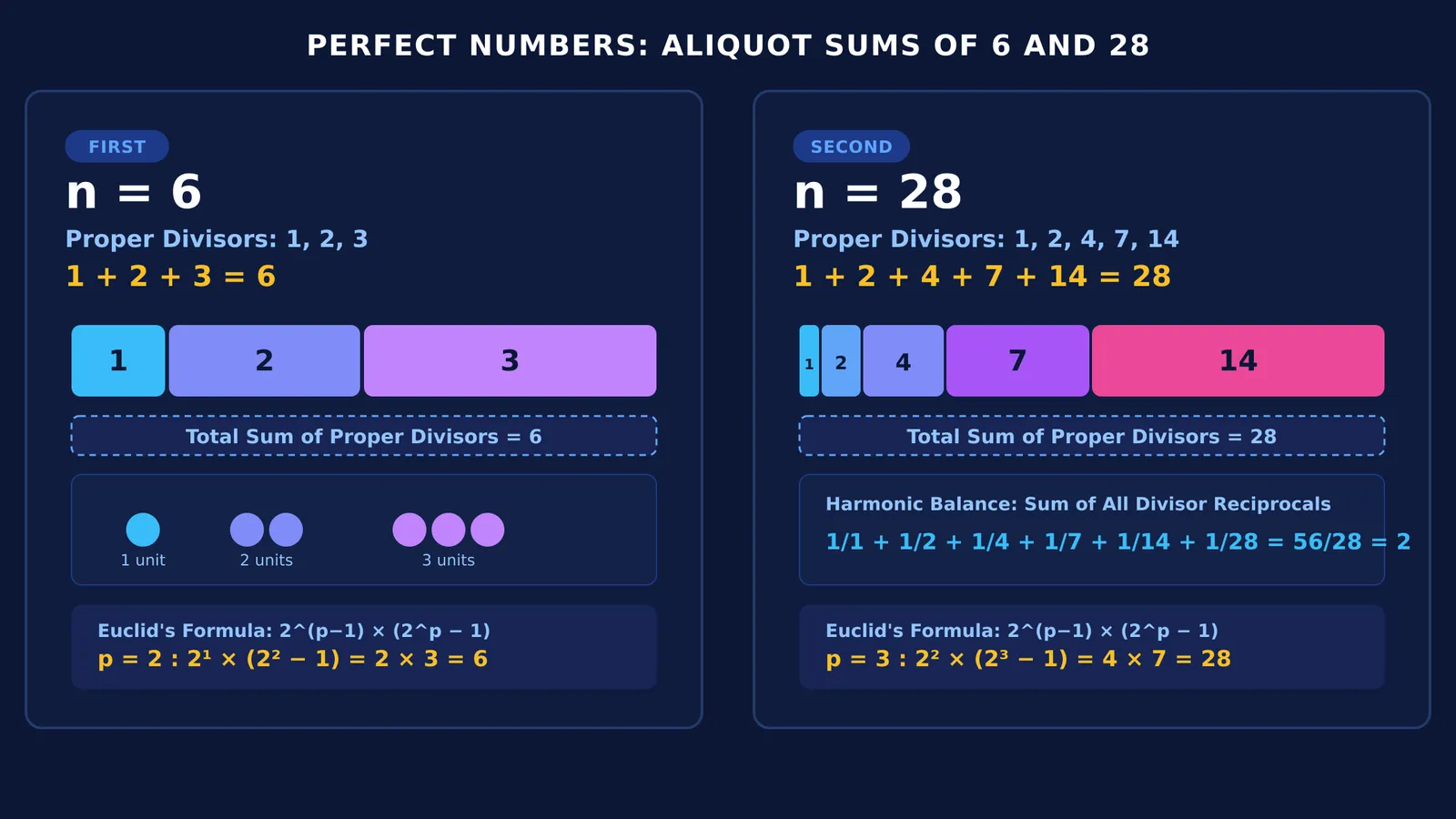
While working through primes and divisibility tests, most numbers fall above or below this balance. Perfect numbers are extraordinarily rare; the first four—6, 28, 496, and 8,128—were known in ancient Greece over two millennia ago. Furthermore, the sum of reciprocals of all divisors of a perfect number always equals 2, because each divisor d pairs with n/d, giving (2n)/n = 2.
How do you verify 6, 28, and 496?
To check whether a number is perfect, sum its proper divisors:
Checking 6: The proper divisors of 6 are 1, 2, and 3. Their sum is 1 + 2 + 3 = 6, making 6 the smallest perfect number.
Checking 28: Prime factorisation yields 28 = 2² × 7. Excluding 28 leaves proper divisors 1, 2, 4, 7, and 14. Their sum is 1 + 2 + 4 + 7 + 14 = 28.
Checking 496: Factoring 496 yields 2⁴ × 31. Its proper divisors are powers of 2 (1, 2, 4, 8, 16) and their products with 31 (31, 62, 124, 248). Powers of 2 sum to 31, while multiples of 31 sum to 465. Together, 31 + 465 = 496.
On exams, missing a single factor easily spoils a solution. Systematic factor extraction is essential when finding the number and sum of divisors using prime factorisation. The Fermi Problem Library has worked problems with a step-by-step solver that explains the reasoning rather than printing an answer.
How does Euclid's formula generate even perfect numbers?
In Book IX, Proposition 36 of his *Elements* (c. 300 BCE), Euclid proved that if the sum of consecutive powers of two from unity, 1 + 2 + 4 + ... + 2^(p-1) = 2^p − 1, is prime, multiplying that sum by the last power of two produces a perfect number, as recorded in Clark University's translation of Euclid's Elements:
n = 2^(p-1) × (2^p − 1)
Primes of the form 2^p − 1 are Mersenne primes. Small prime exponents illustrate the theorem:
For p = 2: 2¹ × (2² − 1) = 2 × 3 = 6.
For p = 3: 2² × (2³ − 1) = 4 × 7 = 28.
For p = 5: 2⁴ × (2⁵ − 1) = 16 × 31 = 496.
For p = 7: 2⁶ × (2⁷ − 1) = 64 × 127 = 8,128.
Not every prime exponent produces a prime: for p = 11, 2¹¹ − 1 = 2047 = 23 × 89, which is composite. In the 18th century, Leonhard Euler proved the converse: every even perfect number must have this form, as detailed in the MacTutor History of Mathematics archive. Whether odd perfect numbers exist remains an unsolved problem; modern computational lower bounds show any odd perfect number must exceed 10¹⁵⁰⁰, as reported on Wolfram MathWorld. These structural properties often appear in advanced competitions, such as number theory divisibility questions.
What makes a number abundant or deficient?
Around 100 CE, Nicomachus of Gerasa classified all positive integers into three families in his *Introductio Arithmetica*:
Deficient numbers: The proper divisor sum is less than the number (σ(n) < 2n). Deficient numbers make up approximately 75.2% of all integers according to OEIS sequence A005100. All primes and prime powers are deficient. For instance, 8 has proper divisors 1, 2, and 4, summing to 7.
Abundant numbers: The proper divisor sum exceeds the number (σ(n) > 2n). Abundant numbers comprise approximately 24.8% of integers, as noted on Wolfram MathWorld. The smallest abundant number is 12 (divisors 1, 2, 3, 4, 6 sum to 16), and the smallest odd abundant number is 945 (divisors sum to 975).
Perfect numbers: The proper divisor sum equals n exactly. As recorded in OEIS sequence A000396, perfect numbers have an asymptotic density of 0%, forming the precise boundary between deficiency and abundance.
To classify any integer n, calculate its divisor sum σ(n) from its prime factors, subtract n to obtain the proper divisor sum s(n), and compare s(n) with n.
When connecting divisor formulas with modular arithmetic and algebra, the Fermi Concept Library covers every concept in physics, chemistry, biology, mathematics and computing, each with its own lesson and its place in the map.


