

On this page
When exam results or bank interest rates are announced, you will often hear two terms thrown around interchangeably: percentage points and percent change. Mixing them up is one of the most common errors in mathematics and daily news reporting (Eurostat Glossary).
If a student scores 40% on their first mock test and 50% on their second, did their score improve by 10% or by 25%? The answer depends entirely on which of these two terms you use. Understanding this distinction is vital for accurate data interpretation in subjects ranging from economics to the sciences.
What is a percentage point?
A percentage point is the absolute arithmetic difference between two percentages. According to the European Union's official statistical body, Eurostat, you find it simply by subtracting the old percentage from the new one (Eurostat Glossary).
If your mock test score goes from 40% to 50%, you subtract 40 from 50. Your score has improved by 10 percentage points (often abbreviated as "pp"). You use this term when you want to describe a flat, absolute addition to a rate or fraction that is already measured out of 100.
This absolute measure is the standard way to report changes in unemployment rates, election polling, and interest rates. If a bank raises its lending rate from 4% to 5%, that is an increase of 1 percentage point.
What is the difference between percentage points and percent change?
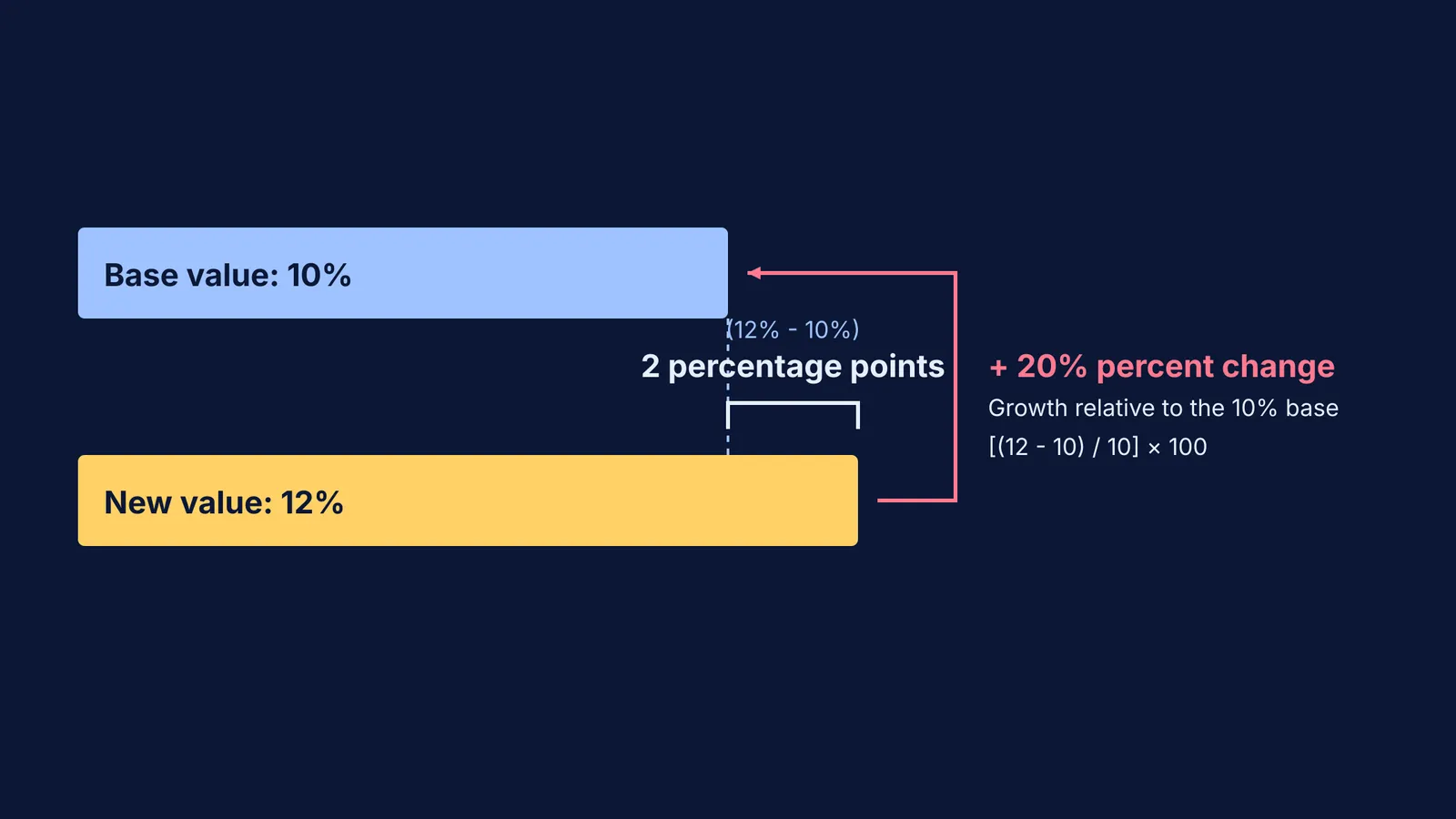
While a percentage point is an absolute difference, percentage change measures the relative rate of change. It tells you how much a value has grown compared to where it started, calculated by dividing the difference by the starting number (Eurostat Glossary).
Going back to our student: the absolute increase is 10 percentage points. But relative to their starting score of 40%, a jump of 10 is actually a quarter of their original marks. Using the formula (New − Old) / Old × 100, we calculate (50 − 40) / 40 × 100 = 25%. The student's score saw a 25 percent change.
A rate moving from 10% to 12% is a 2 percentage point increase, but it is a 20% relative rise. If you are learning the nuances of these formulas, the Fermi Concept Library covers every concept in physics, chemistry, biology, mathematics and computing, each with its own lesson and its place in the map.
Why does this difference matter in exams and results?
Confusing these two terms can drastically overstate or understate reality. When the CBSE Class 12 passing percentage went from 87.33% in 2023 to 87.98% in 2024, the board reported an absolute increase of 0.65 percentage points (Financial Express).
If a news anchor incorrectly said "the pass rate increased by 0.65%", it would technically mean the relative change was 0.65%, which implies the new rate was 87.89% (an absolute addition of only 0.56 points). By using the wrong terminology, the actual magnitude of the change is misrepresented. In situations dealing with small baseline numbers, the confusion can be even more severe. A disease rate climbing from 1% to 2% is a mere 1 percentage point rise, but it represents a 100% relative increase.
This distinction is also a staple in statistical reasoning questions across competitive exams. Just as you must know how adding to or scaling data changes the mean and variance, or how to calculate the variance of two combined groups, understanding absolute versus relative change is a non-negotiable skill in data interpretation.
How do I know which one to use?
To make sure you are always mathematically accurate, use this decision framework before you write out your final answer:
Are both of your numbers already percentages? If yes, and you are simply subtracting them to find the absolute gap, you must say "percentage points".
Are you trying to show how fast something is growing? If you are dividing the difference by the starting amount to find proportional growth, use "percent change" or "percent increase".
Are you dealing with raw numbers? If your data is in absolute counts (like the number of students) rather than rates, any proportional increase is always a "percent change". You cannot use percentage points for raw headcounts.
If you are stuck on a word problem that mixes these concepts up, Fermi's AI tutor teaches — it holds a line of reasoning across a whole session, notices where a student is stuck, and decides whether to explain, ask, or show. By reading the question carefully and checking whether you are subtracting or dividing, you will consistently arrive at the correct statistical conclusion.


