

On this page
The simple pendulum is a classic system in introductory physics and a staple of JEE and NEET exams. However, it is also the source of a subtle mathematical trap. The root of the problem lies in the symbol ω (omega).
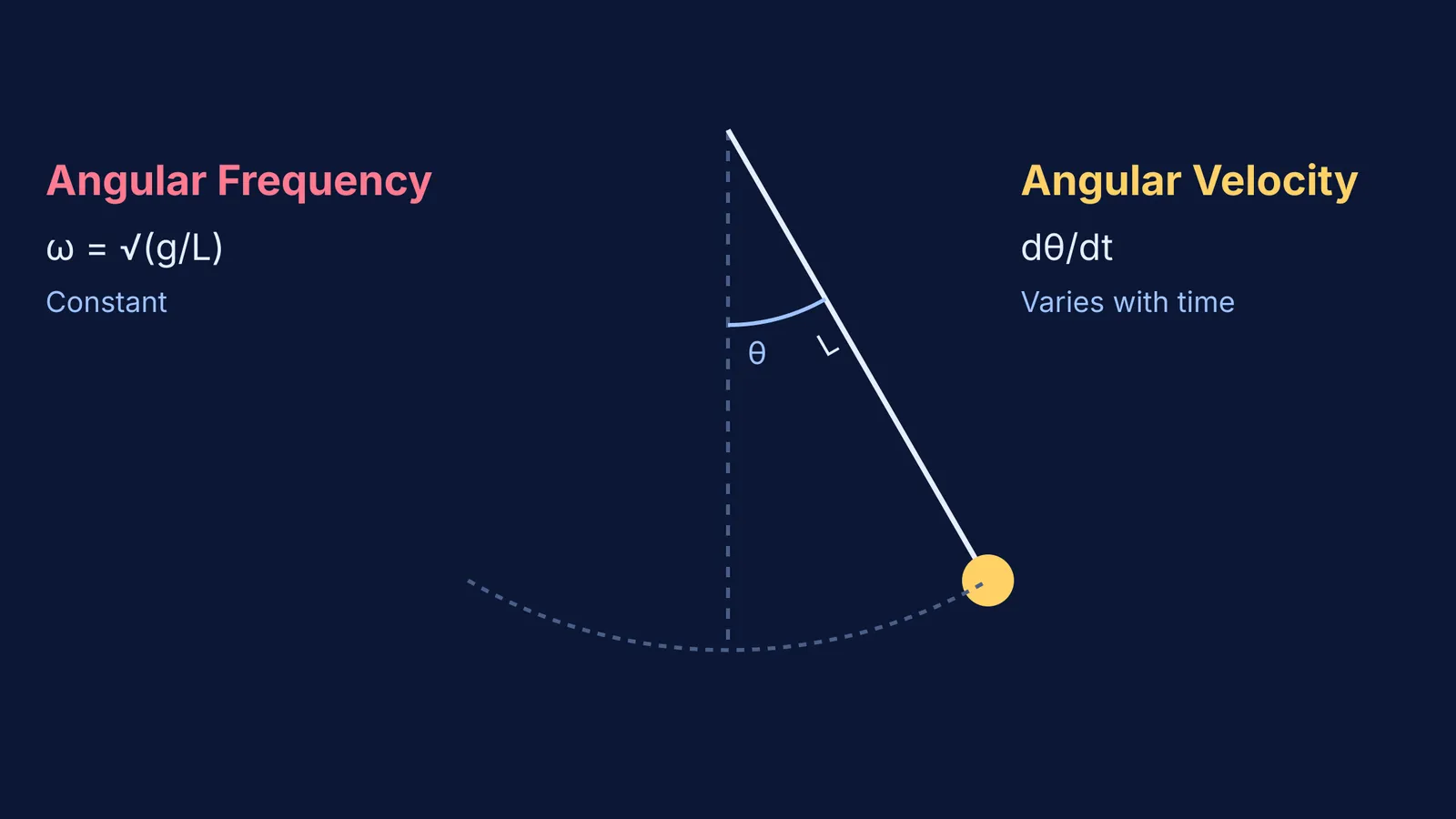
When you solve a simple harmonic motion problem, you will see ω used for two entirely different physical concepts: angular frequency and angular velocity. According to Wikipedia's mathematical derivation of the pendulum), the angular frequency for small swings is a constant ω = √(g/L), while the angular velocity is the derivative of the angle. This dual meaning is a persistent hurdle for students first learning rotational mechanics.
Here is how to break down the definitions and never mix them up again.
What is the angular frequency of a pendulum?
Angular frequency is a constant that belongs to the pendulum as a whole. It describes how fast the system cycles through its phases. For a simple pendulum undergoing small oscillations, it is defined entirely by the acceleration due to gravity (g) and the length of the string (L):
ω = √(g/L)
This value does not change as the pendulum swings. Whether the bob is at its highest point or rushing through the middle, the angular frequency remains exactly the same. It is directly linked to the time period (T) of the pendulum by the formula T = 2π/ω.
What is the angular velocity of the bob?
Angular velocity is the actual, physical speed at which the pendulum string turns through space. It is the time derivative of the angle θ.
Angular velocity = dθ/dt
Unlike angular frequency, the angular velocity changes continuously. When the pendulum reaches its highest point (the amplitude), it stops for a split second, making the angular velocity zero. When the bob swings through the lowest point (the equilibrium position), it moves the fastest, so the angular velocity hits its maximum.
If we look closely at the energy of the pendulum, the distinction becomes even clearer. At the highest point of the swing, all the energy is stored as potential energy, and the angular velocity is perfectly zero. As the bob falls, gravity converts this potential energy into kinetic energy, accelerating the bob until it reaches its maximum angular velocity at the bottom dead centre. Through this entire transfer of energy, the angular frequency never changes. It remains a rigid, constant property of the system, determined before you even release the bob.
Why does the same symbol confuse students?
The confusion happens because both quantities are measured in radians per second (rad/s) and both are conventionally written as ω. When you write the equation for the angle over time, you get:
θ(t) = θ₀ cos(ωt)
In this equation, the ω inside the cosine is the constant angular frequency. But if you want to find the angular velocity, you have to differentiate the equation with respect to time:
dθ/dt = −θ₀ ω sin(ωt)
Here, the instantaneous angular velocity (dθ/dt) is a function of time, and its maximum possible value is θ₀ multiplied by the angular frequency.
In high-stakes exams like the JEE or NEET, questions are deliberately designed to test this exact blind spot. An examiner might give you the maximum angular velocity of the bob and ask you to find the amplitude, testing whether you know the relationship between the two distinct omegas. If you write down ω = dθ/dt and try to plug it into the time period formula, you will end up with an equation that cannot be solved.
When studying rotational mechanics and oscillations, missing the distinction between a constant and a variable will lead you to the wrong answer. If you are struggling to picture how these variables change during a swing, the Fermi Concept Library maps out these distinct ideas with step-by-step physics lessons, ensuring you never mix up a fixed frequency with a changing velocity.
A checklist to tell them apart
When you see ω in a problem, ask yourself these three questions to find out which one the examiner means:
Is it changing with time? If the value is zero at the extremes and maximum at the bottom, it is the angular velocity (dθ/dt).
Is it a fixed property of the setup? If it depends only on gravity and the length of the string, it is the angular frequency (√(g/L)).
Where does it sit in the equation? If it is multiplied by time inside a sine or cosine function, it is the angular frequency.
Once you have the basics down, it helps to explore related pendulum cases. You can practice finding the simple pendulum string tension at any angle, see how a seconds pendulum adjusts its period, or calculate the effective gravity for a pendulum in an electric field.


