

On this page
Phosphorus pentachloride (PCl5) is a classic example in chemistry for predicting molecular shapes. While it behaves as a simple covalent molecule in the gas and liquid phases, it completely changes its structural identity when it freezes into a solid.
In the solid state, PCl5 does not exist as neutral molecules. Instead, it becomes a true ionic solid.
What is the structure of PCl5 in the solid state?
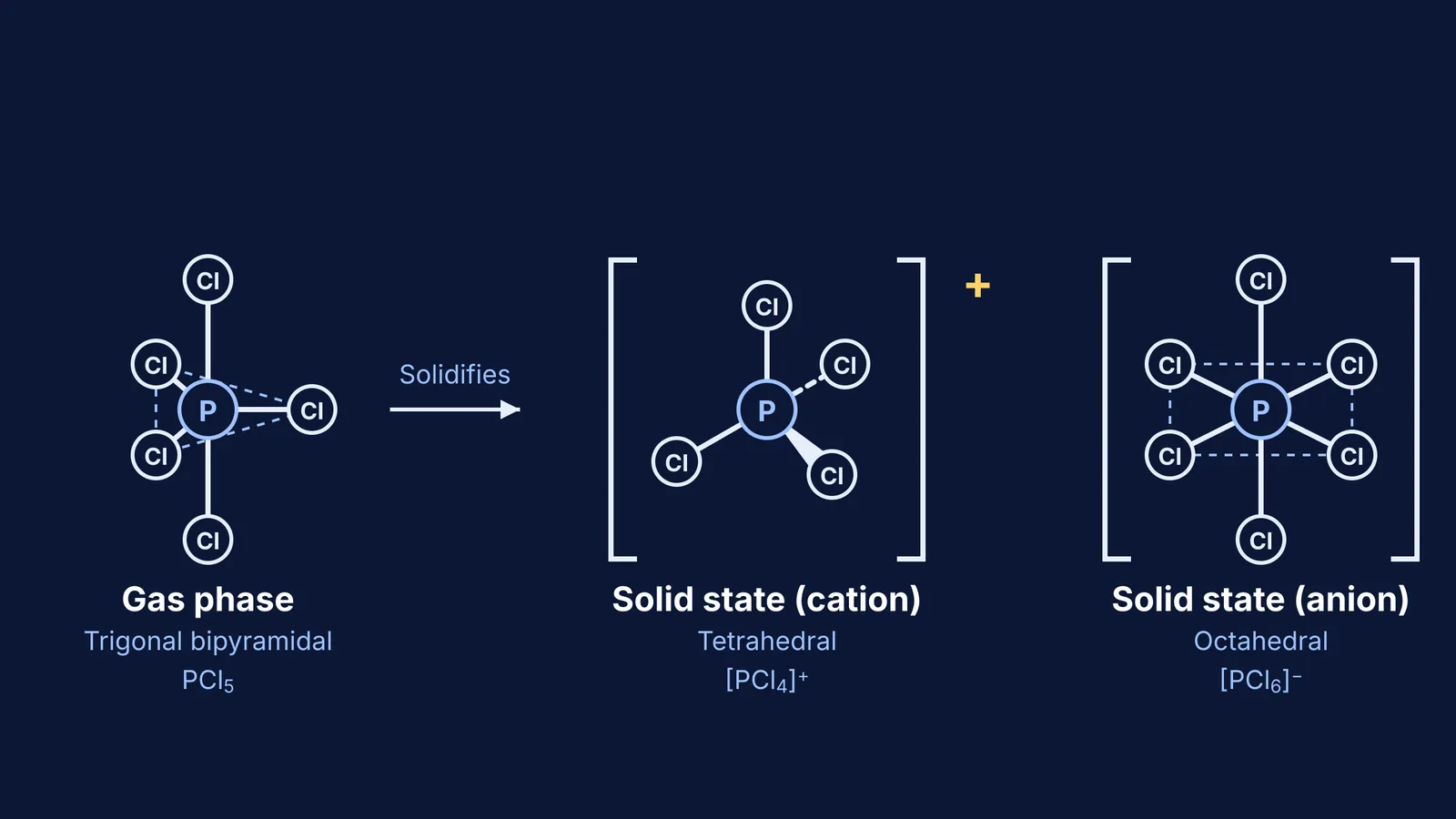
When PCl5 solidifies, the molecules undergo a reaction called auto-ionisation. Two PCl5 molecules react with each other: one gives up a chloride ion, and the other accepts it. This creates two distinct ionic species that pack together into a crystal lattice:
The cation: [PCl4]+ (tetrachlorophosphonium ion). The central phosphorus atom has four bond pairs and no lone pairs. Because all four bonds repel each other equally, they spread out to form a perfect tetrahedron with bond angles of 109.5°. This gives it sp3 hybridisation and a perfect tetrahedral geometry.
The anion: [PCl6]- (hexachlorophosphate ion). The central phosphorus atom has six bond pairs and no lone pairs. These six bonds position themselves as far apart as possible, creating 90° bond angles across the board. This results in sp3d2 hybridisation and an octahedral geometry.
If you are revising how to determine these shapes quickly, you can review the rules in our guide to VSEPR and molecular shapes: predict geometry in four steps.
Why does solid PCl5 exist as [PCl4]+ and [PCl6]-?
In the gas phase, PCl5 exists as isolated molecules with a trigonal bipyramidal geometry (sp3d hybridisation). In this shape, the three equatorial bonds (in a single plane at 120° angles) and two axial bonds (pointing up and down) experience different amounts of electron repulsion. The axial bonds suffer greater repulsion from the equatorial bonds, making the molecule somewhat strained and the axial bonds longer and weaker than the equatorial ones.
When the temperature drops and the substance forms a solid, it can achieve a much lower energy state by forming an ionic lattice. The electrostatic attraction between the positive [PCl4]+ and negative [PCl6]- ions releases a large amount of lattice energy, making the ionic solid far more stable than a collection of neutral covalent molecules held together by weak intermolecular forces. Furthermore, the tetrahedral and octahedral shapes of the ions are highly symmetrical and stable.
If you find it difficult to picture how these electron orbitals mix and arrange themselves, the Fermi Concept Library breaks down every concept in chemistry step by step. You can also brush up on the basics with our article on Hybridisation: sp, sp2, sp3 and beyond, found in seconds.
How do you answer exam questions on PCl5?
Questions about the solid state of PCl5 frequently appear in competitive exams such as JEE Main, JEE Advanced and NEET-UG. They usually test whether you know the hybridisation, the exact geometry, and the auto-ionisation reaction of the two ions.
For example, an exam might ask: "What are the hybridisation states of the central atom in the cationic and anionic parts of solid PCl5, respectively?" Because the cation is [PCl4]+ and the anion is [PCl6]-, the correct answer is sp3 and sp3d2.
Memorising the auto-ionisation reaction—2PCl5 → [PCl4]+ + [PCl6]-—will ensure you can derive the shapes and hybridisations on the spot without relying on memory alone when you face these questions under time pressure.


