

On this page
Students often confuse average speed with average velocity in circular motion problems. For a particle traveling along a circular path, the distance covered is the arc length, but the displacement is the straight-line distance between the start and end points.
If you are studying kinematics, finding the average velocity of a particle after a quarter revolution is a classic test of your grip on vectors. This type of problem highlights the fundamental difference between moving along a curve and taking a straight-line shortcut.
Why does average velocity differ from average speed?
Average speed is a scalar quantity, calculated as the total path length divided by the elapsed time. If a particle moves at a constant speed v, its average speed over any interval is exactly v. It does not matter if the particle is moving in a straight line, a circle, or a random wandering path; the speed remains the same.
Average velocity, however, is a vector quantity defined as the total displacement divided by the time interval (LibreTexts, *University Physics*/Book%3A_University_Physics_I_-_Mechanics_Sound_Oscillations_and_Waves_(OpenStax)/04%3A_Motion_in_Two_and_Three_Dimensions/4.02%3A_Displacement_and_Velocity_Vectors)). Because a curved path is longer than the straight chord connecting its endpoints, the magnitude of the average velocity will always be smaller than the average speed. You can think of displacement as a direct flight between two cities, while distance is the winding road a car must take. For topics like this, building a strong mental model is key. Every concept in physics, chemistry, biology, mathematics and computing, each with its own lesson and its place in the map, can be explored in the Fermi Concept Library.
What is the displacement for a quarter circle?
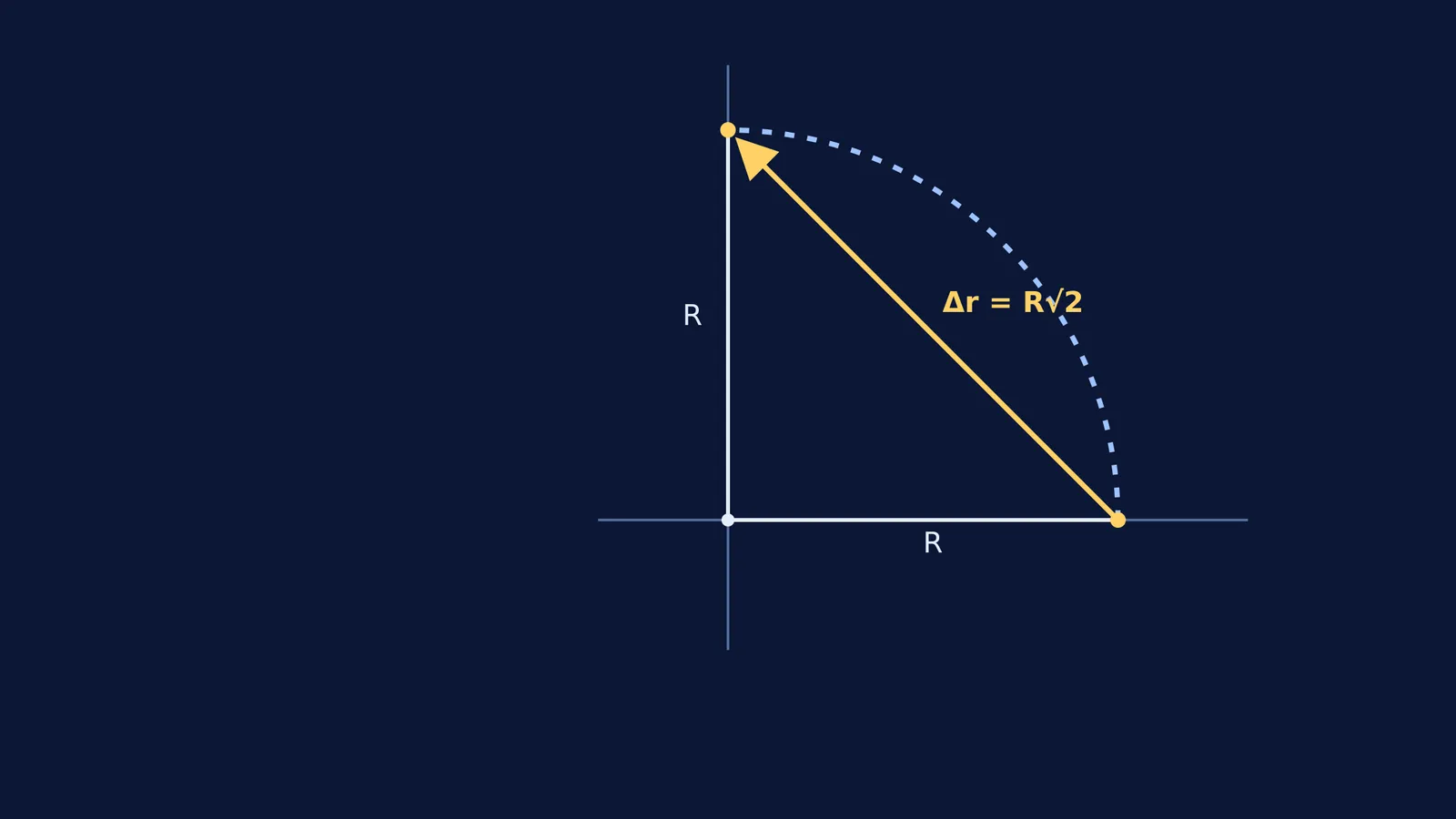
Consider a particle moving along a circular path of radius R. Let it start on the x-axis and move counterclockwise for one quarter of a revolution. We can define its position using coordinates.
Its initial position vector is distance R from the centre along the x-axis. We can write this as R on the x-axis and 0 on the y-axis.
Its final position after a quarter turn is also distance R from the centre, but at a 90° angle to the start. This places it at 0 on the x-axis and R on the y-axis.
The displacement vector is the difference between the final and initial positions. The magnitude of this displacement is the length of the straight line joining the two points. Using the Pythagorean theorem, the hypotenuse of the right-angled triangle formed by the two radii is √(R² + R²) = R√2.
If you find 2D motion tricky, seeing the vectors change in real time helps. The Fermi Simulation Lab offers interactive simulations for the ideas that are easier to see than to read. You can also brush up on how to extract vectors from position equations in our guide to motion in a plane from r(t).
How to calculate the average velocity for a quarter revolution?
To find the average velocity, we need the total time taken for this quarter revolution. We must divide the total arc length by the uniform speed at which the particle is travelling.
Path length: The total circumference of a full circle is 2πR. A quarter of this path is πR / 2.
Time taken: Moving at a constant speed v, the time taken is the distance divided by the speed, which is (πR / 2) / v = πR / 2v.
Average velocity magnitude: Divide the displacement magnitude by the time taken.
Average velocity = (R√2) / (πR / 2v)
When you simplify this fraction, the radius R cancels out entirely, showing that the result is independent of the circle's size. You are left with:
Average velocity = 2√2 v / π
This result proves that the average velocity is indeed smaller than the constant speed v. When you get stuck on the algebra or vector geometry in derivations, the Fermi Problem Library features worked problems with a step-by-step solver that explains the reasoning rather than printing an answer.
How does this compare to a half revolution?
It is useful to see how the result changes if the particle continues to move for a half revolution.
For a half revolution, the particle travels from one side of the circle to the exact opposite side. The displacement is a straight line across the centre, which is simply the diameter, 2R. The path length is half the circumference, which is πR. The time taken to cover this path at a constant speed v is πR / v.
Dividing the displacement (2R) by the time taken (πR / v) gives an average velocity magnitude of 2v / π. This provides another solid checkpoint for your understanding of kinematics and vector division.
Mastering this derivation ensures you won't be thrown off when asked about other angles, like a half circle or a 60-degree arc. For a broader look at particle kinematics, you can also review how to calculate distance in the nth second for straight-line motion.


