

On this page
When dealing with complex numbers in algebra and coordinate geometry, certain identities act as essential shortcuts. One of the most common expressions you will encounter is the sum of the squared moduli of a sum and difference.
Understanding where this equation comes from and what it means geometrically can save you pages of algebra, particularly in timed exams like JEE Main and Advanced.
What is mod z₁ plus z₂ squared plus mod z₁ minus z₂ squared?
For any two complex numbers z₁ and z₂, the expression |z₁ + z₂|² + |z₁ − z₂|² is equal to 2(|z₁|² + |z₂|²).
This result is an exact equation, unlike inequalities which only give you upper or lower bounds. Whenever a problem asks you to evaluate the sum of the squared magnitudes of z₁ + z₂ and z₁ − z₂, the answer depends only on the magnitudes of the individual numbers, not on the angle between them.
How to prove the identity with z z̄?
To prove this identity algebraically, we rely on the fundamental property that the square of a complex number's modulus equals the number multiplied by its conjugate: |z|² = z z̄.
If you are using z z̄ = |z|² to simplify complex number problems, you expand the squared modulus of the sum first: |z₁ + z₂|² = (z₁ + z₂)(z̄₁ + z̄₂)
Multiplying out the terms gives: |z₁ + z₂|² = z₁ z̄₁ + z₁ z̄₂ + z₂ z̄₁ + z₂ z̄₂
Next, expand the squared modulus of the difference: |z₁ − z₂|² = (z₁ − z₂)(z̄₁ − z̄₂)
This yields: |z₁ − z₂|² = z₁ z̄₁ − z₁ z̄₂ − z₂ z̄₁ + z₂ z̄₂
When you add the two equations together, the cross terms (z₁ z̄₂ and z₂ z̄₁) have opposite signs and cancel out perfectly: |z₁ + z₂|² + |z₁ − z₂|² = 2(z₁ z̄₁) + 2(z₂ z̄₂)
Substitute the squared moduli back in, and the proof is complete: |z₁ + z₂|² + |z₁ − z₂|² = 2(|z₁|² + |z₂|²)
Why is it called the parallelogram law?
This algebraic result has a direct and physical meaning when drawn on the complex plane (the Argand diagram).
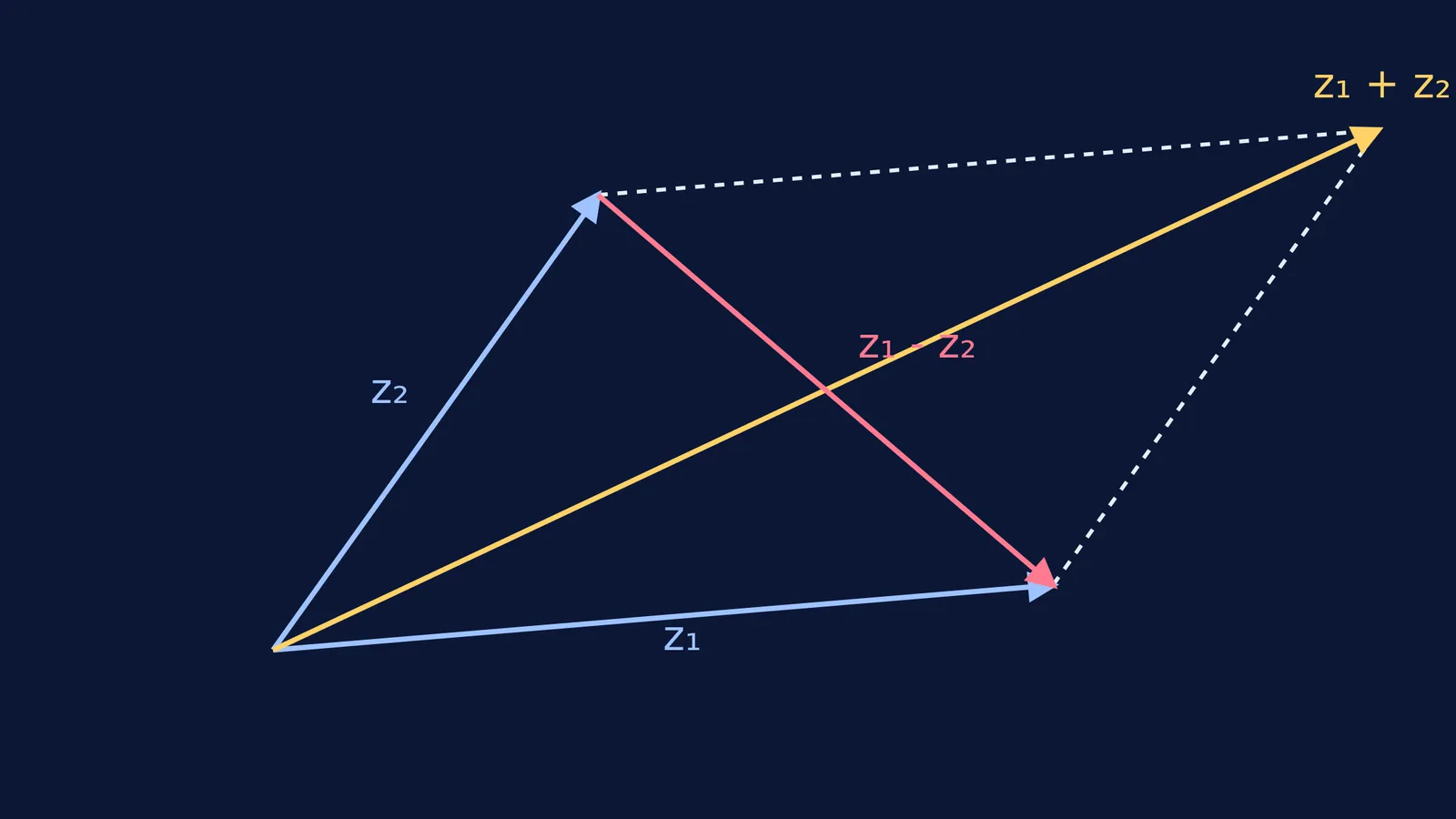
If you draw z₁ and z₂ as vectors starting from the origin, they form two adjacent sides of a parallelogram.
The vector z₁ + z₂ represents the diagonal that starts from the origin.
The vector z₁ − z₂ represents the other diagonal, connecting the tip of z₂ to the tip of z₁.
In Euclidean geometry, the parallelogram law states that the sum of the squares of the lengths of the four sides of a parallelogram equals the sum of the squares of the lengths of its two diagonals.
The lengths of the four sides are |z₁|, |z₂|, |z₁|, and |z₂|. The sum of their squares is 2|z₁|² + 2|z₂|². The lengths of the two diagonals are |z₁ + z₂| and |z₁ − z₂|. The identity we proved algebraically is exactly the statement of this geometric law.
How to use the parallelogram identity in practice?
The parallelogram identity acts as a bridge between pure algebra and geometry. If an exam question provides the lengths of two complex vectors and the length of their sum, you can instantly find the length of their difference without needing to calculate the arguments or coordinates.
Many students attempt solving equations in complex numbers by putting z = x + iy, which replaces one complex variable with two real ones. While that method works for simple equations, using it on squared moduli leads to massive algebraic expansions. The parallelogram law keeps the variables intact and the working brief.
By contrast, if a question asks for the maximum or minimum possible length of a vector sum, you cannot use an exact equation. In those cases, you must rely on the triangle inequality for complex numbers to find the bounds.
If you hit a plateau in coordinate geometry, it often helps to walk through the reasoning step by step rather than just reading a final solution. The Fermi Problem Library has worked problems with a step-by-step solver that explains the reasoning rather than printing an answer. This lets you see exactly when to apply z z̄ expansions and when to rely on a geometric property instead.


