

When a fuel burns with plenty of air, every carbon atom turns into carbon dioxide (CO₂). This complete combustion releases 393.51 kJ/mol of heat (NIST). But when oxygen is restricted, some carbon only makes it halfway, forming carbon monoxide (CO), which releases only 110.53 kJ/mol (NIST). The result is a mixture of two gases, and the total heat released will be a weighted average of these two values.
In exams like the JEE and NEET, a classic limiting reagent problem will give you the starting masses of carbon and oxygen and ask for the final composition of the mixture. Because you have two unknown products, you cannot write a single balanced chemical equation to describe the overall process. Instead, you must use the principle of atom conservation: every atom that goes into the reaction must come out in the products, regardless of the intermediate steps.
How do you solve a carbon combustion stoichiometry problem?
The most reliable way to handle parallel reactions—where one reactant splits to form two different products—is to set up two simultaneous equations based on the moles of individual atoms. You do not need to know the specific step-by-step mechanism of the combustion, only the initial and final states.
Find the initial moles: Convert the starting masses of your reactants, carbon (C) and oxygen (O₂), into moles using their standard molar masses.
Assign variables: Let x be the moles of carbon monoxide (CO) formed, and y be the moles of carbon dioxide (CO₂) formed.
Balance the carbon atoms: Every molecule of CO has exactly one carbon atom, and every molecule of CO₂ also has exactly one carbon atom. Therefore, the total moles of carbon atoms ending up in the products is simply x + y. This total must strictly equal your starting moles of carbon.
Balance the oxygen atoms: Every molecule of CO contains one oxygen atom (x), and every molecule of CO₂ contains two oxygen atoms (2y). The total moles of oxygen atoms in the products is x + 2y. This must equal your starting moles of oxygen *atoms*, which is exactly twice the number of O₂ molecules you began with.
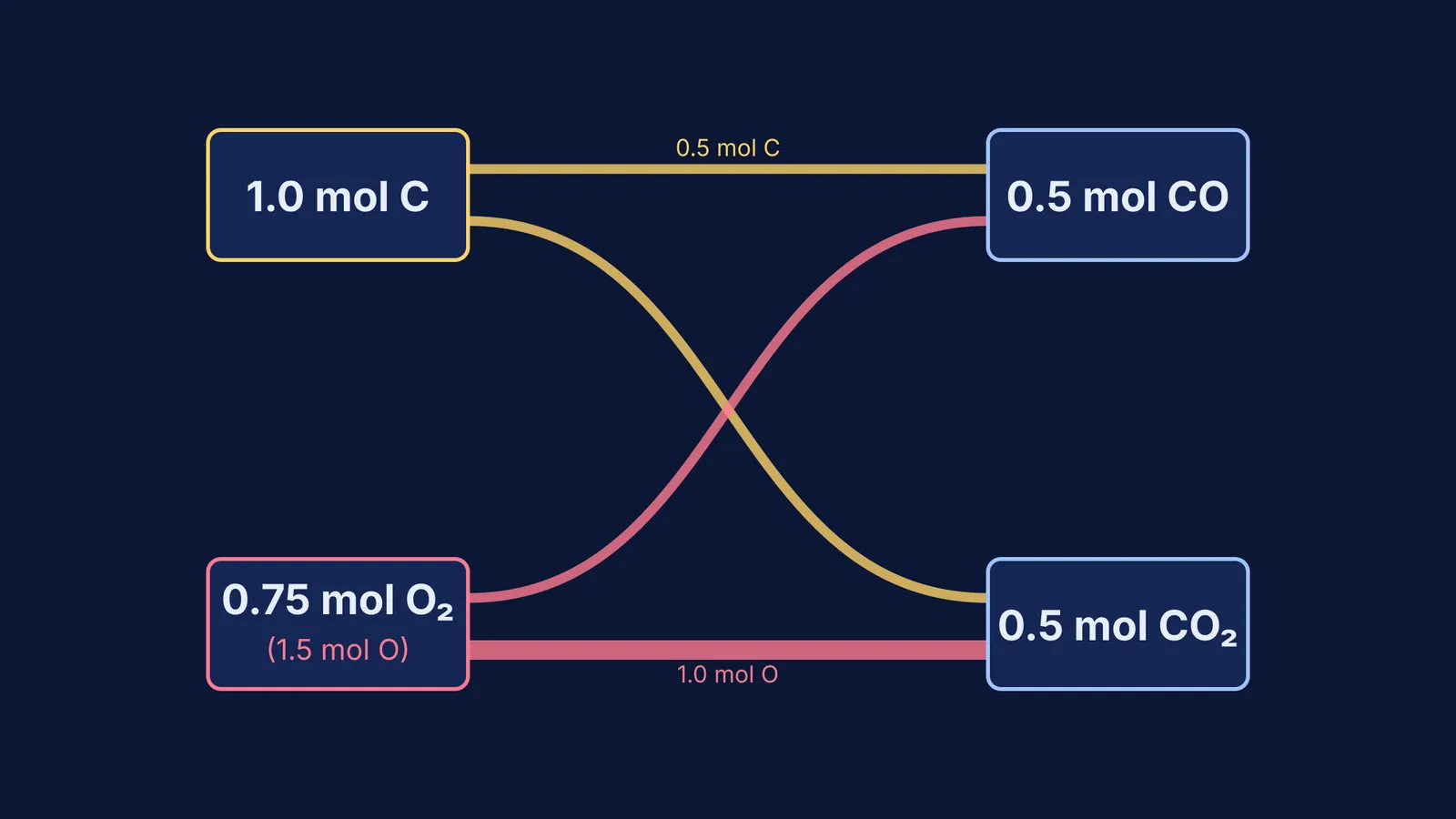
You can then solve these two linear equations algebraically to find x and y. If you are still making mole concept errors when setting up these expressions, sketching a quick flow diagram of the atoms can help clarify where each element goes before you write the equations.
How do you find the final amounts from starting masses?
For example, suppose you burn 12.01 g of carbon in exactly 24.00 g of oxygen gas. First, find the starting moles: 12.01 g of carbon is 1.0 mol of C atoms, and 24.00 g of oxygen gas is 0.75 mol of O₂ molecules. Because oxygen comes as diatomic molecules in its standard state, you actually have 1.5 mol of individual oxygen atoms available for the reaction.
Setting up the atom conservation equations gives you a simple linear system:
Carbon balance: x + y = 1.0
Oxygen balance: x + 2y = 1.5
Solving this system reveals that x = 0.5 mol of CO and y = 0.5 mol of CO₂. To find the final mass of each gas, you simply multiply these molar amounts by their respective molar masses (28.01 g/mol for CO and 44.01 g/mol for CO₂).
Whether you track the mass of the atoms or the energy they release, breaking the reaction down into its individual components ensures you always find the right mixture. If a harder problem adds unreacted carbon or an excess of oxygen, you apply the exact same logic, just as you would when finding empirical formulas from percentage data.
When you bring this kind of problem to the Fermi Problem Library, the AI tutor will not just hand you this final numerical answer; it will guide you to set up the two equations yourself, checking your reasoning at each step before calculating the final masses.


