

On this page
Ever since the ancient Greeks explored why we say parabola, ellipse and hyperbola, finding a parabola's exact shape has meant pinning down its focus and directrix. In modern coordinate geometry, when a parabola's vertex is at the origin, finding its equation comes down to two clues: which axis it is symmetric about, and a single point it passes through. You can use these clues to choose the right standard form and find the missing constant.
Which standard form should you choose?
A parabola with its vertex at the origin has four standard forms, depending on its axis of symmetry. The NCERT Class 11 Mathematics textbook breaks them down by the axis they wrap around:
Symmetric about the x-axis, opening right: Use y² = 4ax. This curve sits entirely in the first and fourth quadrants.
Symmetric about the x-axis, opening left: Use y² = -4ax. This curve sits entirely in the second and third quadrants.
Symmetric about the y-axis, opening upwards: Use x² = 4ay. This curve sits in the first and second quadrants.
Symmetric about the y-axis, opening downwards: Use x² = -4ay. This curve sits in the third and fourth quadrants.
If you are not sure which way it opens, you can simply write y² = 4ax (for the x-axis) or x² = 4ay (for the y-axis). When you substitute the point, the sign of `a` will automatically sort itself out.
What does 'a' actually mean?
Before plugging in numbers, it helps to understand what you are solving for. The constant `a` is the distance from the vertex (the tip of the parabola) to the focus (the point inside the curve where reflected rays meet). Because of the parabola's reflection property, `a` is also the exact distance from the vertex to the directrix (the line behind the curve).
By substituting a point that lies on the curve into the equation, you are forcing the algebra to lock in that exact focal distance.
How do you find the equation given a point?
Once you have the standard form, substituting the coordinates of the known point leaves `a` as the only unknown.
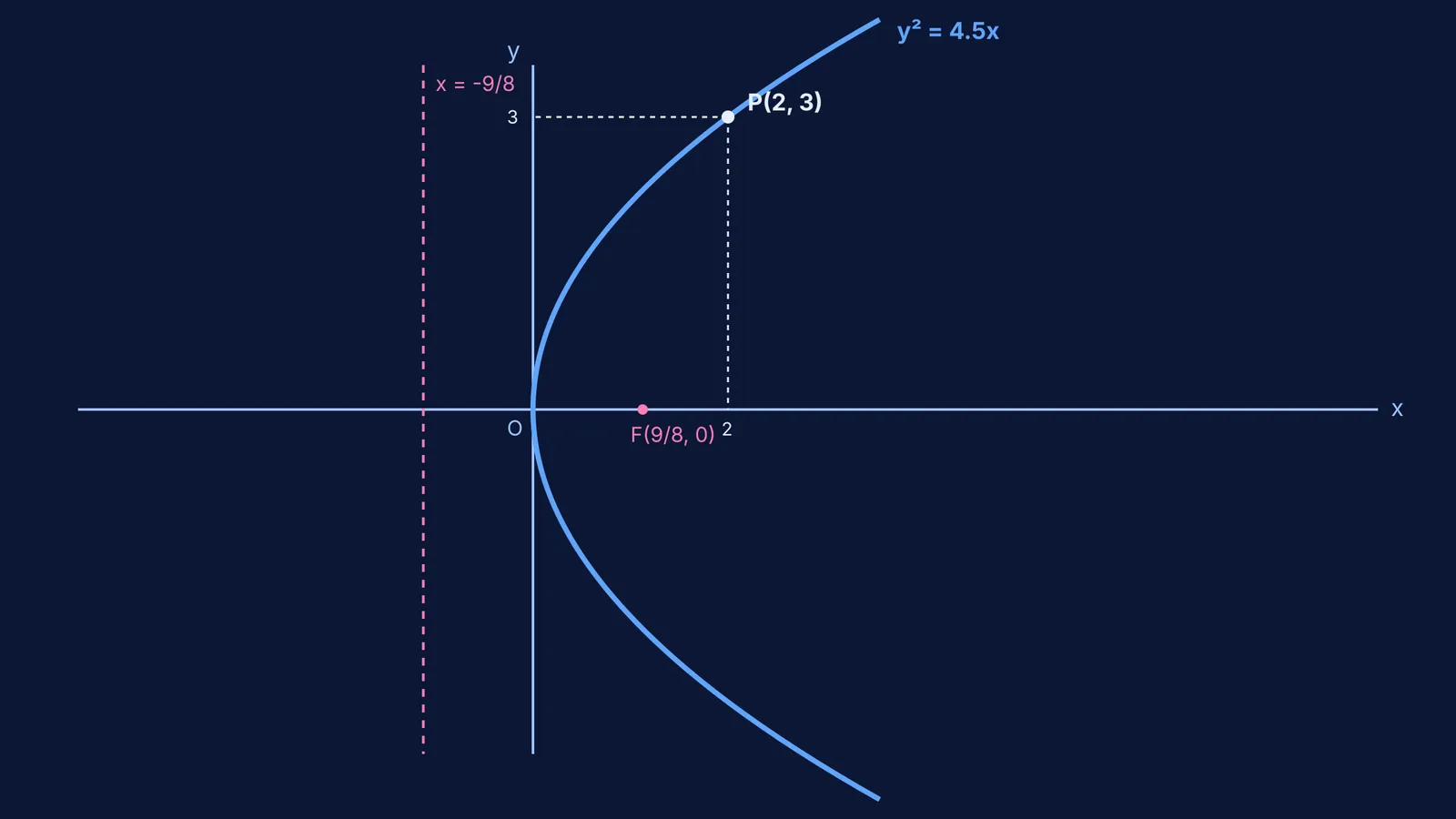
Here is how it works for a parabola symmetric about the x-axis that passes through the point (2, 3).
Identify the axis: The problem states it is symmetric about the x-axis.
Write the form: Start with the general equation y² = 4ax.
Substitute the point: The parabola passes through (x = 2, y = 3). Plugging these values into the equation gives 3² = 4a(2).
Solve for a: Simplifying the arithmetic gives 9 = 8a, which means a = 9/8.
Write the final equation: Put the value of `a` back into the standard form to get y² = 4(9/8)x. This simplifies to y² = (9/2)x, or 2y² = 9x.
What if it is symmetric about the y-axis?
The steps are identical, but you must start with the other standard form. Suppose the parabola passes through (5, 2) and is symmetric about the y-axis.
Write the form: The axis of symmetry is the y-axis, so the equation will take the form x² = 4ay.
Substitute the point: Plug in x = 5 and y = 2 to get 5² = 4a(2).
Solve for a: 25 = 8a, so a = 25/8.
Write the final equation: Substitute `a` back into the original form to get x² = 4(25/8)y. This leaves us with x² = (25/2)y, or 2x² = 25y.
If you struggle to picture how these equations change the shape of the curve, the Fermi Problem Library can step you through similar conic section problems, drawing the figures and checking your reasoning as you go.
Using quadrants to catch mistakes
A common mistake in exams is picking the wrong sign for the standard form. You can prevent this by performing a quick quadrant check before you start calculating.
If a parabola is symmetric about the x-axis, it can only open left or right. If the given point is (−2, 3), that point sits in the second quadrant. A parabola opening to the right (y² = 4ax) cannot reach the second quadrant. Therefore, it must open to the left. If you used y² = 4ax, your calculated `a` will end up being negative, which is your algebraic clue that the parabola opens leftward.
Three things to remember for the exam
If you are facing this type of question in JEE or school board exams, keep these checks in mind to secure your marks:
Watch the squares: A parabola symmetric about the x-axis has the y-term squared. If it is symmetric about the y-axis, the x-term is squared. Mixing these up is the most common error.
Other properties: Once you have `a`, you can immediately write down the focus and the latus rectum. For example, using the standard formulas for latus rectum lengths: 4a for a parabola, 2b²/a for an ellipse, you can quickly answer the next part of a multipart question.
You can also use these standard forms to find focal chords, tangents and normals for more advanced JEE problems once the main equation is known.


