

On this page
How many times can you fold paper to reach the moon?
Imagine holding a standard piece of printer paper. It feels incredibly thin, barely taking up any space between your fingers. But what would happen if you folded it in half over and over again?
Each time you fold a piece of paper, its thickness doubles. A single sheet of office paper is about 0.1 mm thick (Paper - Wikipedia). After one fold, it becomes two layers thick, measuring 0.2 mm. After two folds, it is four layers thick and measures 0.4 mm.
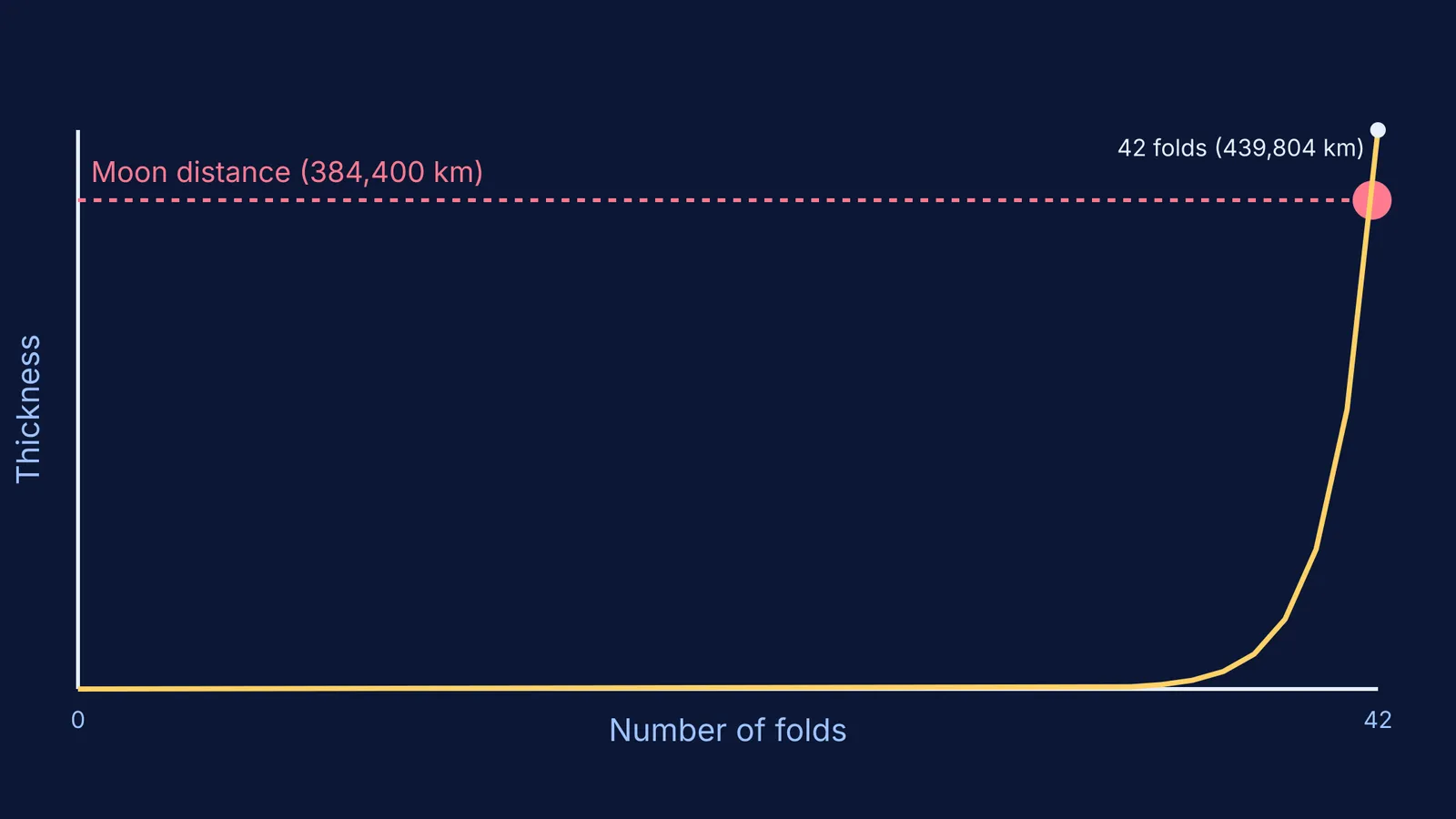
If you could fold it 42 times, the stack would stretch from the surface of the Earth to beyond the Moon. Because the thickness doubles with every fold, this is a classic example of exponential growth. The average distance from Earth to the Moon is 384,400 km (Moon Fact Sheet - NASA). If we multiply our starting thickness of 0.1 mm by 2⁴² (since we double it 42 times), we get 439,804,651,110 mm. When converted to kilometres, that equals roughly 439,804 km. This means the 42nd fold not only reaches the Moon but shoots past it by over 55,000 km.
Why does exponential growth happen so fast?
Exponential growth is deceptive because it starts out painfully slowly. After five folds, assuming a starting thickness of 0.1 mm (Paper - Wikipedia), your paper is still only 3.2 mm thick—about the width of a small pebble. Even after 10 folds, your paper is only 10.2 cm thick, roughly the width of your hand.
However, as the base number grows, the amount added in each subsequent step becomes massive. When you reach the 25th fold, the paper is over 3 kilometres thick, surpassing the altitude of many low-flying aircraft. By the 30th fold, it reaches 107 kilometres, entering outer space.
The real leap happens at the very end. The 41st fold takes the paper from roughly 110,000 km to 220,000 km. The 42nd fold adds another 220,000 km of thickness in a single step. This is why exponents are so powerful in mathematics and physics. When a variable sits in the exponent, as in y = 2ˣ, the function's output accelerates rapidly.
Because humans are used to linear changes, exponential growth can be counterintuitive at first. If you are struggling with the underlying maths, the Fermi Concept Library maps out powers, exponents and geometric progressions with their own lessons, allowing you to walk through the logic at your own pace.
What is the world record for folding paper?
While the mathematics of 42 folds is perfectly sound, the physics of actually folding a piece of paper presents a major obstacle. In practice, you cannot fold a standard A4 sheet of paper anywhere near 42 times. As the paper gets thicker, the outer layers have to stretch further around the bend, creating immense resistance and structural tension. By the seventh or eighth fold, a normal sheet becomes a small, unbending block (Britney Gallivan - Wikipedia).
For decades, it was considered a physical impossibility to fold any piece of paper more than seven or eight times. However, in 2002, a high school student named Britney Gallivan debunked this myth. Using a 1,200-metre roll of specialty toilet paper, she successfully folded it in half 12 times in the same direction.
Gallivan did not just break the record; she wrote the equations to explain it. She derived a mathematical formula that calculates the minimum length of paper required for any number of folds, proving that the limiting factor is not just human strength, but the ratio of the paper's length to its thickness.
How do you calculate exponential growth for exams?
When dealing with geometric progressions (or even biological concepts like arithmetic vs geometric growth in plants) in exams, you will often need to calculate exponential changes. For pure maths problems, such as inserting arithmetic and geometric means between two numbers, having a methodical approach prevents simple errors. Here is a reliable framework for setting up an exponential equation:
Identify the starting value (a). In our paper problem, this is the initial thickness of the sheet. Since we want our final answer in kilometres, we convert 0.1 mm (Paper - Wikipedia) to 10⁻⁷ km.
Identify the growth factor (r). Since the paper doubles with each fold, r = 2. If a population were tripling, r would be 3.
Identify the number of steps (n). We are looking for n, the number of folds required.
Set up the equation. Use the standard formula y = a × rⁿ, where y is the final value you want to reach.
Solve for y or n. In our case, we set 384,400 = 10⁻⁷ × 2ⁿ.


