

On this page
Why is palladium 4d10 5s0 instead of 4d8 5s2?
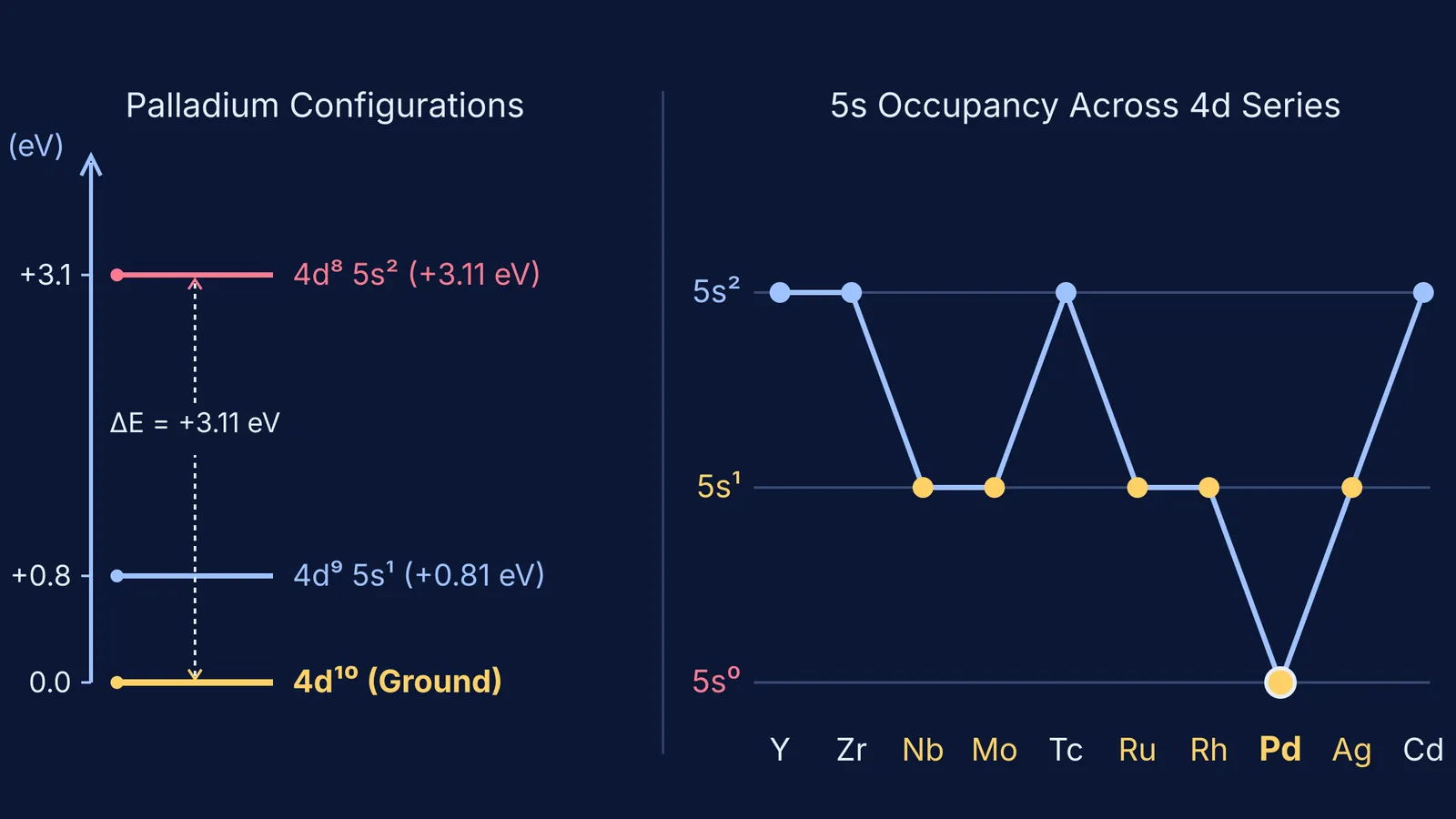
Applying the standard Aufbau principle and the Madelung (n + l) rule predicts that neutral palladium (atomic number 46) should have the configuration [Kr] 4d⁸ 5s², mirroring nickel's [Ar] 3d⁸ 4s². Yet experimental measurements in the NIST Atomic Spectra Database establish that palladium's ground state is [Kr] 4d¹⁰ 5s⁰, leaving its 5s subshell completely empty.
This migration of both 5s electrons into 4d delivers two major stabilization benefits. Under Unsöld's theorem, a filled 4d subshell possesses spherical electron density, minimizing interelectronic repulsion and providing uniform screening. Second, a d¹⁰ subshell maximizes exchange interactions: 10 electrons generate 20 exchange pairs, providing substantial quantum mechanical stabilization.
Spectroscopic records in the NIST Atomic Spectra Database show that the Aufbau-predicted [Kr] 4d⁸ 5s² state lies 25,101 cm⁻¹ (3.11 eV) above the 4d¹⁰ ground state. Even the intermediate [Kr] 4d⁹ 5s¹ state sits 6,564 cm⁻¹ (0.81 eV) above ground. Emptying 5s entirely is thus a deep thermodynamic preference.
Why does the 4d series have so many electron configuration exceptions?
Spectroscopic evaluations compiled in the NIST Atomic Spectra Database establish that while the 3d series features only two exceptions (chromium and copper), six of the ten 4d elements—niobium, molybdenum, ruthenium, rhodium, palladium, and silver—adopt anomalous ground states.
As Melvyn P. Melrose and Eric R. Scerri showed in the Journal of Chemical Education, electron configurations reflect total multi-electron energy rather than an invariant orbital ladder. In period 5, outer subshells compress closer together, narrowing the 4d-5s gap far below the 3d-4s separation.
Additionally, 4d orbitals have one radial node and greater radial extent than compact 3d orbitals. Because 4d orbitals are diffuse, electron pairing repulsion in 4d is lower than in 3d. Moving electrons from 5s into 4d requires minimal promotion energy while avoiding the Coulomb penalty of confining two electrons within the smaller 5s orbital.
How do niobium, molybdenum, ruthenium, and silver fill their 4d orbitals?
According to data compiled in the NIST Atomic Spectra Database, 4d elements balance promotional cost against exchange energy:
Yttrium (Z = 39) and Zirconium (Z = 40): Follow standard filling as [Kr] 4d¹ 5s² and [Kr] 4d² 5s².
Niobium (Z = 41): Adopts [Kr] 4d⁴ 5s¹ instead of 4d³ 5s², avoiding 5s-5s pairing repulsion across a tiny energy gap.
Molybdenum (Z = 42): Adopts [Kr] 4d⁵ 5s¹, maximizing exchange energy with six parallel spins.
Technetium (Z = 43): Returns to [Kr] 4d⁵ 5s², pairing in 5s rather than paying d-orbital pairing energy.
Ruthenium (Z = 44) and Rhodium (Z = 45): Adopt [Kr] 4d⁷ 5s¹ and [Kr] 4d⁸ 5s¹ as increasing nuclear charge stabilizes 4d.
Palladium (Z = 46): Reaches [Kr] 4d¹⁰ 5s⁰, completing subshell closure.
Silver (Z = 47): Adopts [Kr] 4d¹⁰ 5s¹, retaining the full 4d¹⁰ core.
Cadmium (Z = 48): Reaches [Kr] 4d¹⁰ 5s², filling both subshells.
Why is palladium still classified as a transition element?
Although neutral palladium has a filled 4d subshell, it is classified as a transition element. Under the official IUPAC definition confirmed in the NCERT Class 12 Chemistry textbook, a transition metal must have an incompletely filled d subshell in its neutral atom or in a common oxidation state.
In its primary +2 oxidation state, palladium forms Pd²⁺ with configuration [Kr] 4d⁸. Because its 4d subshell is partially filled in this ion, palladium satisfies the definition. This distinguishes palladium from group 12 elements, which retain d¹⁰ across all states, explaining why zinc, cadmium and mercury are not called transition elements.
When forming cations, electrons are removed from the outermost shell first. For ionization mechanisms, see our guide on the electron configuration of ions like Fe³⁺ and Cu⁺ and our analysis of E° values of 3d metals.
How should you write 4d configurations in competitive exams?
To solve exam questions on 4d exceptions accurately, use this four-step sequence:
Identify valence electrons: Subtract 36 (krypton core) from atomic number Z.
Apply the 5s occupancy rule: Set 5s to 0 for palladium (46); set 5s to 1 for niobium (41), molybdenum (42), ruthenium (44), rhodium (45), and silver (47); set 5s to 2 for yttrium (39), zirconium (40), technetium (43), and cadmium (48).
Fill 4d with the remainder: Assign remaining valence electrons to 4d (for example, Pd has 10 − 0 = 10, yielding 4d¹⁰ 5s⁰).
Ionize outer electrons first: For cations like Pd²⁺, remove outer s electrons before d electrons to obtain [Kr] 4d⁸.
The Fermi Problem Library has worked problems with a step-by-step solver that explains the reasoning rather than printing an answer. For a broader overview of periodic trends, the Fermi Concept Library covers every concept in chemistry, each with its own lesson and its place in the map.


