

On this page
When you first study conditional probability, the notation can feel like a trick. You might know how to calculate independent chances by identifying independent vs mutually exclusive events. But when the formula reverses the order of events—asking for P(A|B) instead of P(B|A)—it is incredibly tempting to assume they are mathematically symmetric.
They are not. Assuming they are equal is a logical trap known as the "confusion of the inverse," and it routinely trips up students, lawyers, and scientists alike.
Is P(A given B) equal to P(B given A)?
No. In probability theory, P(A|B) means the chance of event A happening, given that event B has already happened. Reversing the letters to P(B|A) asks a completely different question with a different baseline.
The two probabilities are only equal in the very specific case where the overall, independent chance of A happening is exactly the same as the overall chance of B happening (that is, P(A) = P(B)). In the real world, outside of perfectly balanced coin flips or dice rolls, this is almost never true.
The rain and traffic example
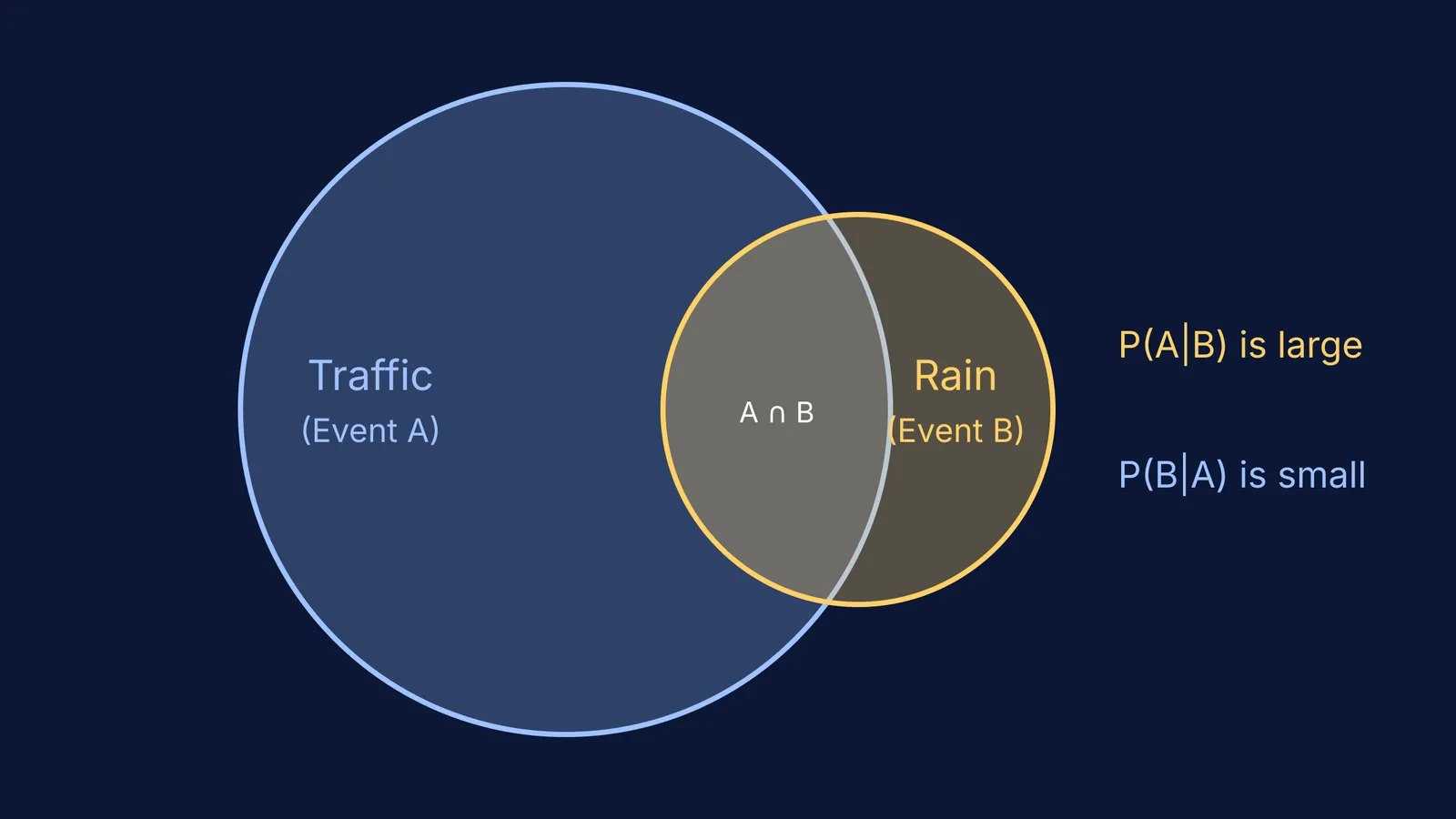
To see why the order matters so much, look at two everyday events: rain (Event B) and heavy traffic (Event A).
First, imagine a dark, rainy morning. What is the chance of heavy traffic? It is very high. Rain slows down cars, causes accidents, and makes people drive to work rather than walk. So, the probability of traffic given rain, P(A|B), might be a high number like 0.85.
Now reverse the scenario. You are sitting in heavy traffic on a Tuesday afternoon. What is the chance that it is raining? Traffic has dozens of different causes: roadworks, rush hour volume, an accident, or a stalled truck. The vast majority of traffic jams happen on perfectly dry days. So, the probability of rain given traffic, P(B|A), might be a much lower number like 0.28.
To prove this mathematically, imagine a town where the probability of rain is 0.20, and the overall probability of heavy traffic is 0.60. If the probability of both rain and heavy traffic occurring on the same day is 0.17, then P(Traffic | Rain) is 0.17 divided by 0.20, or 0.85. However, P(Rain | Traffic) is 0.17 divided by 0.60, which is about 0.28. The overlap is identical, but the changing denominator makes the conditional probabilities completely different.
What is the confusion of the inverse?
Treating P(A|B) as equal to P(B|A) is a surprisingly common mistake, even among professionals who rely on statistics to make life-or-death decisions.
In a classic 1982 study published in *Judgment under Uncertainty*, researcher David M. Eddy presented physicians with a breast cancer screening scenario. They were told that 1% of women in a population had the disease. They were also told that if a woman had cancer, the test would be positive 80% of the time, and if she was healthy, it would falsely read positive 9.6% of the time.
Eddy then asked the physicians: if a woman gets a positive test result, what is the probability she actually has cancer?
About 95 out of 100 physicians guessed the answer was between 70% and 80%. They completely confused P(Positive | Cancer) with P(Cancer | Positive). Because the disease was rare to begin with, a positive result was far more likely to be a false alarm in a healthy person. The true probability was roughly 7.7%.
Just like the rain and traffic example, having the disease usually means a positive test, but a positive test does not automatically mean you have the disease.
How does Bayes' theorem link P(A|B) and P(B|A)?
Even though they are completely different numbers, the two conditional probabilities are mathematically locked together by their intersection.
To find the probability of both events happening together (A ∩ B), you can build your calculation from either side:
Start with the chance of B, then multiply by the chance of A happening given B. This is P(A|B) × P(B).
Start with the chance of A, then multiply by the chance of B happening given A. This is P(B|A) × P(A).
Because both paths are just different ways to calculate the exact same overlap—similar to counting the same outcomes with and without replacement—they must equal each other:
P(A|B)P(B) = P(B|A)P(A)
This elegant equation is the foundation of Bayes' theorem. It proves that the only way P(A|B) could equal P(B|A) is if P(A) and P(B) cancel each other out by being identical.
If you know one conditional probability, you can always divide both sides by the base rate to find the other:
P(A|B) = [P(B|A) × P(A)] / P(B)
If you are practicing these conversions for your exams, the Fermi Problem Library has worked problems with a step-by-step solver that explains the reasoning rather than printing an answer. It helps you set up the sample space correctly before you start plugging in the numbers.


