

On this page
White phosphorus (P₄) forms a discrete molecule where four phosphorus atoms sit at the corners of a regular tetrahedron. Six single P-P bonds trace the edges of this polyhedron, producing acute 60° bond angles that create intense ring strain. In the standard Class 12 chemistry curriculum prescribed by the Central Board of Secondary Education, understanding how P₄ burns under controlled conditions explains the formation of its primary oxides. When phosphorus burns in a limited supply of oxygen, diatomic oxygen inserts cleanly across each of the six strained P-P edges:
P₄ + 3O₂ → P₄O₆
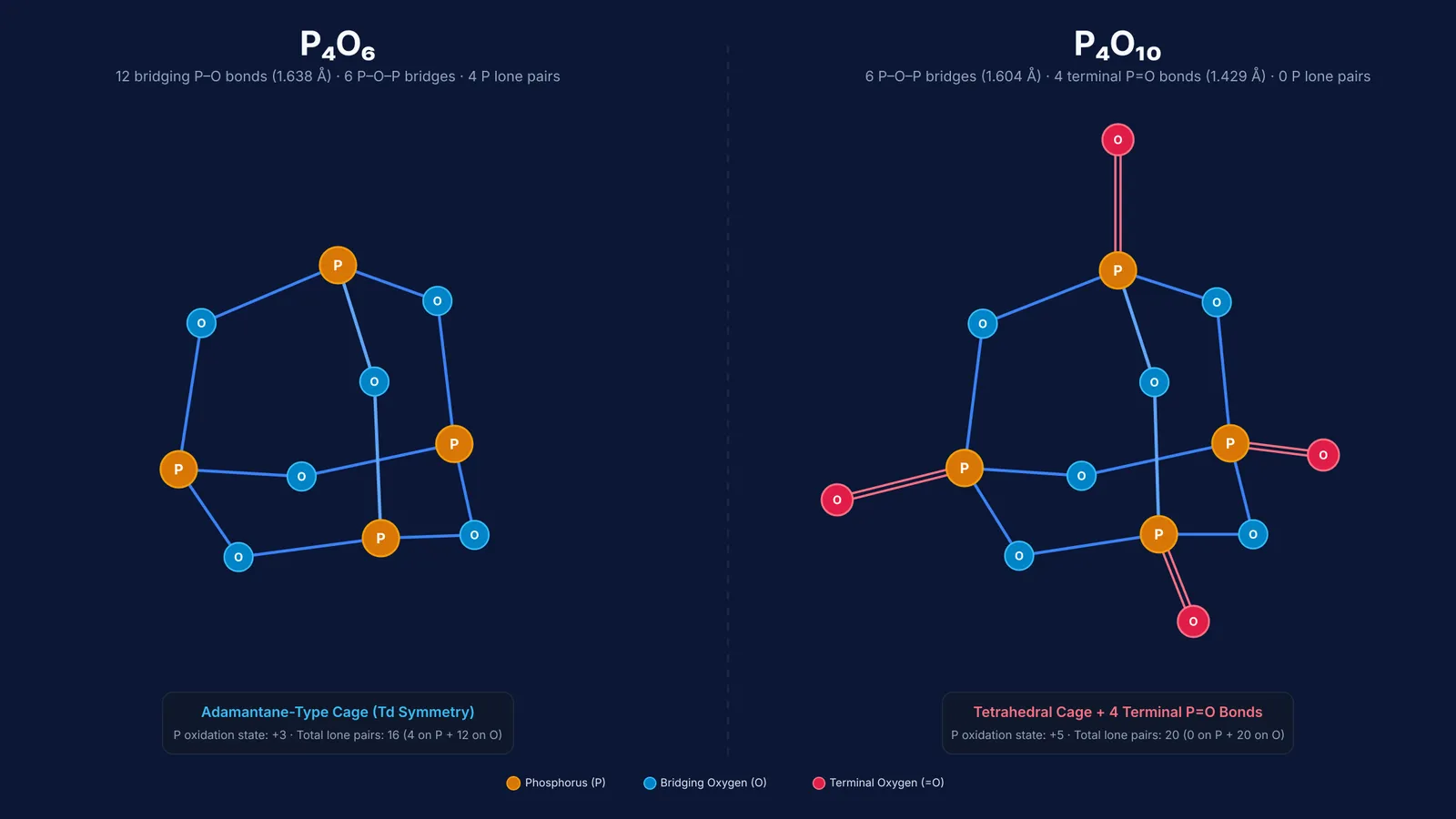
Every single P-P bond in the precursor tetrahedron is cleaved during this reaction. In their place, six oxygen atoms bridge the four original phosphorus vertices, creating six bent P-O-P linkages. Because each bridging oxygen atom attaches to two phosphorus atoms, P₄O₆ contains exactly 12 single P-O bonds and zero remaining P-P bonds. Each phosphorus atom retains its unshared lone pair of electrons in an sp³ hybrid orbital, holding an oxidation state of +3.
Precise structural measurements from gas-phase electron diffraction by Beagley and colleagues published in the Transactions of the Faraday Society established the dimensions of this adamantane-type cage. In P₄O₆, the bridging P-O distance measures 1.638 ± 0.003 Å (163.8 pm), while the bridging P-O-P bond angle opens to 126.4 ± 0.7°. The lone pair on each phosphorus atom compresses the O-P-O angle down to 99.8 ± 0.5°, reflecting the steric repulsion familiar from comparing bond angles and lone-pair repulsions in simple trihydrides.
How does P4O10 differ in bonding and geometry?
When white phosphorus burns in excess air or oxygen, the combustion proceeds further to yield tetraphosphorus decaoxide:
P₄ + 5O₂ → P₄O₁₀
Alternatively, heating P₄O₆ in additional oxygen converts it directly into P₄O₁₀. The six-bridge cage framework remains completely intact, but the four unshared lone pairs on the phosphorus vertices are no longer dormant. In P₄O₁₀, each of the four phosphorus atoms forms an exocyclic terminal bond with an additional oxygen atom, yielding four terminal P=O units.
This structural distinction introduces two completely different types of phosphorus-oxygen bonds into the molecule. Gas-phase electron diffraction measurements by Beagley and colleagues in the Transactions of the Faraday Society revealed that the terminal P=O bonds are significantly shorter at 1.429 ± 0.004 Å (142.9 pm), compared to the bridging P-O bonds which measure 1.604 ± 0.003 Å (160.4 pm). The terminal bond contracts because of effective dπ-pπ back-bonding, where electron density from filled oxygen 2p orbitals overlaps with empty phosphorus 3d orbitals, imparting double-bond character.
Crucially, the bridging P-O bonds in P₄O₁₀ (1.604 Å) are 0.034 Å shorter than those in P₄O₆ (1.638 Å). When you practice determining oxidation numbers from structural formulas, you observe that phosphorus shifts from +3 in P₄O₆ to +5 in P₄O₁₀. The higher formal positive charge pulls shared electron density closer to the phosphorus nuclei, increasing the s-character of the bridging σ-bonds and compressing the bridge. Concurrently, the bridging P-O-P angle tightens slightly to 123.5 ± 0.7°, while the internal O-P-O angle widens to 101.6 ± 0.7° as the bulky terminal double bond repels the cage edges.
How many P-O-P bonds and lone pairs are in each oxide?
Competitive exams administered by the National Testing Agency frequently test these structural details because students tend to guess bond counts directly from empirical subscripts. Reviewing the polyhedral topology removes all ambiguity:
Bridging P-O-P linkages: Exactly 6 in both oxides, corresponding to the 6 edges of the parent tetrahedron.
Terminal P=O bonds: 0 in P₄O₆; exactly 4 in P₄O₁₀ (one at each phosphorus vertex).
P-P direct bonds: Exactly 0 in both molecules.
Total σ-bonds: 12 in P₄O₆ (all bridging); 16 in P₄O₁₀ (12 bridging plus 4 terminal).
Total π-bonds: 0 in P₄O₆; exactly 4 dπ-pπ bonds in P₄O₁₀.
Total lone pairs: 16 in P₄O₆ (4 on phosphorus vertices + 12 on six bridging oxygens); 20 in P₄O₁₀ (0 on phosphorus + 12 on six bridging oxygens + 8 on four terminal oxygens).
When you work through multi-step structural problems, checking each vertex and bridge systematically prevents counting mistakes. The Fermi Problem Library has worked problems with a step-by-step solver that explains the reasoning rather than printing an answer, allowing you to trace cage structures with complete clarity.
Why does P4O10 act as such a powerful dehydrating agent?
The distinct structures of the two oxides dictate how they interact with water. Dissolving P₄O₆ in cold water hydrolyses the bridges without oxidising the phosphorus atoms, producing orthophosphorous acid:
P₄O₆ + 6H₂O → 4H₃PO₃
In contrast, P₄O₁₀ reacts vigorously and exothermically with water to form orthophosphoric acid:
P₄O₁₀ + 6H₂O → 4H₃PO₄
The enormous thermodynamic driving force behind this reaction stems from converting the strained cage network of bridging P-O-P units into resonance-stabilised tetrahedral phosphate ions containing strong P=O bonds and extensive hydrogen-bonding capacity. This affinity for moisture makes P₄O₁₀ one of the most effective chemical desiccant agents known in organic and inorganic synthesis.
For example, P₄O₁₀ extracts the elements of water from oxoacids, dehydrating concentrated nitric acid to generate solid dinitrogen pentoxide (N₂O₅). Just as examining cage and chain structures in nitrogen oxides clarifies reaction mechanisms, mapping phosphorus polyhedra reveals why P₄O₁₀ can strip water from primary amides to yield nitriles and convert carboxylic acids to anhydrides.
To explore how cage compounds, oxoacids, and molecular geometries connect across the periodic table, visit the Fermi Concept Library, which covers every concept in chemistry, each with its own lesson and its place in the map.


