

On this page
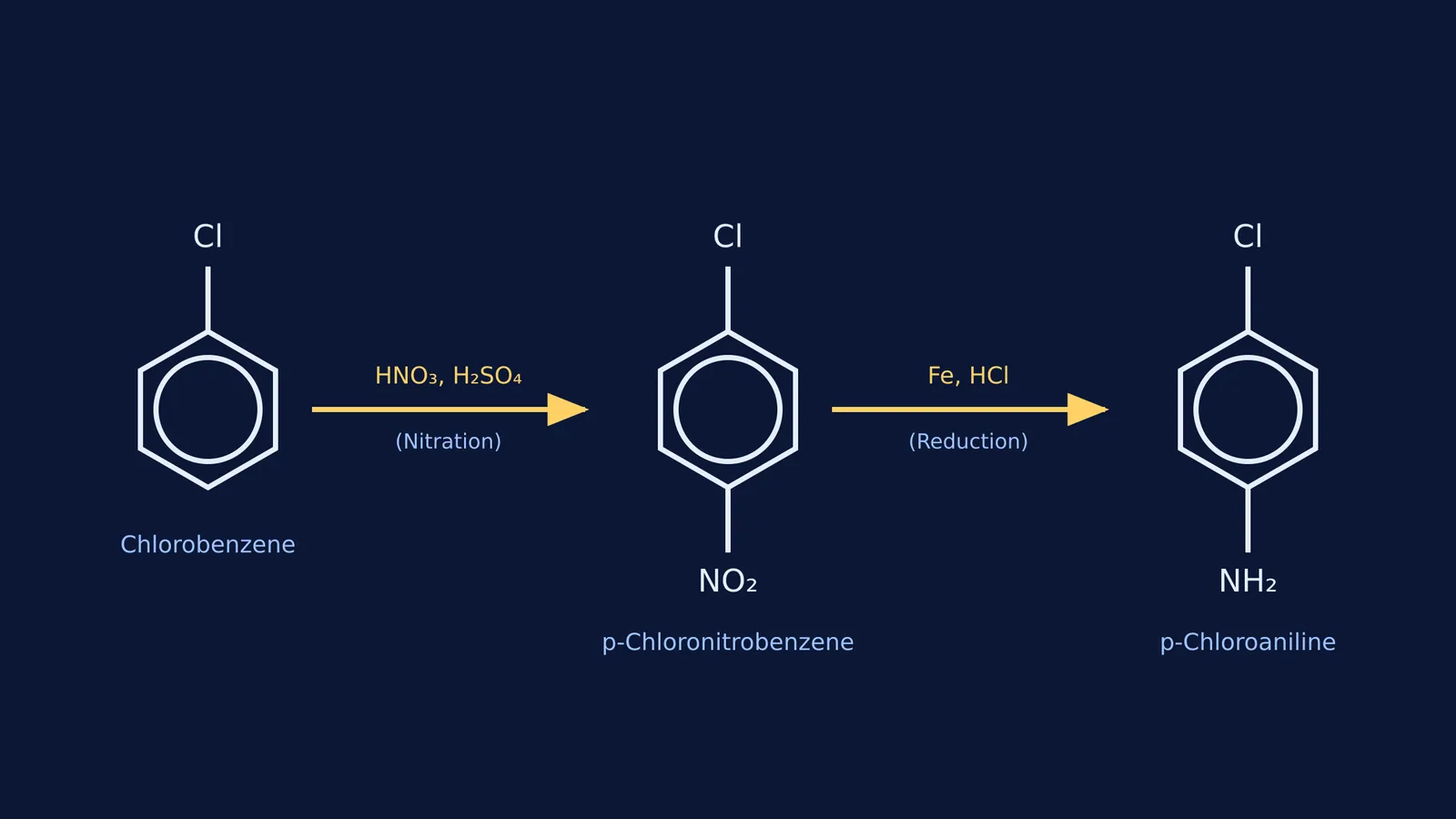
To make p-chloroaniline, you cannot simply swap the hydrogen atoms on chlorobenzene directly for an amine group. Electrophilic aromatic substitution with an amine is not straightforward because a stable "+NH₂" electrophile does not exist. Instead, organic chemists rely on a classic two-step pathway: introducing a nitro group to the ring, and then reducing it to an amino group.
Why is chlorine an ortho/para director?
Before starting the reaction, it helps to understand how the chlorine atom behaves on the benzene ring. Halogens are unusual substituents. Because chlorine is highly electronegative, it pulls electron density away from the ring through the inductive effect, making the ring less reactive than plain benzene.
However, chlorine also has lone pairs of electrons. When an electrophile attacks the ortho or para positions, these lone pairs can participate in resonance, stabilising the intermediate carbocation. Because of this resonance stabilisation, chlorine acts as an ortho/para directing group, ensuring incoming groups attach right next to it or directly opposite it.
Step 1: Nitration of chlorobenzene
The first step is to nitrate the chlorobenzene using a mixture of concentrated nitric acid (HNO₃) and concentrated sulphuric acid (H₂SO₄).
Because chlorine is an ortho/para director, the nitronium ion (NO₂⁺) attaches to the ring to form two distinct structural isomers: *o*-chloronitrobenzene and *p*-chloronitrobenzene.
Under standard conditions, nitration of chlorobenzene yields about 65% of the para isomer and 34% of the ortho isomer (Wikipedia). The para product is heavily favoured because the bulky chlorine atom creates steric hindrance at the ortho positions, physically blocking the incoming nitro group.
Before moving to the next step, you must separate the two isomers. This is usually done by fractional crystallization. The symmetrical para isomer packs tightly into a crystal lattice and melts at around 83 °C (PubChem), whereas the ortho isomer melts at just 33 °C (Wikipedia).
Step 2: How do you reduce p-chloronitrobenzene?
Once you have isolated the pure p-chloronitrobenzene, the final step is to convert the -NO₂ group into an -NH₂ group.
In the laboratory, this is typically done by adding tin (Sn) and hydrochloric acid (HCl). The metal and acid react to supply hydrogen, safely reducing the nitro group while leaving the carbon-chlorine bond completely intact.
For commercial production, the preferred industrial method uses iron scrap (Fe) and HCl because it requires only a small amount of hydrochloric acid (NCERT). The iron reacts with the acid to form ferrous chloride (FeCl₂), which then hydrolyses to release HCl back into the reaction mixture. This self-sustaining cycle makes the iron-based reduction far more cost-effective.
Memorising organic reactions can feel overwhelming, but understanding the underlying resonance explains why chlorine is ortho/para directing. If you are reviewing directing groups, the Concept Library has every concept in chemistry, each with its own lesson. When you practice synthesis questions in the Fermi Problem Library, you get worked problems with a step-by-step solver that explains the reasoning rather than printing an answer.
Checklist for converting substituted benzenes
When planning a multi-step synthesis for an exam like JEE or NEET, keep these rules in mind:
Check directing groups: Is the existing group electron-donating (ortho/para) or withdrawing (meta)? Remember that halogens are deactivating but still ortho/para directing.
Check for steric hindrance: The para product is almost always the major isomer if the existing group is bulky.
Separate before proceeding: If you need a pure para product, isolate it before the next reaction step to avoid a messy mixture of ortho and para final products.
Plan your reduction: Use Fe/HCl or Sn/HCl to reduce -NO₂ to -NH₂ without harming halogens on the ring.
If you are reviewing other nitrogen-containing compounds, you may also want to read about the Gabriel phthalimide synthesis and the reagents used for reducing nitrobenzene to aniline. For nucleophilic substitutions, it is vital to know the difference between aqueous vs alcoholic KOH.


