

On this page
Ozonolysis of an alkyne is a classic reaction in organic chemistry, but it carries a distinct twist compared to the ozonolysis of alkenes. When preparing for JEE or NEET, the choice of workup conditions dictates the entire shape of the final molecule.
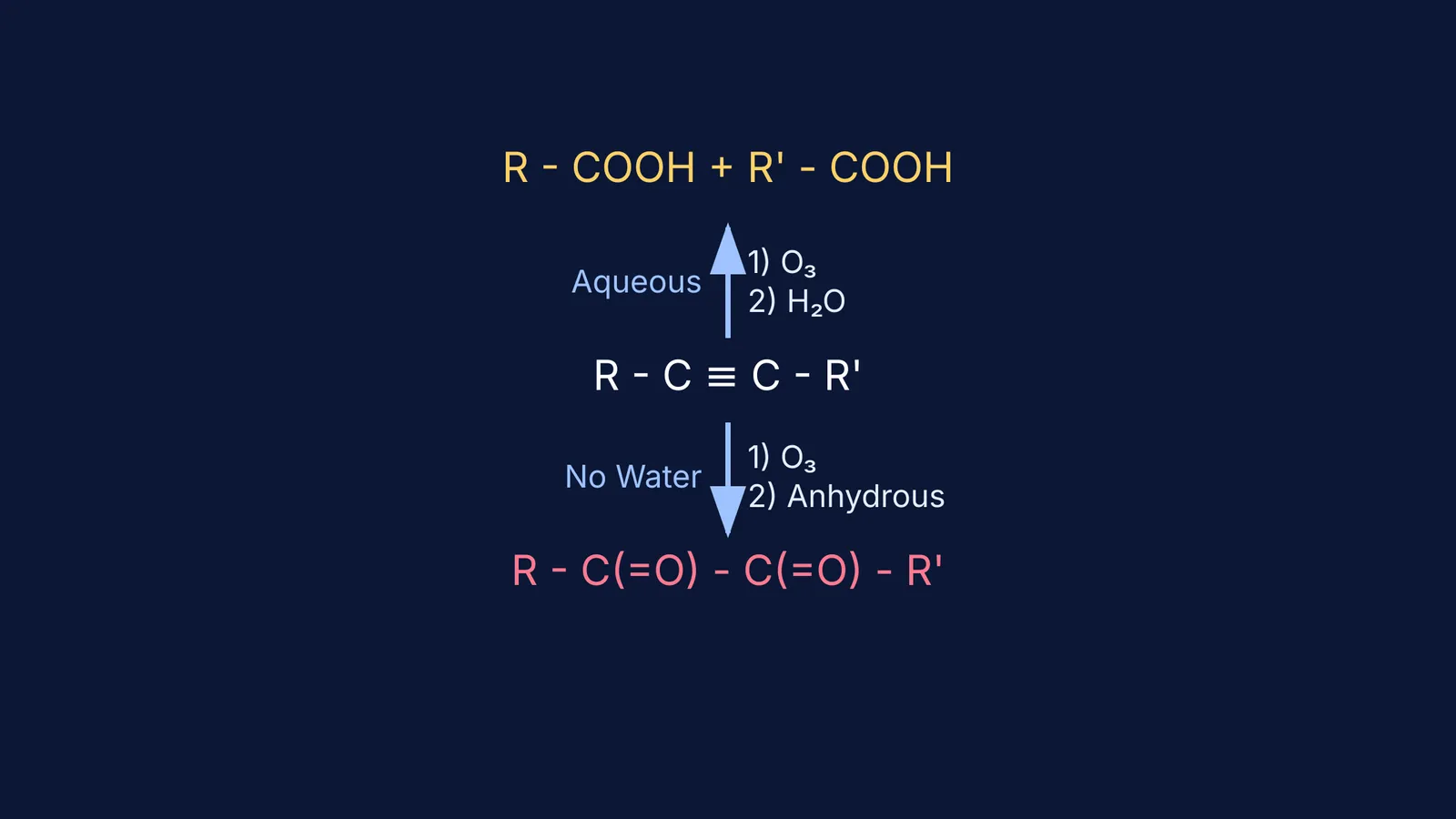
While an alkene simply splits in two, alkynes can either split into two carboxylic acids or stop partway to form a single 1,2-diketone or acid anhydride molecule.
Does ozonolysis of alkynes produce diketones or acids?
The final product depends on the workup conditions.
Water leads to carboxylic acids. If the ozonolysis of an alkyne is performed in the presence of water (H₂O), the intermediate anhydride hydrolyzes to give two carboxylic acids (Wikipedia). An internal alkyne (such as 2-butyne) will break apart to give two molecules of acetic acid.
Excluding water leads to 1,2-diketones or anhydrides. Unlike alkenes, a reducing agent is not needed for these reactions to stop at the diketone or anhydride stage (Wikipedia). After treating the alkyne with ozone (O₃), if water is excluded, the carbon-carbon bond can survive. For example, recent chemical synthesis protocols note that alkyne ozonolysis at extremely low temperatures (−78 °C) followed by a reductive quench (such as with triphenylphosphine) can yield 1,2-diketones at ~75% yield.
If you are struggling to remember these oxidation states under exam pressure, you can look up the reactions in the Fermi Concept Library to see exactly what products form.
Why does the alkyne triple bond behave differently?
While the exact mechanism of alkyne ozonolysis is unknown (Wikipedia), the carbon atoms in the triple bond are already at a higher oxidation state. In alkene ozonolysis, a reductive workup stops the oxidation at the aldehyde or ketone stage, while an oxidative workup pushes it to a carboxylic acid.
For an alkyne, the initial cleavage with ozone is complex. Because the carbons are triple-bonded, cleaving two of those bonds with oxygen leaves one carbon-carbon bond intact, forming a dicarbonyl or anhydride species. If there is any water present—even without a strong oxidant—that last bond is highly susceptible to hydrolysis, which is why alkene addition rules feel different here. The intermediate rapidly breaks down into two carboxylic acids. You have to actively prevent this breakdown by using anhydrous conditions to isolate the diketone.
How do you predict the products of alkyne ozonolysis?
Imagine an exam question asks you to predict the major product when 2-pentyne reacts with O₃ followed by H₂O.
Identify the reactant: 2-pentyne is an internal alkyne with a five-carbon chain (CH₃-C≡C-CH₂-CH₃).
Check the reagents: The presence of H₂O signals hydrolysis.
Cleave the bond: Break the triple bond completely.
Form the products: The two-carbon fragment becomes acetic acid (ethanoic acid), and the three-carbon fragment becomes propionic acid (propanoic acid).
If the exact same starting material, 2-pentyne, were treated with O₃ at −78 °C in anhydrous conditions, the single carbon-carbon bond between the second and third carbons would survive. The product would be pentane-2,3-dione, a 1,2-diketone.
How to work back from products to the alkyne?
In competitive exams, you are often given the products and asked to identify the starting material. This is where working backward (retrosynthesis) becomes a vital skill.
If the product is a 1,2-diketone: You know the reaction excluded water. To find the starting alkyne, simply remove the two oxygen atoms from the adjacent carbonyl groups and replace the single bond between them with a triple bond.
If the products are two carboxylic acids: The reaction involved water. Place the two acid molecules side by side so their carboxyl groups face each other. Remove the COOH oxygen and OH groups, and join the remaining carbons with a triple bond.
It helps to practice this visually. If you often make mistakes joining the fragments back together, Fermi's AI tutor can draw out the carbon skeleton with you on a shared board, checking your valencies before you commit to an answer.
What are common exam pitfalls?
A frequent trap in multiple-choice questions is presenting an alkyne with O₃ and a reductive workup, and offering a pair of carboxylic acids as an option. Students instinctively choose the acids because they memorise that alkynes "always" fully cleave. Remember the conditions: excluding water or using a mild reductive environment stops the reaction at the diketone stage.
Similarly, be careful with the preparation of aldehydes and ketones involving alkynes. While hydration of an alkyne (using Hg²⁺ and H₂SO₄) also yields a ketone, it gives a single monoketone, not a 1,2-diketone. Knowing these subtle reagent differences is what elevates a good score to a great one. If you want to compare other carbonyl reactions, such as Clemmensen vs Wolff-Kishner, the reasoning principles remain the same.


