

On this page
When mixing two non-reacting solutions—such as aqueous glucose and aqueous urea—finding the resulting osmotic pressure often trips up students. Many mistakenly average the initial pressures, while others wonder whether glucose molecules exert different pressure than urea molecules because glucose has three times the molar mass of urea, as discussed in the NCERT Class 12 Chemistry textbook.
Neither confusion holds up in physical chemistry. Osmotic pressure is a colligative property. According to NCERT solutions principles, colligative properties depend solely on the total number of solute particles in solution, regardless of their identity or mass. To find the osmotic pressure of the mixture, sum the solute moles, divide by the combined volume, and apply the van 't Hoff equation.
How do you calculate osmotic pressure after mixing two solutions?
In 1887, Jacobus Henricus van 't Hoff demonstrated in the *Zeitschrift für physikalische Chemie* that dilute solutions obey an equation analogous to the ideal gas law: π = CRT. For this work, van 't Hoff received the first Nobel Prize in Chemistry in 1901 for discovering the laws of chemical dynamics and osmotic pressure in solutions.
Just as Dalton's law of partial pressures applies to gas mixtures, van 't Hoff established in his 1888 Philosophical Magazine paper that the total osmotic pressure of mixed dilute solutes equals the sum of their individual partial osmotic pressures.
When mixing solution 1 (volume V₁, concentration C₁) with solution 2 (volume V₂, concentration C₂) at constant temperature T:
Solute moles in solution 1: n₁ = C₁ × V₁.
Solute moles in solution 2: n₂ = C₂ × V₂.
Total solute moles: n_total = n₁ + n₂.
Total volume: V_total = V₁ + V₂.
Mixture molarity: C_mix = (n₁ + n₂) / (V₁ + V₂).
Resulting osmotic pressure: π_mix = C_mix × R × T = [(n₁ + n₂) / (V₁ + V₂)] × R × T.
Because π₁ = C₁RT and π₂ = C₂RT, this rearranges to a direct volume-weighted average:
π_mix = (π₁V₁ + π₂V₂) / (V₁ + V₂)
This matches the standard principle for mixing and diluting solutions to find final molarity.
Why can you add moles of glucose and urea directly?
Glucose (C₆H₁₂O₆) and urea (NH₂CONH₂) are non-electrolytes: as defined in NCERT Class 12 Chemistry, neither dissociates nor associates in water, so each has a van 't Hoff factor of i = 1.
In 1877, botanist Wilhelm Pfeffer showed in *Osmotische Untersuchungen* that osmotic pressure depends on the number of solute particles rather than their molecular weight. Pfeffer's data formed the foundation of van 't Hoff's theory. Our profile of Wilhelm Pfeffer's osmotic pressure measurements details his original apparatus.
Because osmotic pressure is colligative, 1 mole of glucose yields 6.022 × 10²³ dissolved particles, exactly like 1 mole of urea. Although a mole of glucose weighs 180 grams and a mole of urea weighs 60 grams, both exert identical pressure per mole. Solute moles add directly: n_total = n_glucose + n_urea.
How do you solve a worked example of mixing glucose and urea?
Consider a standard numerical problem aligned with NCERT Class 12 Chemistry:
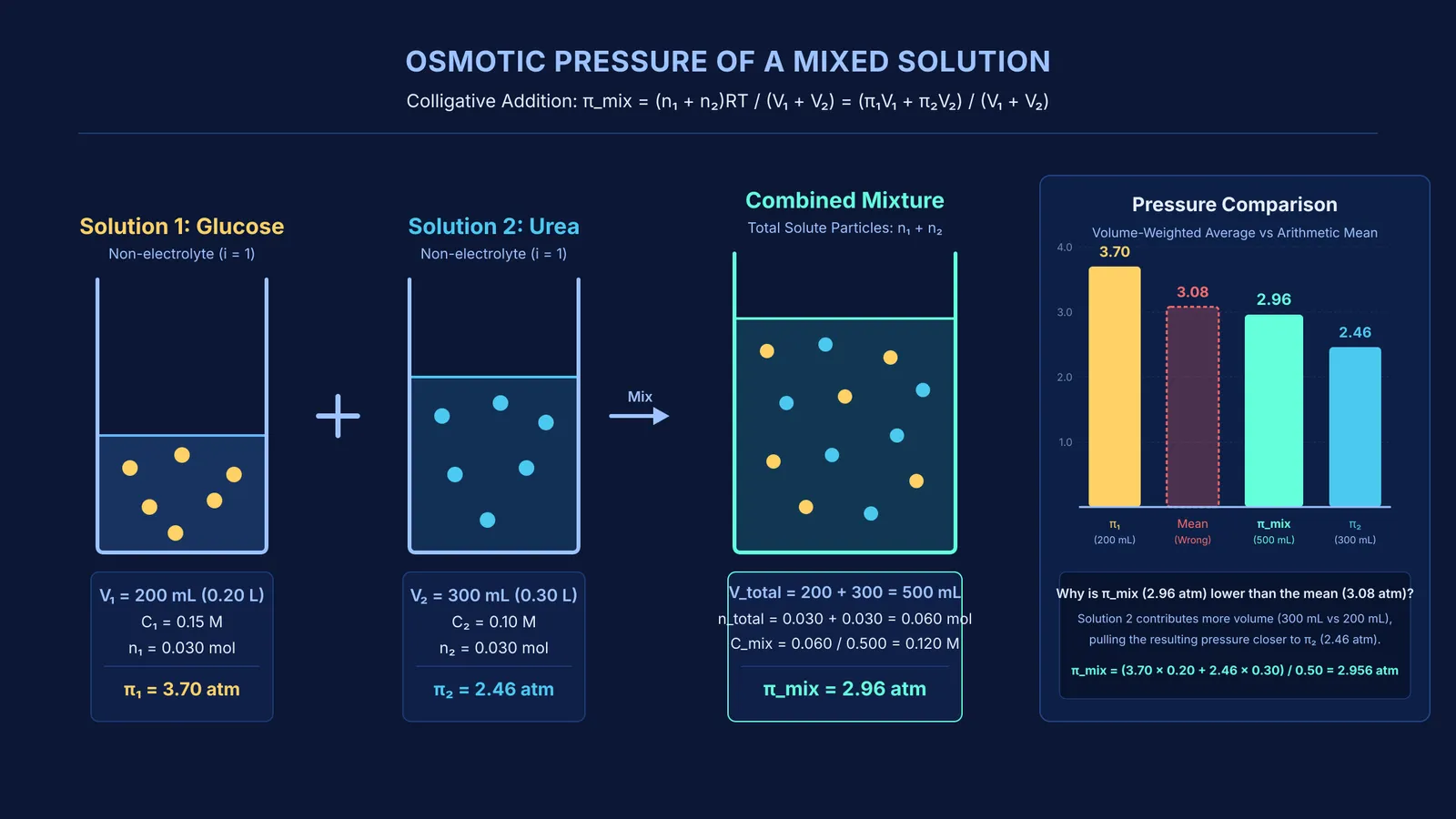
Suppose 200 mL of 0.15 M glucose solution is mixed with 300 mL of 0.10 M urea solution at 27 °C (300 K). What is the osmotic pressure of the mixture in atmospheres? (Use R = 0.0821 L·atm·K⁻¹·mol⁻¹).
Find moles of each solute:
Glucose: n₁ = 0.15 mol/L × 0.200 L = 0.030 mol.
Urea: n₂ = 0.10 mol/L × 0.300 L = 0.030 mol.
Find total moles and combined volume:
n_total = 0.030 mol + 0.030 mol = 0.060 mol.
V_total = 0.200 L + 0.300 L = 0.500 L.
Calculate mixture concentration and osmotic pressure:
C_mix = 0.060 mol / 0.500 L = 0.120 M.
π_mix = 0.120 mol/L × 0.0821 L·atm·K⁻¹·mol⁻¹ × 300 K = 2.956 atm.
Alternatively, using the volume-weighted formula:
π₁ = 0.15 × 0.0821 × 300 = 3.695 atm.
π₂ = 0.10 × 0.0821 × 300 = 2.463 atm.
π_mix = (3.695 × 0.200 + 2.463 × 0.300) / 0.500 = 2.956 atm.
When problems give mass rather than molarity, our guide on finding molar mass from osmotic pressure covers the conversion.
What common mistakes happen in mixing problems?
Students often make three errors on mixing numericals, as noted in the NCERT Chemistry Solutions chapter:
Taking a simple arithmetic average: Averaging 3.695 atm and 2.463 atm gives 3.079 atm. This is incorrect whenever the mixed volumes differ.
Forgetting electrolyte dissociation: If an electrolyte like sodium chloride is mixed instead of urea, multiply molarity by its van 't Hoff factor (i ≈ 2) before summing effective osmoles.
Inconsistent gas constant units: Pairing litres with R = 8.314 J·K⁻¹·mol⁻¹ yields kilopascals instead of atmospheres. Always match volume and pressure units to R.
When working through multi-stage colligative numericals, the Fermi Problem Library has worked problems with a step-by-step solver that explains the reasoning rather than printing an answer. To explore how colligative laws connect to vapour pressure lowering and freezing point depression across syllabus topics, the Fermi Concept Library covers every concept in physics, chemistry, biology, mathematics and computing, each with its own lesson and its place in the map.


