

On this page
In physics, we deal with quantities that span enormous ranges, from the mass of an electron to the distance to a distant galaxy. Writing out all those zeros is impractical and prone to errors. Instead, we use the order of magnitude to estimate and compare these scales quickly.
What is the order of magnitude of a number?
The order of magnitude is the power of 10 that is closest to the physical quantity's value. It gives us an immediate sense of scale—whether something is measured in the tens, thousands, or millions.
To find the order of magnitude, you first write the number in standard scientific notation: N = a × 10ᵇ
Here, b is an integer (the exponent), and a is a number between 1 and 10 (1 ≤ a < 10). Once the number is in this form, the final order of magnitude depends purely on the value of a.
How do you write a number as a × 10ᵇ?
If you are starting with a standard number, you must correctly move the decimal point before you can determine the order of magnitude. The goal is to create a number a that has exactly one non-zero digit to the left of the decimal point.
For large numbers (greater than 10): Move the decimal point to the left until you have a number between 1 and 10. Count the number of places you moved the decimal point; this count becomes your positive exponent b. For example, 45,000 becomes 4.5 × 10⁴.
For small numbers (less than 1): Move the decimal point to the right until you have a number between 1 and 10. The number of places you moved the decimal point becomes your negative exponent b. For instance, 0.00078 becomes 7.8 × 10⁻⁴.
Only after completing this step can you look at the a value to round it.
Which cutoff rule should you use: 5 or 3.16?
Once your number is written as a × 10ᵇ, you have to decide whether to round a down to 1 (leaving the exponent as b) or round it up to 10 (increasing the exponent to b + 1).
There are two common rules for deciding the threshold:
The 3.16 Rule (The Mathematical Standard): Because orders of magnitude operate on a logarithmic scale, the halfway point between 1 (10⁰) and 10 (10¹) is their geometric mean, which is √10 or approximately 3.162. According to this strict rule, if a ≤ 3.16, the order of magnitude is 10ᵇ; if a > 3.16, the order of magnitude is rounded up to 10ᵇ⁺¹ (Wikipedia).
The 5 Cutoff Rule (The Simplified Convention): Many high school textbooks, including those in the Indian NCERT curriculum, use 5 as a practical and simpler cutoff for quick estimation. By this convention, if a ≤ 5, the order of magnitude is 10ᵇ, and if a > 5, it is 10ᵇ⁺¹.
How do you find the order of magnitude of a nucleus, an atom and Earth?
Let us apply this rounding logic to real physical objects across the universe to see how the mathematical scale works in practice.
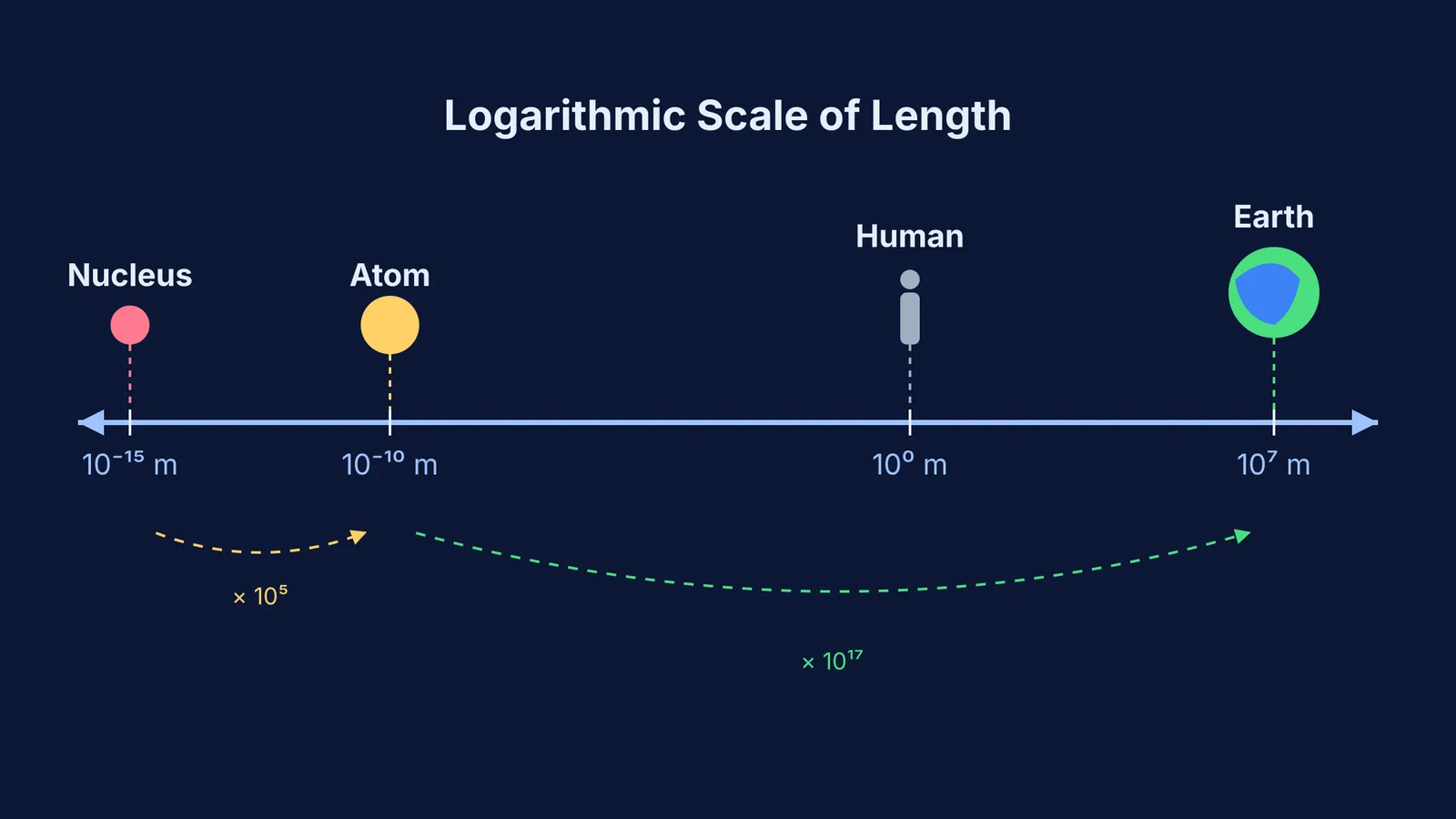
Size of an atomic nucleus: The diameter of a single hydrogen nucleus (a proton) is roughly 1.7 × 10⁻¹⁵ m (Wikipedia). Since 1.7 is less than 3.16 (and less than 5), we keep the current exponent. The order of magnitude is simply 10⁻¹⁵ m.
Size of an atom: A typical atom has a diameter of about 100 picometers, or 1 × 10⁻¹⁰ m (Wikipedia). The multiplier is exactly 1, so the order of magnitude is clearly 10⁻¹⁰ m.
If we compare the atom and the nucleus, the ratio is 10⁻¹⁰ / 10⁻¹⁵ = 10⁵. The atom is a hundred thousand times larger than the tiny nucleus at its centre. (To see how early chemists first worked out such tiny dimensions, read about Josef Loschmidt and the first estimate of molecule size).
Radius of the Earth: Earth's mean radius is 6,371,000 m, which becomes 6.371 × 10⁶ m in standard scientific notation (Wikipedia). Because 6.371 is strictly greater than both 3.16 and 5, we round up the exponent by adding 1. The correct order of magnitude for the Earth's radius is therefore 10⁷ m.
When converting a quantity between unit systems using dimensions, verifying your final answers using an order of magnitude estimate is one of the most reliable ways to catch arithmetic errors.
If you get stuck trying to picture exactly how these physical scales relate to formulas, Fermi's AI tutor can work out what you already know and build a plan to teach you estimation step by step. You can also dive into the Fermi Concept Library, which houses every concept in physics and chemistry, to explore the mathematical scales of the microscopic and macroscopic world.


