

On this page
Why does a closed pipe have only odd harmonics?
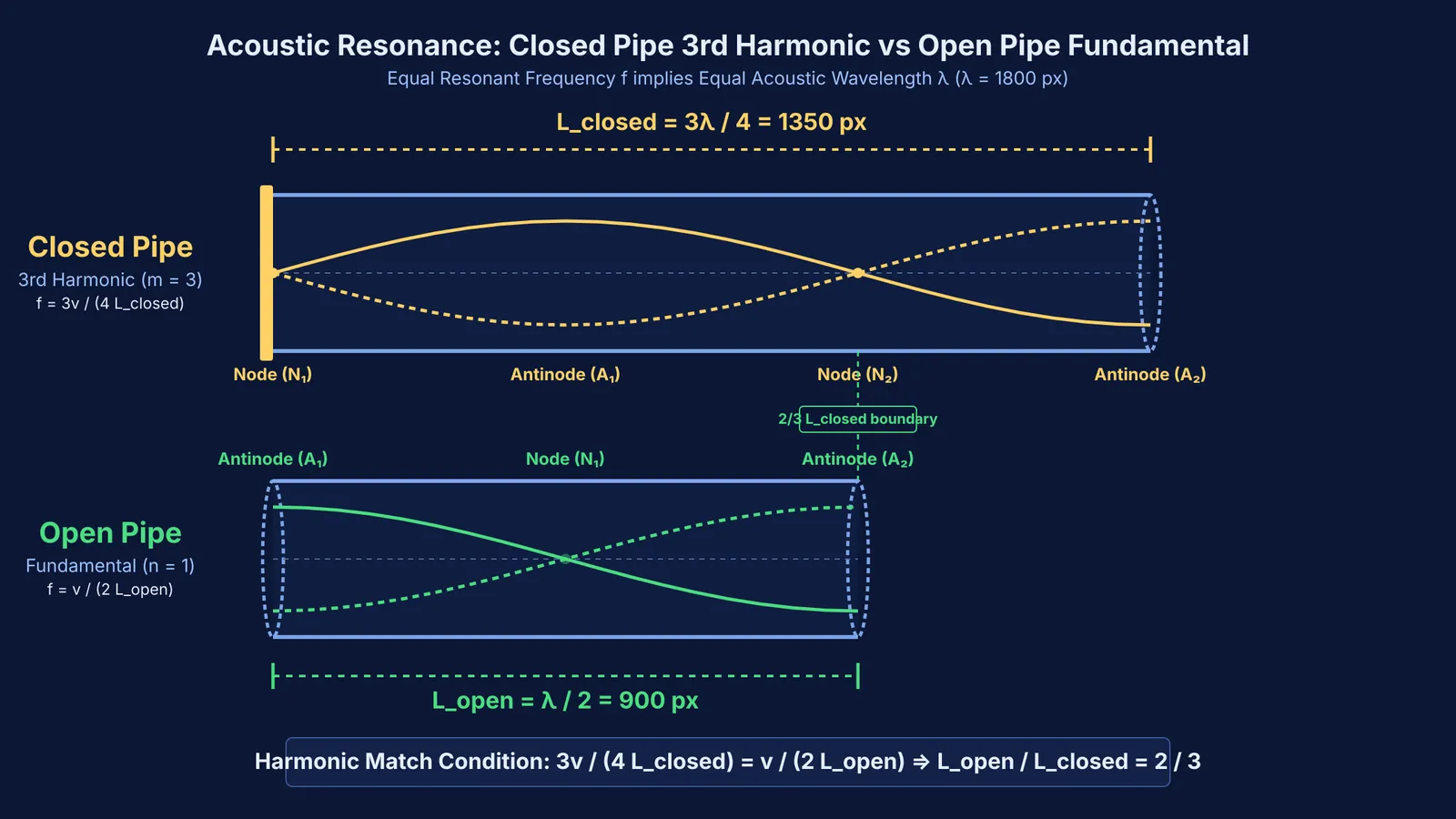
When sound reflects inside an organ pipe, boundary conditions determine standing wave nodes. At a closed end, a rigid wall forces air particle velocity to zero, forming a displacement node (pressure antinode). At an open end, exposure to ambient air pressure permits maximum particle oscillation, forming a displacement antinode (pressure node), as outlined in OpenStax College Physics.
An open pipe of length L_open requires antinodes at both ends, accommodating an integer number of half-wavelengths: L_open = n(λ / 2), producing all harmonics f_n = nv / (2L_open) for n = 1, 2, 3, ...
A closed pipe of length L_closed requires a displacement node at the base and an antinode at the mouth, accommodating an odd number of quarter-wavelengths: L_closed = (2m − 1)(λ / 4). Its resonant frequencies are f_m = (2m − 1)v / (4L_closed) for m = 1, 2, 3, ... Even harmonics cannot form because they cannot satisfy these opposite boundary conditions. Research in *Physical Review Special Topics - Physics Education Research* (Zeng et al., 2014) notes that students often confuse longitudinal air modes with transverse string waves, obscuring the phase relations explained in displacement and pressure waves in sound.
Closed pipe third harmonic equals open pipe fundamental: how do you find the ratio?
When an entrance examination problem states that a closed pipe third harmonic equals open pipe fundamental frequency, as catalogued by the National Testing Agency, you equate their frequency formulas: f_closed,3 = 3v / (4L_closed) f_open,1 = v / (2L_open)
Because both pipes resonate in identical air, sound speed v cancels: 3v / (4L_closed) = v / (2L_open) 3 / (4L_closed) = 1 / (2L_open) 6L_open = 4L_closed L_open / L_closed = 4 / 6 = 2 / 3
The open pipe must be two-thirds (66.7%) the length of the closed pipe (L_closed = 1.5 L_open).
In NEET 2018, candidates were asked for the length of an open pipe whose fundamental frequency equalled the third harmonic of a 20 cm closed pipe. Substituting L_closed = 20 cm gives L_open = (2/3) × 20 cm = 13.33 cm (reported as 13.2 cm in the official key).
What is the difference between an overtone and a harmonic in organ pipes?
As outlined in OpenStax College Physics, confusing overtones with harmonics is a common trap in entrance tests like JEE Main and NEET:
Harmonic: Any integer multiple of the fundamental frequency f₁.
Overtone: Any resonant frequency above the fundamental, numbered in ascending order.
In an open pipe, all integer harmonics exist: the 1st overtone is the 2nd harmonic (2f₁), and the p-th overtone is the (p + 1)-th harmonic.
In a closed pipe, even harmonics are absent:
Fundamental = 1st harmonic (f₁)
1st overtone = 3rd harmonic (3f₁)
2nd overtone = 5th harmonic (5f₁)
p-th overtone = (2p + 1)-th harmonic
In NEET 2016 Phase II (NTA NEET), a problem asked for the length of an open pipe whose second overtone matched the first overtone of a closed pipe of length L. The open pipe's 2nd overtone is its 3rd harmonic (3v / 2L_open), and the closed pipe's 1st overtone is its 3rd harmonic (3v / 4L). Equating them gives 3v / (2L_open) = 3v / (4L), which simplifies to L_open = 2L. Confusing the 2nd overtone with a 2nd harmonic leads to the wrong answer of L.
A broader comparison is available in our guide to standing waves in strings and organ pipes. For step-by-step guidance on multi-harmonic problems, the Fermi Problem Library provides worked problems with a step-by-step solver that explains the reasoning rather than printing an answer.
How do end corrections alter the physical length ratio?
In real pipes, vibrating air extends slightly beyond the open end, placing the displacement antinode an acoustic distance e ≈ 0.6r outside the tube, where r is internal radius (Underfer, 1966):
Closed pipe (one open end): L_closed,eff = L_closed + 0.6r
Open pipe (two open ends): L_open,eff = L_open + 1.2r
Equating acoustic frequencies requires L_open,eff = (2 / 3) L_closed,eff: L_open + 1.2r = (2 / 3)(L_closed + 0.6r) L_open = (2 / 3)L_closed − 0.8r
Accounting for radius proves that the physical open pipe must be slightly shorter than two-thirds of the closed pipe. In practical setups like the resonance tube experiment, neglecting this 0.8r offset distorts sound velocity calculations.
How can you solve harmonic matching questions systematically?
To solve pipe matching problems consistently, apply this four-step checklist based on acoustic resonance principles (OpenStax):
Identify boundary conditions: Determine whether each tube is open at both ends (open-open) or closed at one end (closed-open).
Convert overtones to harmonics: Identify harmonic index m for the closed pipe (odd integers only: 1, 3, 5) and n for the open pipe (1, 2, 3).
Equate frequencies: Set mv / (4L_closed) = nv / (2L_open) and cancel sound speed v.
Isolate lengths: Simplify to L_closed / L_open = m / (2n), then solve for the unknown length.
To see boundary conditions in action, the Fermi Simulation Lab offers interactive simulations for ideas that are easier to see than to read. To review acoustic resonances in the wider curriculum, the Fermi Concept Library maps every concept in physics, chemistry, biology, mathematics and computing, each with its own lesson and its place in the map.


