

On this page
When you boil water, store hot coffee, or run an engine, you are dealing with thermodynamic systems. In physical science, a thermodynamic system is the specific part of the universe you are studying, separated from its surroundings by a defined boundary.
Everything outside that boundary is considered the surroundings. Thermodynamics classifies systems into three distinct types based entirely on whether mass and energy can cross this boundary. Knowing which category your experiment falls into is the first step in applying the laws of thermodynamics correctly.
What are open systems?
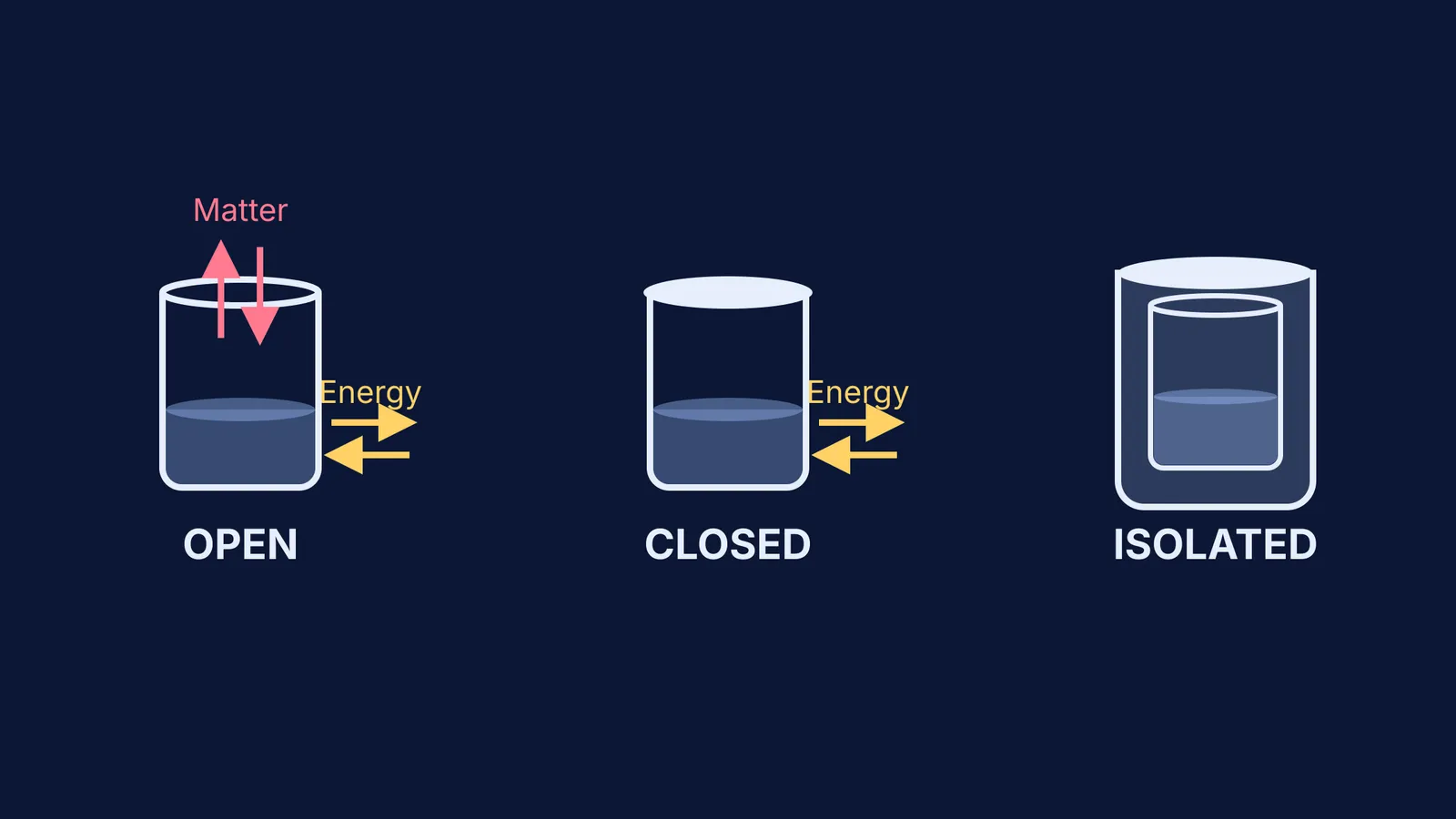
An open system can interact with its surroundings by freely exchanging both matter and energy.
The most common example is an open beaker of hot water. As the water sits on the desk, it loses energy (heat radiates away) and it loses matter (liquid water evaporates into the air). If you add an ice cube, you are again transferring both matter and energy into the system.
Open systems are common in nature and engineering. The human body is an open system: we constantly take in matter (food and oxygen) and energy, and we release heat and expel waste into our surroundings. Mechanical devices like turbines and jet engines also operate as open systems because fluid flows in and out while they perform work.
What are closed systems?
A closed system can exchange energy (in the form of heat and work) with its surroundings, but it cannot exchange matter. The total mass inside a closed system remains exactly constant throughout the process.
If you place a tight, impermeable stopper on that beaker of hot water, you have created a closed system. The water vapour can no longer escape into the air, meaning no mass is lost. However, the glass walls of the beaker still conduct heat, so the water will eventually cool down to room temperature.
A sealed cylinder fitted with a moving piston is another standard example of a closed system. The gas inside cannot escape, but you can heat the cylinder from the outside, or you can compress the piston to do mechanical work on the gas. You use this exact model when calculating the work in irreversible expansion of a gas. Another everyday example is a closed pressure cooker: it heats up and builds pressure, but as long as the safety valve does not release steam, the mass inside stays constant.
What are isolated systems?
An isolated system does not exchange matter or energy with its surroundings in any way.
If you pour your hot water into a high-quality thermos flask and seal it completely shut, it becomes an isolated system. The sealed lid stops any matter from escaping, and the internal vacuum insulation prevents heat from entering or leaving via conduction or convection.
In strict reality, no system on Earth is perfectly isolated because some transfer is always possible through gravity or background radiation. However, a good vacuum flask or a bomb calorimeter is an excellent approximation, and we treat them as perfectly isolated systems for most chemistry and physics calculations.
In theoretical physics, the universe as a whole is considered the only truly isolated system, because there is nothing outside of it to interact with. Complete isolation is also assumed in specific thought experiments, such as the free expansion of an ideal gas, where a gas expands into a vacuum within a rigid, thermally insulated container. In an isolated system, the total energy is always strictly conserved, which makes calculating final temperatures much simpler.
How do you use this in your studies?
When you solve a thermodynamic problem or start converting PV, PT and VT graphs, identifying the system type must be your first step. If you misidentify the system, you will likely apply the wrong conservation law.
You can figure out the system type by running through a quick mental checklist:
Check for mass flow: Is a gas or liquid entering or leaving the container? Does the problem mention a tap, a leak, or adding a solid reagent? If yes, it is an open system.
Check for heat flow: Does the problem state that the container is "insulated", "adiabatic", or a "calorimeter"? If it is perfectly insulated and sealed, it is an isolated system.
Check for work: Is it a sealed container but with moving parts (like a piston) or made of heat-conducting material (like thin metal)? If it is sealed but can be heated or compressed, it is a closed system.
If you have concept gaps when setting up the boundary for a complex problem, the Fermi Concept Library has every concept in physics, chemistry, biology, mathematics and computing, each with its own lesson and its place in the map. Knowing the system type immediately tells you how to apply the First Law of Thermodynamics: in an isolated system, the change in internal energy is always zero.


