

On this page
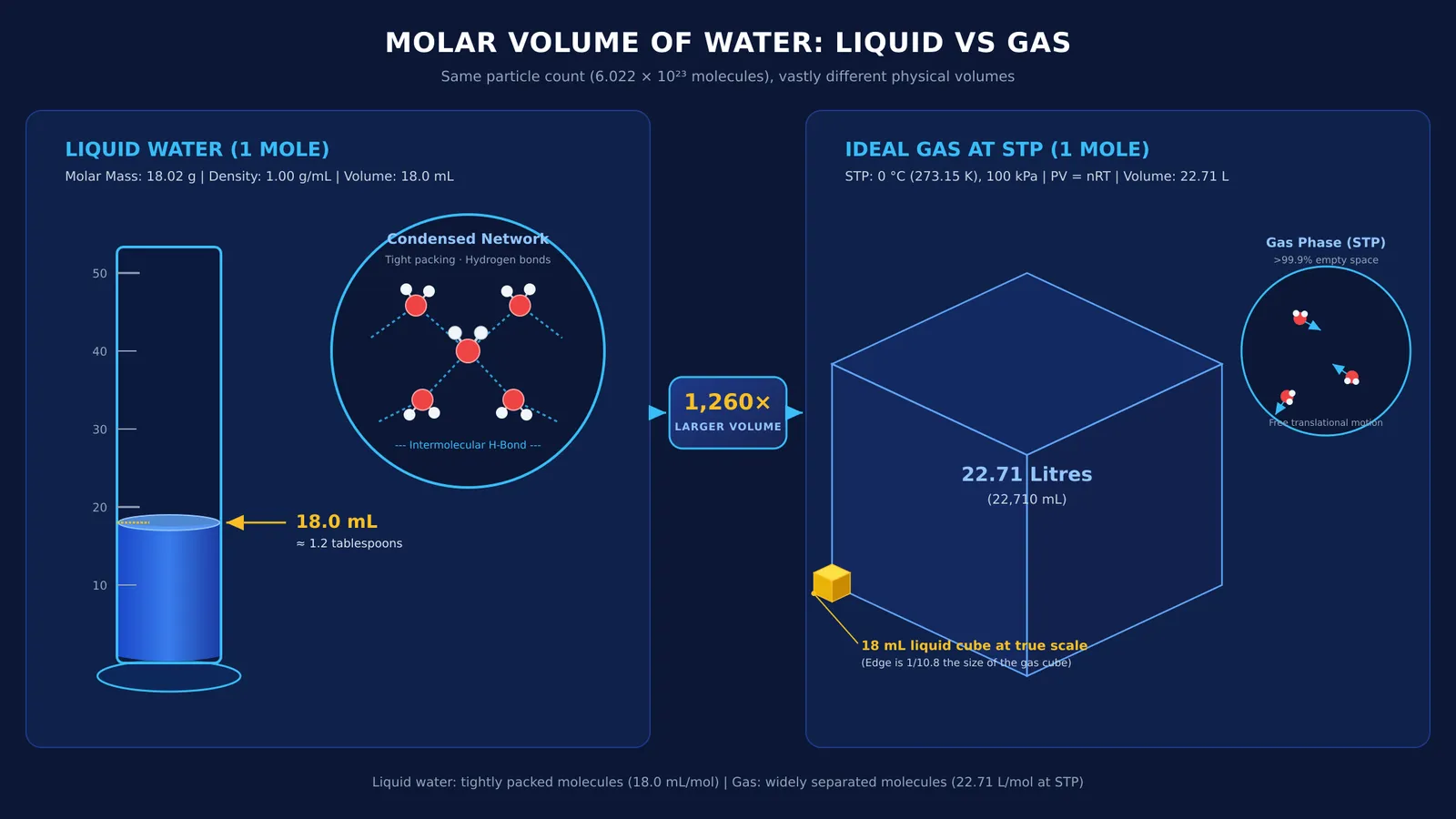
Avogadro's number is notoriously difficult to picture. One mole represents exactly 6.02214076 × 10²³ elementary entities, a universal constant defined by the International Bureau of Weights and Measures (BIPM). If you counted that many grains of sand, they would blanket entire continents meters deep. Yet if you measure out one mole of pure liquid water, it does not fill a flask or even a drinking glass. It measures just 18 millilitres—barely enough to cover the bottom of a small teacup.
For chemistry students, this often causes confusion. After memorising that one mole of gas occupies 22.7 litres at standard conditions according to NIST CODATA, pouring a single tablespoon of liquid and calling it "one mole" feels contradictory. Understanding why one mole of water is only 18 mL reveals the fundamental divide between liquids and gases.
Why is one mole of water only 18 mL?
The answer comes down to water's molar mass and density. A water molecule (H₂O) consists of two hydrogen atoms bonded to one oxygen atom. According to the Commission on Isotopic Abundances and Atomic Weights (CIAAW), hydrogen has an atomic weight of 1.008 and oxygen has an atomic weight of 15.999. Adding these yields a molar mass of 18.015 grams per mole, standard data catalogued by the NIST Chemistry WebBook and taught in Chapter 1 of NCERT Class 11 Chemistry.
To find how much space 18.02 grams of water occupy, we apply the density formula: volume equals mass divided by density (V = m / ρ). At 4 °C (277.15 K), liquid water reaches its maximum density of 1.000 gram per millilitre, while at 25 °C its density is 0.997 gram per millilitre. Dividing 18.015 grams by 1.000 gram per millilitre gives 18.02 mL at 4 °C (and 18.07 mL at 25 °C). That is roughly 1.2 standard tablespoons.
Why doesn't the 22.7-litre gas rule apply to liquid water?
The most common trap in stoichiometry is applying the gaseous molar volume to liquids. Under standard temperature and pressure (STP: 0 °C and 100 kPa), one mole of an ideal gas occupies 22.71 litres, as documented in the NIST CODATA recommended values (or 22.41 litres under 1 atmosphere, explained in our guide on molar volume at STP: when to use 22.7 L and when 22.4 L).
This 22.7-litre volume is governed by the ideal gas law (PV = nRT). Gas molecules are separated by vast empty spaces, with the physical volume of the molecules themselves accounting for less than 0.1% of the total gas volume. In liquid water, extensive hydrogen bonding pulls molecules into close physical contact in a condensed network. Liquid volume is determined by the intrinsic size and tight packing of 6.022 × 10²³ molecules touching one another, rather than empty space between them. Dividing 22,710 mL by 18.0 mL shows that an ideal gas at STP takes up over 1,260 times more volume than liquid water. Mixing up these states is among the top mole concept errors that cost marks.
What happens to the volume when 18 mL of water boils?
When liquid water boils into steam at 100 °C (373.15 K) and standard atmospheric pressure (101.325 kPa), the hydrogen-bonded network breaks apart. Data from the NIST Chemistry WebBook shows that once water enters the vapour phase, its molecules behave nearly like an ideal gas.
Using PV = nRT for 1.0 mole of steam at 373.15 K and 101.325 kPa yields a volume of approximately 30.6 litres. That 18 mL sip of liquid expands into more than 30,000 mL of steam—an expansion of roughly 1,700 times. This dramatic expansion drove steam engines during the industrial revolution, and it explains why heating water in a sealed container creates dangerous pressure.
How do you calculate moles in liquid volumes?
To solve mixed-phase problems accurately in school and entrance exams, use this three-step routine:
Check the physical state: Verify whether the reactant is a gas, liquid, or solid at the stated temperature and pressure.
Select the conversion path: If it is a gas at STP, divide volume by 22.7 L (or 22.4 L under 1 atm). If it is a liquid or solid, never divide by 22.7 L; multiply volume by density (m = V × ρ) to find mass.
Compute moles from mass: Divide mass by molar mass using n = m / M, as detailed in NCERT Class 11 Chemistry.
For example, to find moles in 90 mL of liquid water:
Mass = 90 mL × 1.00 g/mL = 90 g.
Moles = 90 g / 18.02 g/mol = 5.0 moles.
If the problem instead specified 90 mL of water vapour at STP, the amount would be 0.090 L / 22.71 L/mol ≈ 0.00396 moles—over 1,200 times fewer molecules. Mastering these distinctions prevents errors in molarity, molality and mole fraction problems.
When tackling multi-step calculations, the Fermi Problem Library provides worked problems with a step-by-step solver that explains the reasoning rather than printing an answer. If you want to review the underlying theory, the Fermi Concept Library covers every concept in physics, chemistry, biology, mathematics and computing, each with its own lesson and its place in the map. For visualizing how molecular packing shifts between phases, the Fermi Simulation Lab provides interactive simulations for ideas that are easier to see than to read.


