

On this page
When you face a complex algebra or logic question asking if a sum or product can be odd, calculating the exact value wastes valuable time. Instead, you can use parity rules—the mathematical properties that determine whether an integer is even or odd.
By applying a few simple rules, you can eliminate wrong answers in seconds. This approach shifts you from grinding through calculations to thinking structurally about the problem. It is a critical skill for exams where speed and precision are required.
What are the parity rules for sums?
Parity is the property of an integer indicating whether it is even or odd (Wikipedia: Parity (mathematics))).
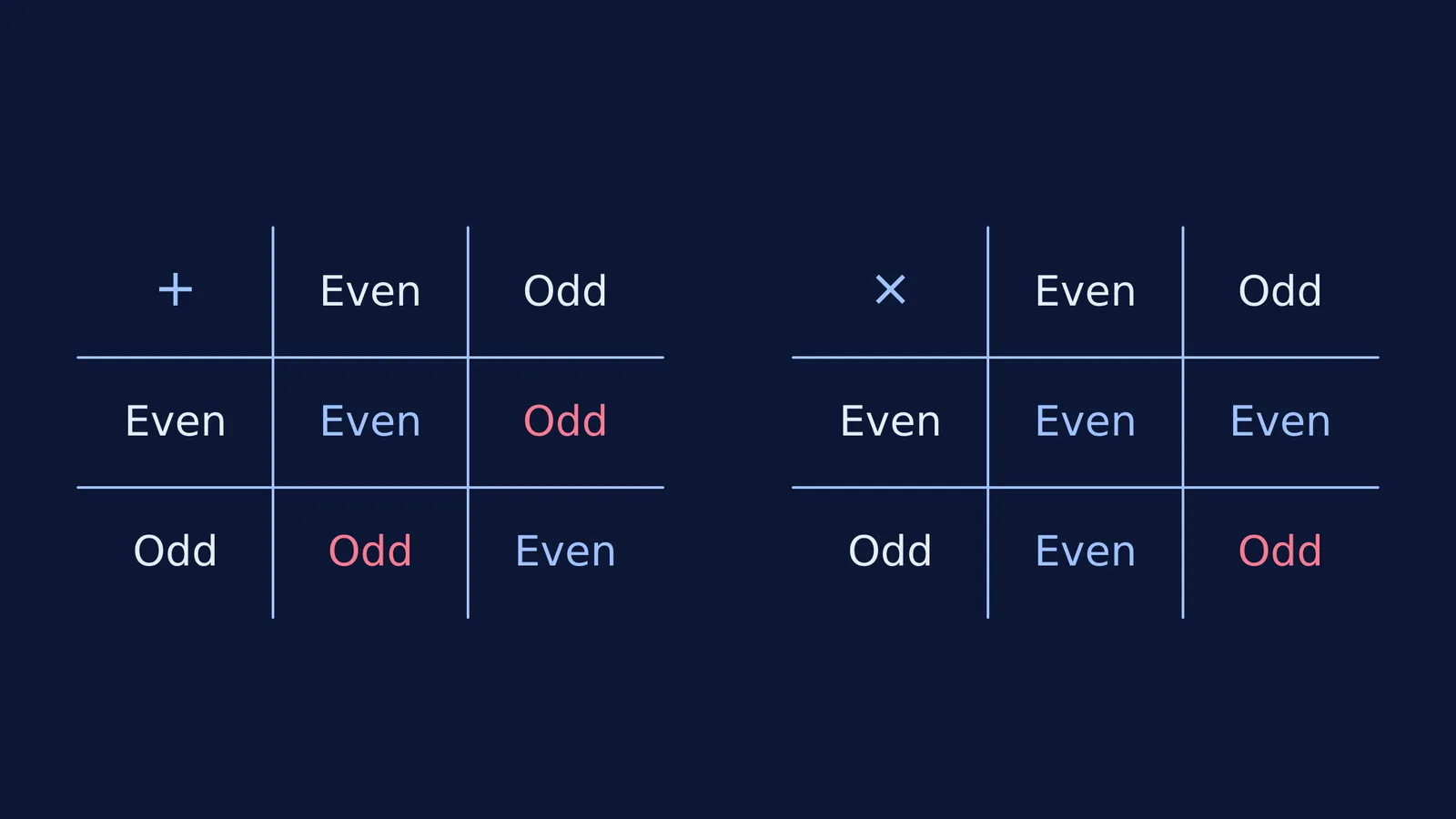
When adding or subtracting integers, the results follow strict patterns:
Even + Even = Even
Odd + Odd = Even
Even + Odd = Odd
Because subtraction is identical to addition in modulo 2 arithmetic, these exact same rules apply when you subtract one integer from another. If you add three odd numbers together, the first two make an even sum, and adding the third makes the final total odd.
This simple logic scales up effortlessly. If you are adding fifty integers together, you do not need to perform fifty additions. You only need to count the number of odd integers in the list. If you have an even count of odd numbers, the sum is even. If you have an odd count of odd numbers, the final sum is odd. The even numbers in the list can simply be ignored because adding an even number never changes the parity of the current total.
What are the parity rules for products?
Multiplication follows its own set of rules, driven by the presence of the number 2 as a factor. Because an even number is defined as any integer that is a multiple of 2, introducing an even number into a multiplication injects that factor of 2 into the final result.
Even × Even = Even
Even × Odd = Even
Odd × Odd = Odd
Notice that the only way to get an odd product is to multiply odd numbers together. If even a single even number is introduced into a string of multiplications, the entire product immediately becomes even. You could multiply a hundred odd numbers together, and the result would be odd. But the moment you multiply that massive odd result by 2, the final product is instantly even.
How do powers and exponents work with parity?
Another common scenario in math problems is exponentiation. When you raise an integer to a positive power, you are simply multiplying that integer by itself repeatedly.
Because an even number multiplied by anything is even, raising an even number to any positive power will always result in an even number. Similarly, because an odd number multiplied by another odd number is always odd, raising an odd number to any positive power will always result in an odd number. This means that x raised to a positive integer power n always has the exact same parity as the base x itself.
How can parity answer "can the total be odd?"
These rules are powerful tools in competitive exams and logic puzzles. A classic application is the mutilated chessboard problem, proposed by Max Black in 1946, which asks if you can cover a chessboard missing two opposite corners with dominoes (Wikipedia: Mutilated chessboard problem). By realizing that each domino must cover exactly one black (even) and one white (odd) square, and that removing opposite corners leaves unequal parities, you can prove it is impossible without testing a single domino arrangement.
When you encounter an exam question asking "Can the total be odd?", use this framework:
Count the odd terms: In a sum, the even terms do not change the final parity. Ignore them completely.
Check the odds: If there is an odd number of odd terms, the sum is odd. If there is an even number of odd terms, the sum is even.
Scan for even factors: In a product, look for any even multiplier. If you spot one, the entire product is even.
Simplify exponents: Treat any base raised to a power as having the same parity as its base.
For example, if a question asks whether x² + 3x + 5 is odd when x is an integer, you can test both parities. If x is even, x² is even and 3x is even, so Even + Even + Odd = Odd. If x is odd, x² is odd and 3x is odd, so Odd + Odd + Odd = Odd. The total is always odd.
When practicing these shortcuts, the Fermi Problem Library provides worked problems with a step-by-step solver that explains the reasoning rather than printing an answer. Rather than letting you get stuck on brute-force calculations, Fermi's AI tutor works out what you already know, builds a plan for the session, and teaches through it—guiding you to use structural rules like parity to reach the solution faster.


