

On this page
Finding the roots of a cubic equation f(x) = ax³ + bx² + cx + d = 0 is a standard problem in higher mathematics. While you can often guess a root and factorise the polynomial, this method fails if the roots are irrational. When an exam question asks only for the *number* of real roots, rather than their exact values, you can save time by checking the turning points of the curve using calculus.
Before relying on memorised formulas, exploring the shape of polynomial graphs in the Fermi Concept Library can help you see why the roots behave this way.
How does the derivative find the turning points?
The first derivative of a cubic is a quadratic function: f'(x) = 3ax² + 2bx + c. Setting this derivative to zero gives the critical points, which are the x-coordinates where the curve turns (the local maximum and local minimum).
Because the derivative is a quadratic, you can check its discriminant, Δ = 4b² − 12ac, to see if these turning points actually exist.
If Δ ≤ 0, the derivative has at most one real root. This means the original curve never changes direction; it is strictly increasing or strictly decreasing everywhere. Since a cubic function always stretches from negative infinity to positive infinity, a curve without turning points must cross the x-axis exactly once. A cubic equation in this category always has exactly one real root.
What if the derivative has two roots?
If Δ > 0, the derivative has two distinct real roots. These are the x-coordinates of the local maximum and the local minimum. Let us call them x1 and x2.
To find out how many times the curve crosses the x-axis, you must plug x1 and x2 back into the original cubic equation to find their y-values: y1 = f(x1) and y2 = f(x2). The product of these two y-values reveals the number of real roots:
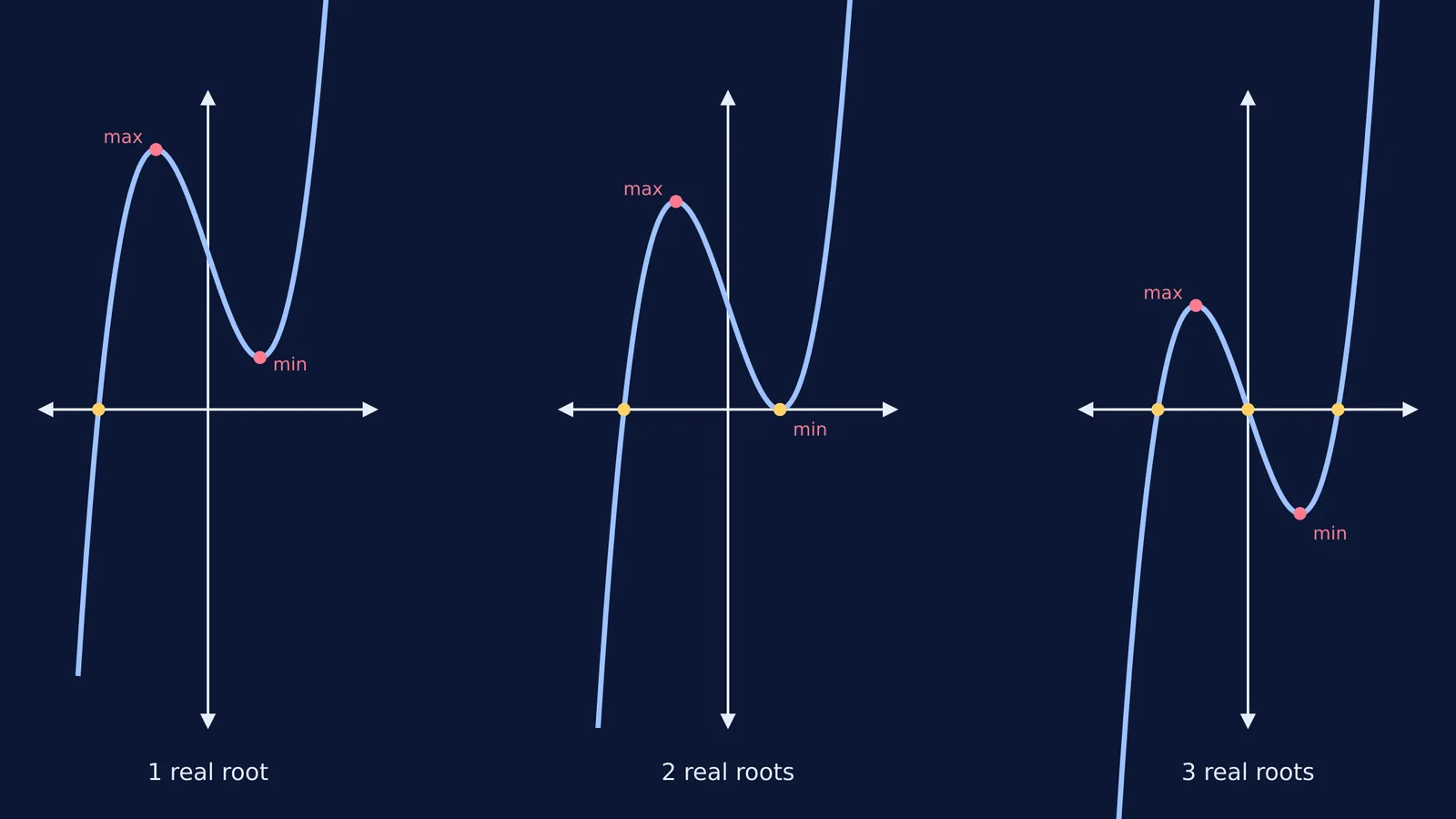
Three real roots: If y1 × y2 < 0, the local maximum and local minimum have opposite signs. One turning point is above the x-axis and the other is below it, so the continuous curve must cross the axis three times to connect them.
One real root: If y1 × y2 > 0, both turning points are on the same side of the x-axis. The curve turns around before it can reach the axis, so it only crosses once.
Two real roots: If y1 × y2 = 0, one of the turning points lies exactly on the x-axis. This gives one simple root and one double root.
If you are unsure why a specific curve turns where it does, Fermi's AI tutor holds a line of reasoning across a session, noticing where you are stuck and drawing the figure to check your understanding as it goes.
What does this mean geometrically?
When you draw a cubic curve on a graph, it usually takes the shape of an 'S' that has been stretched out vertically. If the 'S' shape is pulled tight enough that it never folds back on itself, the derivative has no real roots, and the function simply crosses the horizontal axis once.
However, when the 'S' shape folds into two distinct bends, those bends form the local maximum and minimum. The horizontal axis is a straight line at y = 0. If both bends sit above this line, the curve drops down to the minimum but turns back upwards before it can break through the surface. It must then cross the axis just once on its way up from negative infinity. The same logic applies if both bends are trapped below the line. It is only when the maximum is above the line and the minimum is below it that the curve is forced to punch through the axis three times.
You can visualise this by shifting a cubic graph up and down. Moving the graph vertically changes the constant term (d), which alters the positions of the turning points relative to the x-axis without changing the shape of the bends.
A worked example: how many roots does x³ − 3x + 1 = 0 have?
You cannot easily guess a rational root for f(x) = x³ − 3x + 1. Instead, apply the derivative test to classify the roots quickly:
Differentiate: f'(x) = 3x² − 3.
Find the critical points: Set 3x² − 3 = 0. This gives x = 1 and x = −1.
Find the y-values at these points:
For x = 1, f(1) = 1³ − 3(1) + 1 = −1. For x = −1, f(−1) = (−1)³ − 3(−1) + 1 = 3.
Multiply the y-values: 3 × (−1) = −3.
Because the product is negative, the local maximum is above the x-axis and the local minimum is below it. Without solving the full equation algebraically, we know it has exactly three distinct real roots.
When to use this on an exam?
Calculus is the fastest way to classify the roots of a high-degree polynomial when algebraic factorisation is a dead end. Questions asking for the "number of real solutions" are a strong hint to look at the shape of the function rather than calculating exact numerical values.
For more ways to map out equations visually, read about counting intersections of two sketched curves or review the applications of derivatives: maxima, minima and rates of change. If you want to know how sixteenth-century mathematicians originally solved these equations without calculus, see the story of Niccolò Tartaglia and the cubic rule he hid in a poem.


