

On this page
Proteins and peptides are chains of amino acids linked by peptide bonds. In exams like NEET and JEE, counting the number of possible sequences is a common question that bridges biology and combinatorics. The number of possible peptides depends on whether you have a limited set of amino acids and whether they can repeat.
Why does a dipeptide from glycine and alanine have two forms?
When two amino acids join, they form a dipeptide and release a water molecule. A dipeptide formed from glycine and alanine can be either glycylalanine (Gly-Ala) or alanylglycine (Ala-Gly) (NCERT Class 12 Chemistry).
This happens because the peptide bond is directional. It forms between the carboxyl group (–COOH) of one amino acid and the amino group (–NH₂) of the next. In Gly-Ala, glycine provides the free amino end (the N-terminus) and alanine provides the free carboxyl end (the C-terminus). In Ala-Gly, the roles are reversed. Even though they contain the same building blocks, they are distinct molecules with different chemical and biological properties.
In nature, cellular machinery always reads and builds these chains from the N-terminus to the C-terminus. You can read more about drawing these structures in our guide to peptide bonds and dipeptide naming.
How many tripeptides can be formed from three amino acids?
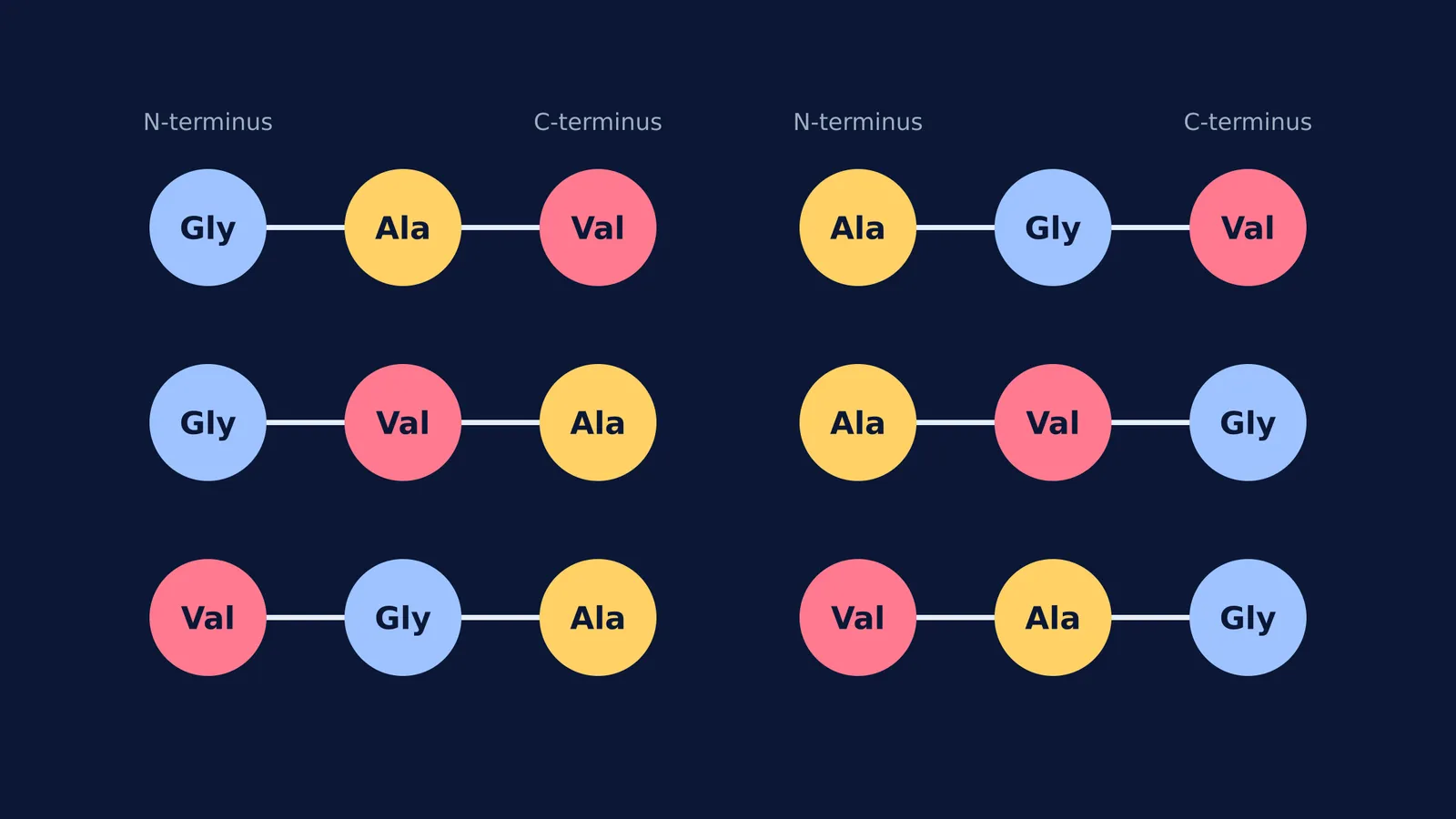
A tripeptide contains three amino acids joined by two peptide linkages. If you are given exactly three distinct amino acids—such as glycine, alanine and valine—and must use each one exactly once, this is a permutation problem.
You have 3 choices for the first position, 2 choices for the second, and 1 choice for the third. That gives 3 × 2 × 1 = 6 possible tripeptides (LibreTexts/18%3A_Amino_Acids_Proteins_and_Enzymes/18.02%3A_Peptides)).
The six sequences are Gly-Ala-Val, Gly-Val-Ala, Ala-Gly-Val, Ala-Val-Gly, Val-Gly-Ala, and Val-Ala-Gly. They are all chemically unique because of the N-to-C directionality. For example, Gly-Ala-Val and Val-Ala-Gly are completely different molecules, much like how the words "ACT" and "CAT" have different meanings despite using the same letters.
How many tripeptides are possible if amino acids can repeat?
If the question asks how many tripeptides can be formed from a specific set of amino acids where repeats are allowed, the maths changes. This is similar to solving probability problems with replacement.
Instead of counting down your choices, you have the same number of choices for every position in the chain. If you can choose any of the 20 standard amino acids for each spot in a tripeptide, you have 20 choices for the first, 20 for the second, and 20 for the third. This means there are 20 × 20 × 20 = 8,000 possible tripeptides in nature (LibreTexts/18%3A_Amino_Acids_Proteins_and_Enzymes/18.02%3A_Peptides)).
If you only have three types of amino acids available but can repeat them, you might create a chain like Gly-Gly-Ala or Val-Val-Val. In this case, you have 3 choices for the first spot, 3 for the second, and 3 for the third, making the total number of sequences 3 × 3 × 3 = 27.
What happens when the peptide chain gets longer?
As the number of amino acids in a chain increases, the number of possible sequences grows exponentially. For a tetrapeptide (four amino acids), drawing from the 20 standard amino acids gives 20⁴ = 160,000 possible sequences (LibreTexts/18%3A_Amino_Acids_Proteins_and_Enzymes/18.02%3A_Peptides)).
Most functional proteins in the human body are much longer, often containing hundreds or even thousands of amino acids. A small protein of just 100 amino acids has 20¹⁰⁰ possible sequences. This vast combinatorial space explains how biological systems can create an enormous diversity of proteins, each folded into a highly specific shape to perform a unique job, using just a small alphabet of 20 building blocks.
Learning biochemistry with Fermi
Counting sequences and understanding permutations is just the start of making sense of biomolecules. If you are struggling with the structures of amino acids, the stereochemistry of chiral centres, or the mechanisms of peptide bond formation, the Fermi Concept Library holds interactive explanations for the entire chemistry syllabus.
When you work through a sequence problem or balance a chemical equation, Fermi's AI tutor can check your reasoning step by step. It asks questions to ensure you grasp the underlying principles—like the difference between permutations and exponents—before moving on to the next topic, so you are ready for whatever the exam throws at you.


