

On this page
A Punnett square is fine for one or two genes. With three it becomes an 8 × 8 grid of 64 boxes, and one copying slip ruins the answer. Multi-gene questions need three short rules instead, plus the habit of treating each gene separately.
All three rules depend on Mendel's law of independent assortment, which OpenStax Biology 2e states as: genes do not influence each other with regard to the sorting of alleles into gametes.
How many types of gametes does a trihybrid produce?
The number of different gametes is 2ⁿ, where n is the number of heterozygous gene pairs (OpenStax Biology 2e, section 12.3).
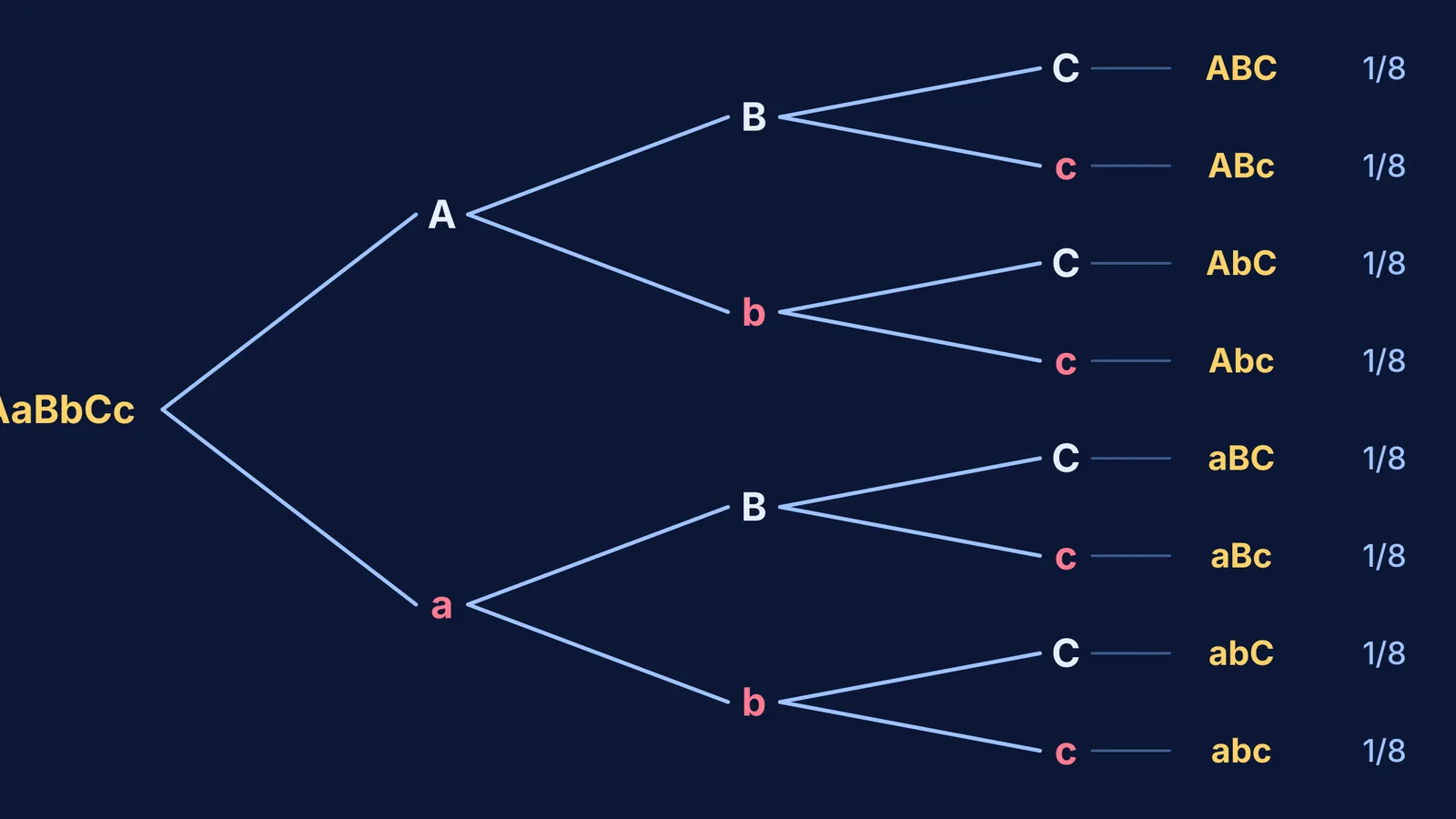
A trihybrid, AaBbCc, has three heterozygous pairs, so it makes 2³ = 8 types of gametes. Each gamete gets one allele of every gene, and each gene splits 1/2 and 1/2, so each type has a probability of (1/2)³ = 1/8:
ABC, ABc, AbC, Abc
aBC, aBc, abC, abc
Count only the heterozygous pairs. AaBBCc has two of them (Aa and Cc), so it makes 2² = 4 types of gametes: ABC, ABc, aBC and aBc. AABBCC makes only one type. Counting genes instead of heterozygous pairs is a common trap here.
How many genotypes and phenotypes does a trihybrid cross give?
When two individuals that are heterozygous for n genes are crossed, OpenStax gives the number of different offspring genotypes as 3ⁿ and, with dominant and recessive alleles, the number of different phenotypes as 2ⁿ (OpenStax Biology 2e).
For AaBbCc × AaBbCc:
Gamete types from each parent: 2³ = 8
Gamete combinations (boxes in the full square): 8 × 8 = 64
Different genotypes: 3³ = 27
Different phenotypes: 2³ = 8
The same section gives the trihybrid phenotypic ratio as 27:9:9:9:3:3:3:1, and notes that four genes would need a 16 × 16 grid of 256 boxes. Why 3ⁿ? Each gene alone gives three genotypes (AA, Aa, aa), and the genes combine freely, so 3 × 3 × 3 = 27.
How do you find the probability of a particular offspring?
Use the product rule: the probability of two or more independent events happening together is the product of their individual probabilities (LibreTexts, Probabilities in genetics/01%3A_Introduction_to_heredity/1.07%3A_Probabilities_in_genetics)). Because the genes assort independently, each one is a separate event.
Use the sum rule when one gene can give the result in more than one way. In the OpenStax example, the chance of AA is 1/4 and of Aa is 1/2, so the chance of AA or Aa, a dominant phenotype for that gene, is 1/4 + 1/2 = 3/4.
Worked example 1, a genotype: in AaBbCc × AaBbCc, what fraction of offspring are AaBBcc?
Aa × Aa gives Aa with probability 1/2.
Bb × Bb gives BB with probability 1/4.
Cc × Cc gives cc with probability 1/4.
Multiply: 1/2 × 1/4 × 1/4 = 1/32.
Worked example 2, a phenotype: in the same cross, what fraction show all three dominant traits? Each gene gives a dominant phenotype with probability 3/4, so the answer is (3/4)³ = 27/64. That is the 27 at the front of the 27:9:9:9:3:3:3:1 ratio, out of 64 boxes.
Worked example 3, unequal parents: in AaBbCc × aaBbCC, what fraction are aabbCc? Here 3ⁿ does not apply, but the product rule still does:
Aa × aa gives aa with probability 1/2.
Bb × Bb gives bb with probability 1/4.
Cc × CC gives Cc with probability 1/2.
Multiply: 1/2 × 1/4 × 1/2 = 1/16.
The product rule scales: in the LibreTexts five-gene example, AaBbCcDdEe × AaBbCcDdEe, each parent makes abcde gametes with probability (1/2)⁵ = 1/32, so aabbccddee is 1/32 × 1/32 = 1/1024.
A four-step check for any multi-gene question
Split the cross into one-gene crosses, written in a column.
For each gene, write the probability of the genotype or phenotype the question asks for. Add (sum rule) if there is more than one way to get it.
Multiply down the column (product rule).
Sanity-check: for simple crosses like these, is the denominator a power of 2? Is the answer between 0 and 1?
For the basic ratios and the traps around test crosses, see our guide to Punnett squares, ratios and traps in NEET genetics. The product rule itself is ordinary probability, covered in independent and mutually exclusive events.
To practise, solve a textbook cross with the four steps, then compare your working line by line. The Fermi Problem Library has worked problems with a step-by-step solver that explains the reasoning rather than printing an answer, so you can find the step where a count went wrong.


