

On this page
The nucleolus is the largest and most prominent structure inside the eukaryotic nucleus. It is often described as the cell's "ribosome factory" because its main job is to produce and assemble the subunits that make up ribosomes. Whether you are preparing for NEET or simply trying to untangle cell biology for your school exams, understanding what the nucleolus does—and how it manages this without a membrane—makes the complex process of protein synthesis much easier to follow.
What is the function of the nucleolus in a cell?
The nucleolus is the dedicated site of ribosome biogenesis. Ribosomes are the essential molecular machines that translate messenger RNA into proteins, and building them requires a massive, coordinated effort inside the nucleolus. This manufacturing process happens in three main stages:
Transcription of rRNA: An enzyme called RNA polymerase I transcribes ribosomal DNA (rDNA) into a long precursor molecule called pre-rRNA.
Processing: This long precursor RNA is chemically modified and cleaved into smaller, mature pieces (specifically the 18S, 5.8S, and 28S rRNAs in humans).
Assembly: Ribosomal proteins, which are synthesized out in the cytoplasm and imported into the nucleus, bind to these rRNA pieces. Together, they fold and assemble to form the large (60S) and small (40S) ribosomal subunits. These subunits then exit the nucleus and enter the cytoplasm to begin their work.
If you struggle to recall the different stages of RNA processing in eukaryotes, or if you forget what the three RNA polymerases in eukaryotes actually make, the Fermi Concept Library can help you map out the sequence. Instead of just giving you a textbook definition, Fermi's AI tutor walks you through the concepts step by step until the ideas click into place.
Why does the nucleolus have no membrane?
Unlike the nucleus or the mitochondria, the nucleolus is not wrapped in a lipid bilayer. For decades, biologists wondered how such a distinct structure could maintain its shape without a physical boundary. It turns out that the nucleolus is a biomolecular condensate formed through liquid-liquid phase separation, behaving much like oil droplets separating from water (Feric et al., 2016).
Not having a membrane provides the nucleolus with two major structural advantages:
Rapid exchange of materials: Ribosome synthesis requires a continuous, high-speed flow of raw materials. Nucleotides and ribosomal proteins must constantly enter the nucleolus, and fully assembled ribosomal subunits must constantly leave. A lipid membrane would act as a severe bottleneck, slowing down this exchange.
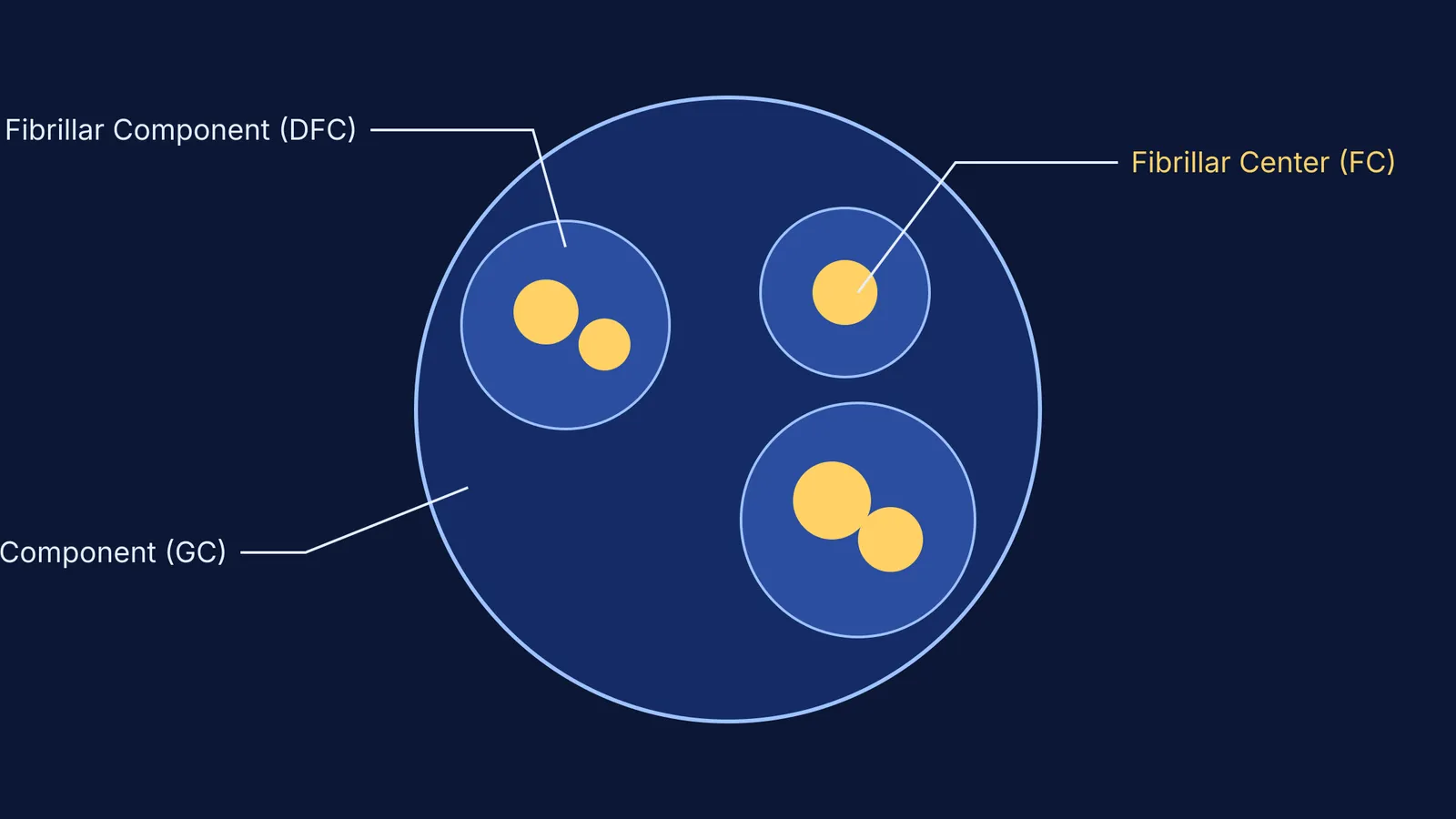
Dynamic subcompartments: The nucleolus is not just a uniform droplet. It has a nested architecture consisting of three coexisting liquid phases, each handling a different step of ribosome assembly (Feric et al., 2016). The innermost Fibrillar Center (FC) handles rDNA transcription, the Dense Fibrillar Component (DFC) manages pre-rRNA processing, and the outer Granular Component (GC) handles the final assembly of the subunits. This liquid-within-a-liquid structure keeps the assembly line organized without the need for physical walls.
Why do cells making lots of protein have larger nucleoli?
The size of a nucleolus is not a fixed trait; it is a direct, visible reflection of a cell's metabolic demand.
Ribosome synthesis is one of the most energy-intensive processes in biology. A cell that produces unusually large amounts of protein—such as a secretory cell in the pancreas, a muscle cell, or a rapidly dividing cancer cell—must manufacture a vast number of ribosomes to keep up with the workload. To meet this intense demand, the cell ramps up its rRNA transcription and imports more proteins for assembly. As these components accumulate, the nucleolar "droplet" physically expands.
Because of this direct relationship, pathologists actively use nucleolar size to measure the rapidity of cell proliferation in cancer tissues (Derenzini et al., 20001096-9896(200006)191:2%3C181::aid-path607%3E3.0.co;2-v)). An enlarged nucleolus, or the presence of multiple large nucleoli within a single nucleus, is a strong clinical indicator of a highly active cell that is dividing rapidly and demanding vast amounts of new protein.
By treating the nucleolus not just as a static dot on a diagram, but as a dynamic, phase-separated droplet that grows and shrinks with the cell's needs, the logic of cell biology becomes much easier to visualize. This active-learning approach—focusing on the why rather than just memorizing the what—is the most reliable way to master biology for competitive exams.


