

On this page
Every eukaryotic cell faces a fundamental logistical problem: it must keep its DNA protected in a central vault, yet continuously send out instructions and receive supplies. The solution is the nuclear envelope, a highly regulated boundary that separates the nucleus from the cytoplasm.
Far from being a simple wall, this boundary is a dynamic double membrane studded with thousands of sophisticated gates. These gates dictate exactly which molecules can enter to interact with your genes and which can leave to build the rest of the cell.
What is the nuclear envelope?
The nuclear envelope is a double-membrane system that encloses the nucleoplasm. It consists of two distinct lipid bilayers: the inner nuclear membrane and the outer nuclear membrane.
The outer membrane is continuous with the cell's endoplasmic reticulum and is often studded with ribosomes. The inner membrane, by contrast, associates with a meshwork of intermediate filaments called the nuclear lamina, which provides structural support to the nucleus. Separating these two layers is the perinuclear space, a fluid-filled gap that is typically 30–50 nm wide. Like cell membrane transport, the physical barrier of these lipid bilayers prevents most water-soluble molecules from crossing freely.
What is the structure of the nuclear pore complex?
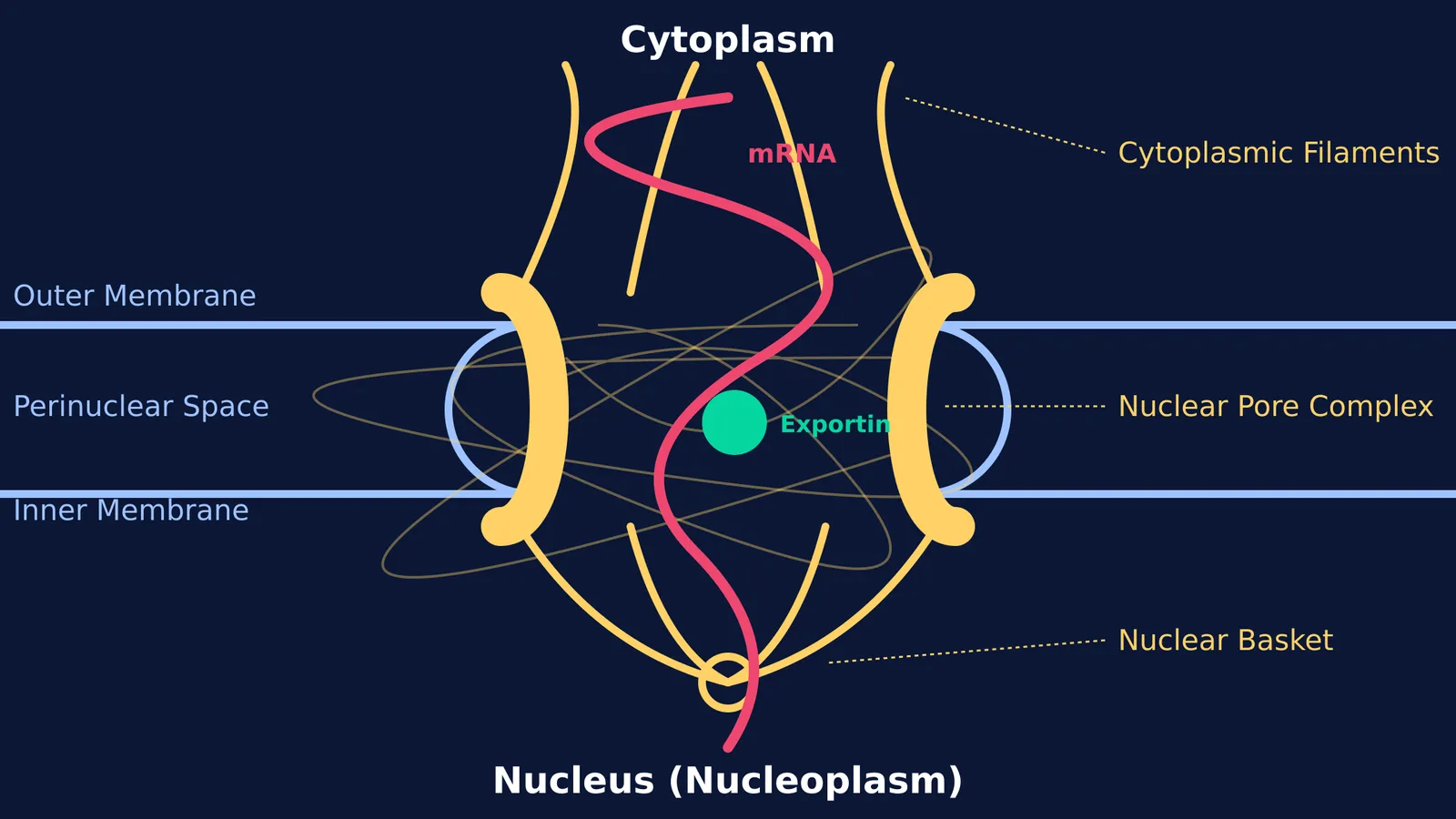
To allow essential traffic across this double membrane, the cell uses the nuclear pore complex (NPC). The NPC sits exactly where the inner and outer nuclear membranes fuse.
It is one of the largest protein assemblies in the cell. In humans, the nuclear pore complex has a mass of approximately 110 megadaltons (MDa) and is built from roughly 30 different types of proteins known as nucleoporins.
The NPC has a distinct eightfold radial symmetry. Its core scaffold forms a channel through the envelope, while specialized structures extend from both sides. On the cytoplasmic face, flexible filaments reach out to catch incoming cargo. On the nuclear side, filaments converge to form a structure known as the nuclear basket.
How do nuclear pores function in transport?
The primary role of the nuclear pore is to manage nucleocytoplasmic transport. Small molecules, such as ions and metabolites under 40 kDa, can pass through the central aqueous channel by passive diffusion.
However, large macromolecules require active transport. For example, three RNA polymerases in eukaryotes transcribe different types of RNA inside the nucleus. After RNA processing is complete, the mature messenger RNA (mRNA) must be actively exported to the cytoplasm to be translated into proteins.
This active transport relies on transport receptors called karyopherins (importins and exportins). The central channel of the pore is lined with specific nucleoporins that contain phenylalanine-glycine (FG) repeats. These FG repeats form a disordered, gel-like meshwork. Karyopherins bind to their cargo, interact with this FG meshwork, and effectively carry large molecules through the barrier without letting the pore permanently open.
How Fermi's AI tutor teaches cellular biology
Visualising a massive protein complex actively moving mRNA strands can be difficult from a textbook description alone. If you have concept gaps in cellular biology, the Fermi Concept Library can help.
Fermi works out what you already know and builds a plan for the session. The AI tutor teaches through it—drawing the figure, running the simulation, and checking understanding as it goes, so you sit down to a clear next step instead of a blank page.
A checklist for understanding nuclear transport
If you are studying university biology or revising for an exam, check that you can trace a molecule's path:
Identify the molecule's size (does it need passive diffusion or active transport?).
Name the transport receptor required (importin for entering, exportin for leaving).
Trace the path: through the cytoplasmic filaments, into the FG-repeat meshwork, and out through the nuclear basket.
Recall the energy source (the Ran-GTPase cycle drives the directionality of the movement).


