

On this page
Permutations and combinations are two of the most heavily tested concepts in algebra and discrete mathematics. Permutations, written as nPr, count the number of ways to arrange a specific number of items in order. Combinations, written as nCr, count the number of ways to select a group of items where the order does not matter. While exam questions often try to confuse students by presenting large numerical values for both in the same problem, they are connected by a single, powerful bridge: the factorial of r. When you are handed a problem containing both, you do not need to expand the complex factorials of n. You only need to remember how they relate.
The number of combinations relates to the number of permutations by the formula nPr = nCr × r! because each chosen combination can be arranged in r! different ways (Wikipedia). This simple relation turns a seemingly impossible equation into a quick piece of division.
If npr equals 720 and ncr equals 120 find r?
To find the value of r when you know both the permutations and the combinations for the same n and r, we rely directly on the formula connecting the two concepts. You do not need to expand the definition of nPr into its full factorial form of n! / (n-r)!.
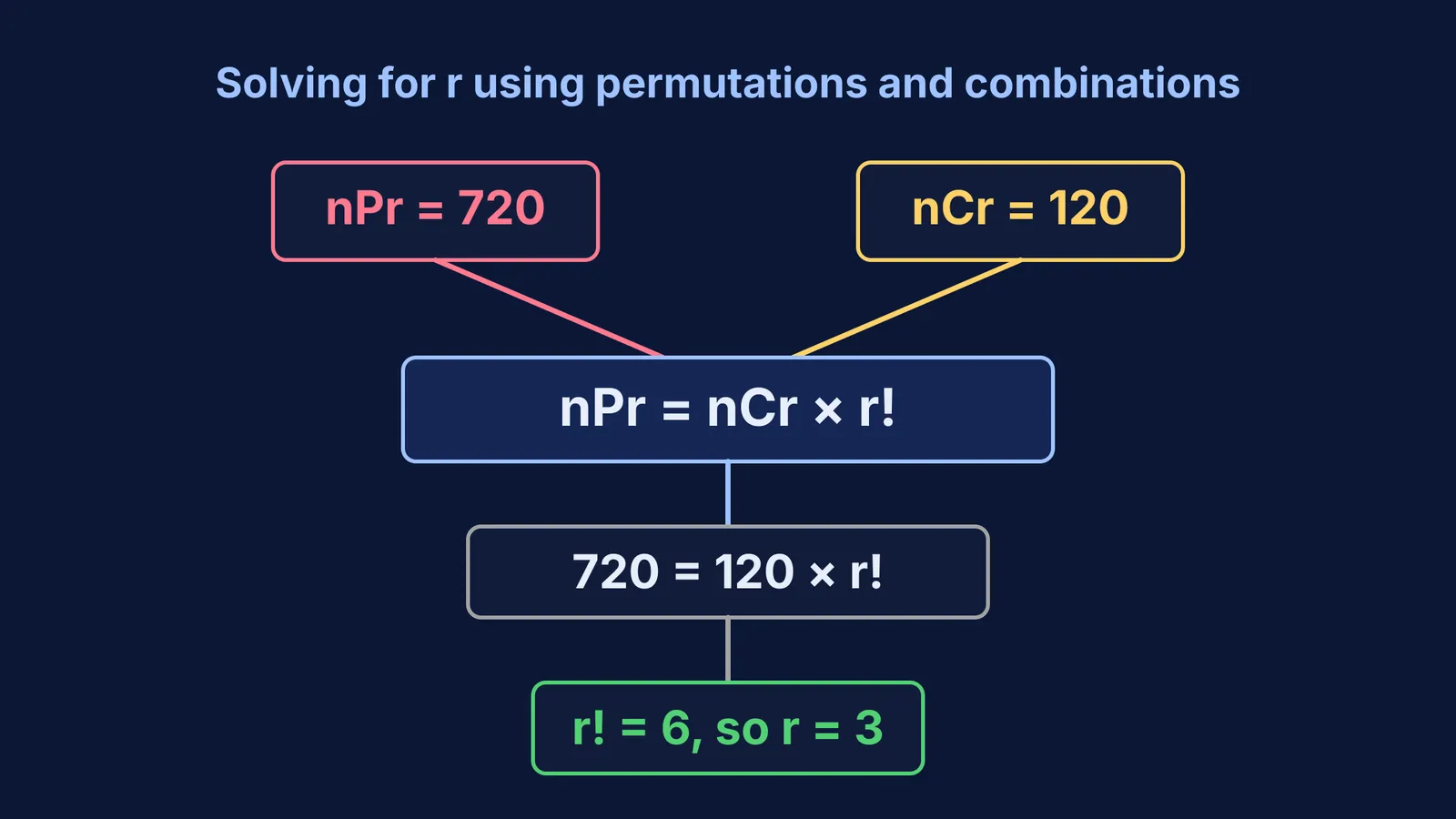
Write the relationship: nPr = r! × nCr
Substitute the numbers you were given: 720 = r! × 120
Divide both sides of the equation by 120: r! = 720 / 120 = 6
Ask yourself which integer's factorial equals 6. Since 3! = 3 × 2 × 1 = 6, we know r = 3.
In four lines, the r variable drops out perfectly, leaving you with a straightforward number. By memorising this connection, you bypass the need for any complicated algebra involving unknown factorials.
How do you find n once you know r?
Now that you know r = 3, you can use either the permutation formula or the combination formula to find the value of n. The permutation side is usually faster to solve because it avoids the extra division step found in the combination formula.
We know that nP3 = 720. By expanding the permutation formula, we get the product of three descending terms starting from n: n(n - 1)(n - 2) = 720
Instead of expanding this expression into a cubic equation, which would be time-consuming and difficult to factor, use estimation. We need three consecutive positive integers that multiply to 720. If we try 10 as our starting point, we get 10 × 9 × 8. Let us check the math: 9 × 8 = 72 72 × 10 = 720
It matches perfectly, which means n = 10. You have now solved for both variables completely.
Why does the factorial shortcut work?
The logic behind the formula nPr = nCr × r! lies in how we count choices versus arrangements. Imagine you are selecting a team of three students from a class of ten.
First, you pick the three students. This is a combination problem, represented by 10C3, which equals 120. At this stage, the order in which you picked the students does not matter; it is just a single group.
Next, imagine you need to assign these chosen students to distinct roles: captain, vice-captain, and secretary. This means you must arrange them. Any group of three people can be arranged in 3! (which is 3 × 2 × 1 = 6) different ways.
To find the total number of possible ordered arrangements, which is what permutations count, you multiply the number of ways to pick the group (120) by the number of ways to arrange the group (6). This gives you 720, which is exactly 10P3. The formula works for any values of n and r because selecting elements and then arranging those selected elements will always yield the total number of permutations.
If nCr = nCs, what does it mean?
Another frequent exam trick involves equating two combinations. The symmetry formula states that choosing r elements from a total of n is mathematically equivalent to choosing the n-r elements to leave out (Wikipedia).
Because of this symmetry, the equation nCr = nCs means that one of two things must be true:
Either the variables at the bottom are identical: r = s
Or they add up to the total number of items: r + s = n
For example, if a question states that nC8 = nC2, it means that 8 + 2 = n, making n = 10. This property is heavily tested because students who do not know the rule will waste a long time trying to expand the factorials and solve a difficult polynomial, while those who know the rule solve it in seconds.
If you ever freeze mid-calculation or forget how to expand a factorial equation, the Fermi Problem Library has worked problems with a step-by-step solver that explains the reasoning rather than printing an answer. By holding a line of reasoning across a whole session, Fermi's AI tutor works out what you already know and builds a plan for the session, so you sit down to a clear next step.
To master similar algebraic tricks, you can read our guides on Equations and inequalities with modulus: the case-split method or Solving equations in complex numbers by putting z = x + iy.


