

On this page
A Norman window is a classic architectural shape: a rectangle topped by a semicircle. Designing one is a standard calculus optimization problem. If you have a limited amount of framing material (the perimeter), how do you shape the window to let in the most light?
Maximising window area is a practical concern; the International Residential Code requires that habitable rooms have an aggregate window glass area of at least 8% of the room's floor area. To find the dimensions that yield the maximum area for a given perimeter, you write the area as a function of one variable, take the derivative, and find where it equals zero.
If you are just starting with applications of derivatives, the Fermi Concept Library maps out how to set up an objective function from a geometric constraint.
What are the perimeter and area equations for a Norman window?
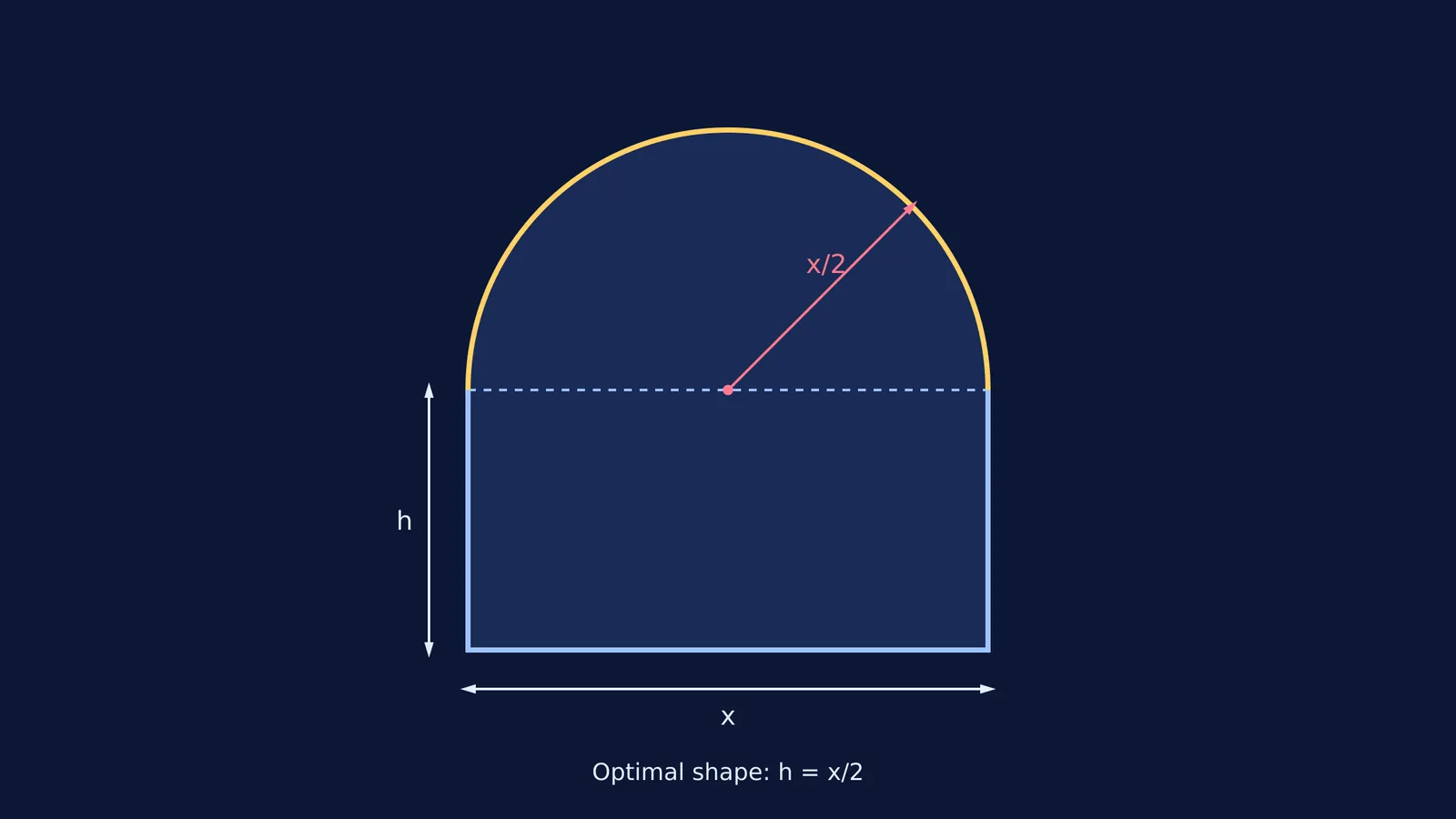
Let the width of the window be x. Because the top is a semicircle, its diameter is x and its radius is x/2. Let the height of the rectangular section be h.
The window is framed along its flat base (length x), its two vertical sides (each length h), and its semicircular top. The arc length of a full circle is πd, so the semicircular arc is πx / 2. The total perimeter P is: P = x + 2h + (πx / 2)
The total area A is the area of the rectangle plus the area of the semicircle: A = xh + (1/2)π(x/2)² A = xh + (πx² / 8)
How do you express the area in terms of one variable?
To maximise A, we need it as a function of a single variable, say x. We use the perimeter equation to eliminate h.
Rearranging the perimeter equation for 2h gives: 2h = P − x − (πx / 2)
Dividing by 2, the height h is: h = P/2 − x/2 − πx/4
Substitute this h into the area equation: A(x) = x(P/2 − x/2 − πx/4) + πx² / 8
Multiply the x through: A(x) = (P/2)x − (1/2)x² − (π/4)x² + (π/8)x²
Combine the x² terms (noting that −π/4 + π/8 = −π/8): A(x) = (P/2)x − (1/2 + π/8)x²
How do you differentiate to find the maximum area?
To find the maximum area, we take the derivative of A(x) with respect to x and set it to zero.
A'(x) = P/2 − 2(1/2 + π/8)x A'(x) = P/2 − (1 + π/4)x
Set A'(x) = 0: (1 + π/4)x = P/2 ((4 + π) / 4)x = P/2 x = 2P / (4 + π)
To be certain this gives a maximum (and not a minimum), we take the second derivative. A''(x) = −(1 + π/4) Since the second derivative is always negative, the curve is concave down, confirming this x gives the absolute maximum area. (You can also check the endpoints x = 0 and h = 0 to confirm the absolute maximum on a closed interval).
What is the geometric rule for the maximum area?
What does this optimal shape look like? We can find the optimal height h by plugging our result for x back into the height equation: h = P/2 − x/2 − πx/4 = P/2 − (x/2)(1 + π/2)
Substitute x = 2P / (4 + π): h = P/2 − (P / (4 + π))((2 + π) / 2) h = (P(4 + π) − P(2 + π)) / (2(4 + π)) h = 2P / (2(4 + π)) h = P / (4 + π)
Notice that h = x/2. For a Norman window to admit the maximum light, the height of its rectangular section must exactly equal the radius of its semicircular top.
When using the closed interval method, it is worth checking the physical boundaries of the problem. If x = 0, the window has zero width and zero area. If h = 0, the rectangle vanishes and the window becomes a pure semicircle resting on its base. For a pure semicircle of perimeter P, the straight base is x and the arc is πx / 2. This makes the perimeter P = x + πx / 2, which solves to x = 2P / (2 + π).
The area of this pure semicircle is A = πx² / 8 = πP² / (2(2 + π)²). When you evaluate this expression, the result is smaller than the maximum area of our optimal Norman window, which is P² / (2(4 + π)). This confirms that the greatest amount of light comes from the combined shape, not from shrinking the rectangular section to nothing.
Steps to solve window optimization problems
Draw the window and label the width x and height h.
Write down the constraint equation (the fixed perimeter P).
Write down the objective function (the area A you want to maximise).
Use the constraint to substitute h out of the area equation.
Take the derivative A'(x) and set it to zero.
Solve for x and use the second derivative to confirm it is a maximum.
If you get stuck on the algebra while substituting terms, Fermi's AI tutor can work out what you already know and build a plan for the session, writing on a board alongside you to find the mistake. To see more optimization problems worked out step by step, visit the Fermi Problem Library.


