

On this page
It is easy to tune out the roar of city traffic or the hum of an air conditioner, but your autonomic nervous system never stops listening. While you might habituate to a noisy environment consciously, your body continues to treat unpredictable sounds as potential threats. The effects of noise pollution reach far beyond the ears, altering stress hormones and degrading the sleep required for memory and recovery.
How is noise measured?
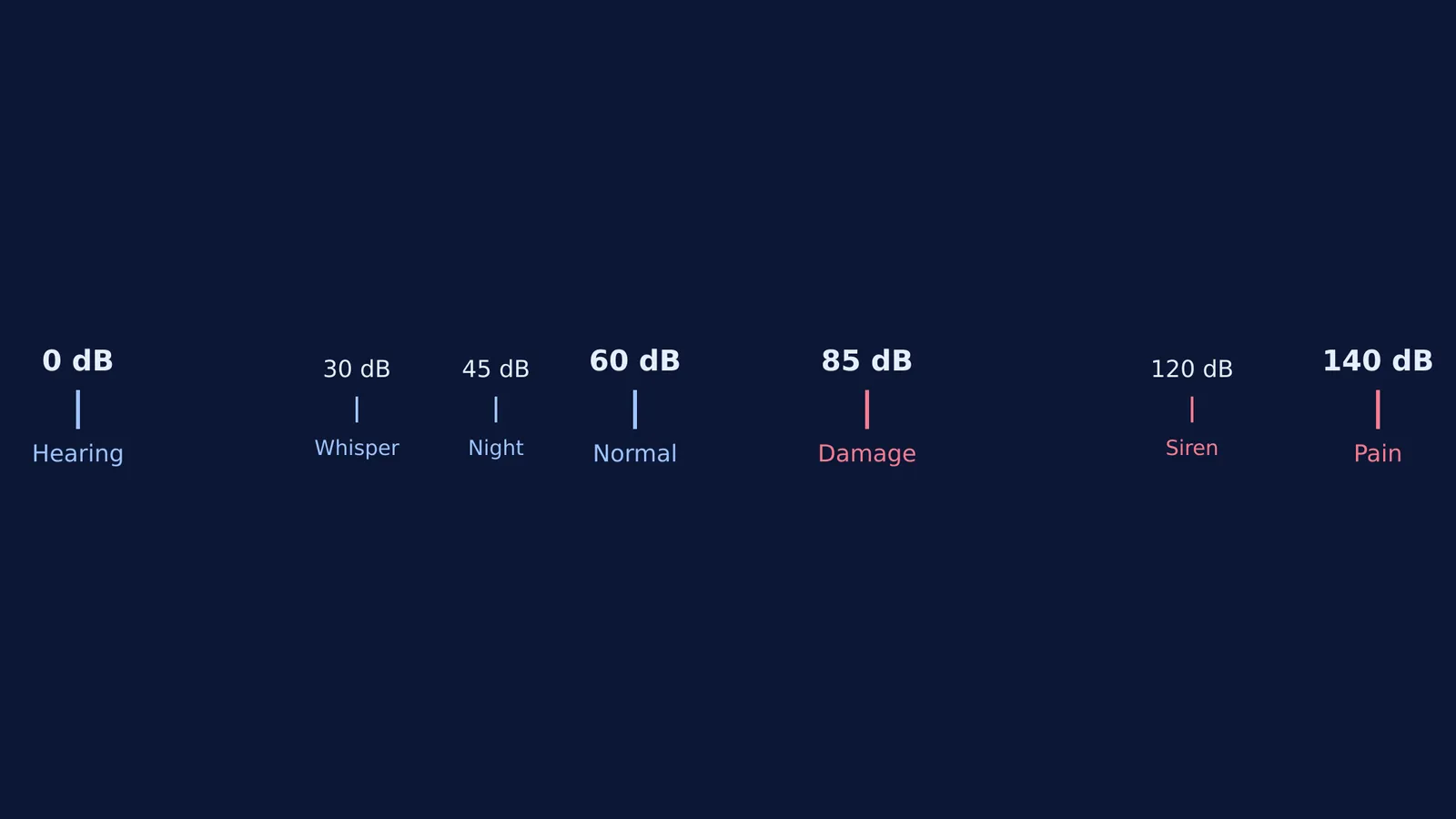
Sound intensity is measured in decibels (dB), a logarithmic scale where small increases in numbers mean massive increases in physical pressure. A quiet whisper is around 30 dB, while normal conversation registers at 60 dB. Because the scale is logarithmic, a 70 dB sound is much more intense than a 60 dB sound. If you are curious about the physics of sound waves, the Fermi Concept Library maps out the logarithmic scale of decibels and the frequency of pressure waves.
The National Institute on Deafness and Other Communication Disorders (NIDCD) warns that prolonged exposure to sounds at or above 85 decibels (dB) can cause hearing loss. For context, heavy city traffic often hovers around this 85 dB threshold. Sounds at or above 120 dB, such as a siren or a rock concert, can cause immediate and irreversible damage.
How does loud noise damage hearing?
The physical damage from noise happens deep inside the cochlea, the snail-shaped structure in the inner ear. The cochlea is lined with sensory hair cells, each topped with a bundle of microscopic, hair-like projections called stereocilia. When sound waves enter the ear, they bend these stereocilia, opening ion channels that send electrical signals to the brain.
Intense noise acts as a mechanical trauma. Most noise-induced hearing loss is caused by the damage and eventual death of these hair cells. If the damage is sublethal, the hair cells may recover, leading to a temporary muffled sensation. However, if the hair cells die, they cannot regenerate in humans. Once they are gone, the hearing loss is permanent.
Why does noise pollution affect sleep and stress?
The auditory system is permanently open, meaning it scans the environment even while you sleep. When the brain detects a sudden or loud noise, it activates the amygdala, triggering the hypothalamic-pituitary-adrenal (HPA) axis as part of the fight-or-flight response. This biological cascade prompts the adrenal glands to release cortisol and adrenaline.
The WHO Environmental Noise Guidelines state that average night-time road traffic noise above 45 dB is associated with sleep disturbance. Exposure to environmental noise during sleep keeps the body in a state of heightened alertness. This continuous stress fragments sleep architecture, disrupting the rest required for physical repair and memory consolidation.
How to study in a noisy environment
If you are preparing for exams in a noisy home or a busy neighbourhood, the constant activation of your stress response can drain your focus and elevate anxiety. Here is a practical framework to manage it:
Use passive isolation: Soft furnishings, thick curtains, and closed doors absorb higher-frequency sounds better than hard walls do.
Wear hearing protection: Simple foam earplugs can significantly reduce noise, bringing a traffic rumble down to a manageable level.
Mask unpredictable sounds: The brain reacts to sudden changes in volume rather than a steady hum. Use a fan or a white noise app to create a constant acoustic baseline, preventing your HPA axis from spiking at every passing car.
Plan your hardest work for quiet hours: If the noise is unavoidable, shift your most demanding problem-solving to early mornings or late nights when the background noise drops.


