

On this page
In organic chemistry, transforming a substituent on a benzene ring often means swapping it out completely. The conversion of nitrobenzene to benzoic acid is a classic example of this strategy. You cannot simply oxidise or reduce a nitro group directly into a carboxylic acid. Instead, you must run through a sequence: reducing the nitro group to an amine, converting the amine into a reactive diazonium salt, replacing that salt with a nitrile, and finally hydrolysing the nitrile. Globally, about 95% of all nitrobenzene produced is reduced to aniline Wikipedia, highlighting how fundamental this first transformation is.
If you are mapping out these conversions, the Fermi Concept Library shows how these functional groups link together across the organic chemistry syllabus.
What are the steps to convert nitrobenzene to benzoic acid?
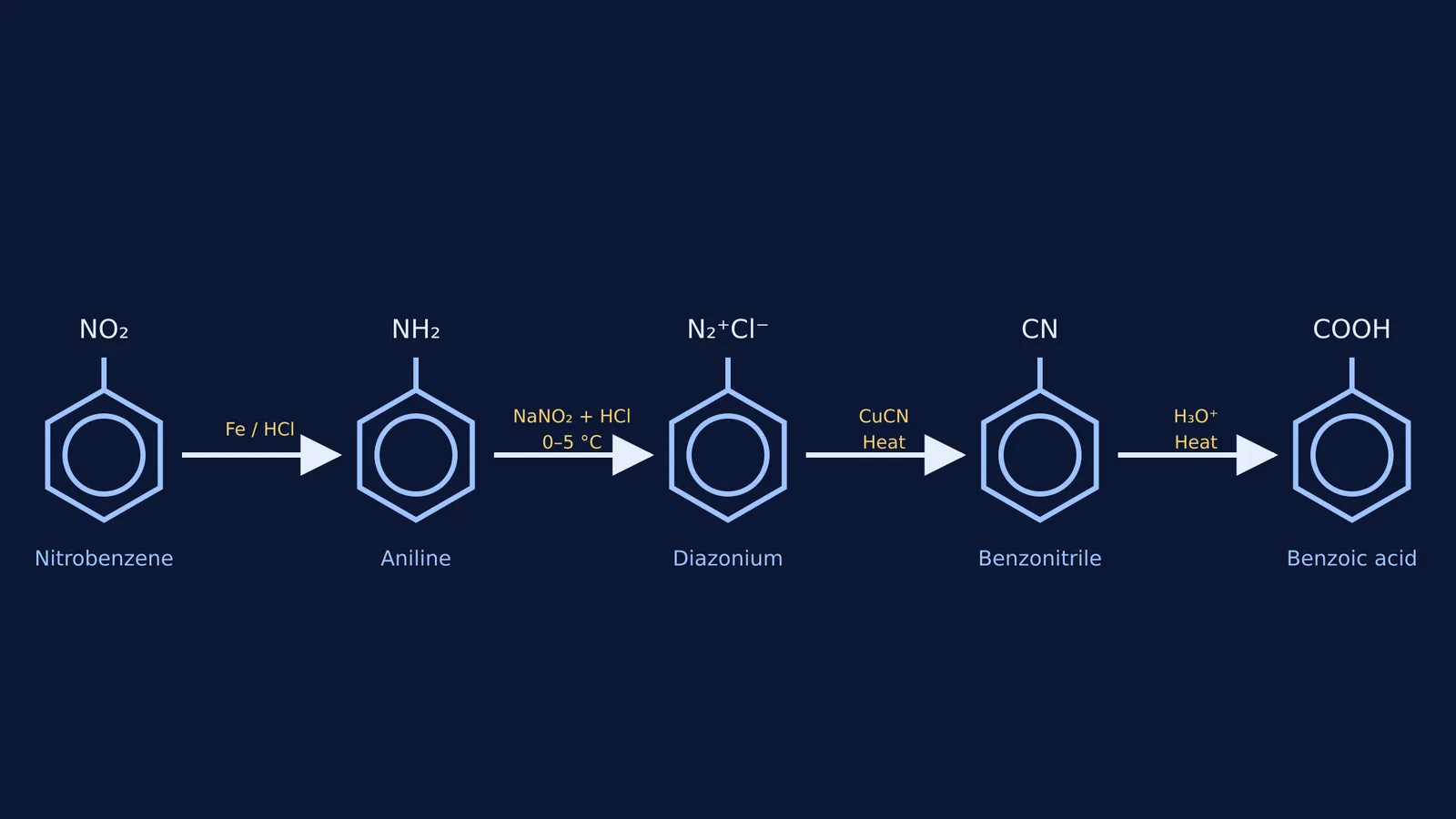
The complete route from nitrobenzene to benzoic acid uses four sequential reactions.
Reduction: Nitrobenzene reacts with iron and hydrochloric acid to form aniline.
Diazotisation: Aniline reacts with nitrous acid to form benzene diazonium chloride.
Sandmeyer cyanation: The diazonium salt is treated with cuprous cyanide to yield benzonitrile.
Hydrolysis: Benzonitrile is boiled with dilute acid to produce benzoic acid.
Let us break down the exact reagents and conditions for each stage.
How do you reduce nitrobenzene to aniline?
The first step is to strip the oxygen atoms from the nitro group (–NO₂) and replace them with hydrogen. Nitrobenzene is reduced to aniline using a metal and a concentrated mineral acid.
While tin (Sn) and hydrochloric acid work perfectly well, iron (Fe) and hydrochloric acid are preferred in industrial and laboratory settings. The iron(II) chloride formed in the reaction is hydrolysed by water to release hydrochloric acid. Consequently, you only need a small amount of initiator acid to keep the reaction going.
Reducing nitrobenzene to aniline: Sn/HCl, Fe/HCl and why
Why must the diazotisation reaction stay cold?
Once you have aniline, you must convert its stable amine group (–NH₂) into a highly reactive diazonium group (–N₂⁺Cl⁻). You treat the aniline with sodium nitrite (NaNO₂) and a mineral acid, typically hydrochloric acid Wikipedia, which mix to generate nitrous acid (HNO₂) in the flask.
The critical condition for diazotisation is temperature: it must be strictly maintained between 0 °C and 5 °C Wikipedia. Benzene diazonium chloride is unstable because nitrogen gas is an exceptionally good leaving group. If the flask warms up to room temperature, the diazonium salt decomposes, releasing nitrogen gas and leaving phenol behind instead.
Forming benzonitrile via the Sandmeyer reaction
With the diazonium salt secured in an ice bath, the next step is to introduce the new carbon atom. The Sandmeyer reaction achieves this by displacing the diazonium group with a cyanide group.
You add the cold diazonium solution to a warm mixture of cuprous cyanide (CuCN) Wikipedia. Often, potassium cyanide (KCN) is added to the solution to form a soluble complex. The copper(I) transfers a single electron to initiate the substitution Wikipedia. The nitrogen gas bubbles away, and the cyanide group attaches to the benzene ring, forming benzonitrile.
Sandmeyer and Gattermann reactions: replacing the diazo group
Hydrolysing the nitrile to benzoic acid
The final step is to convert the nitrile group (–C≡N) into a carboxylic acid (–COOH). Nitriles undergo hydrolysis when heated with water in the presence of an acid or a base.
For this sequence, acidic hydrolysis is the most straightforward. You reflux (boil) the benzonitrile with an aqueous mineral acid, such as hydrochloric acid or sulfuric acid (written as H₃O⁺ and heat). The water molecules attack the triple bond, ultimately cleaving the carbon-nitrogen bond. The nitrogen leaves as an ammonium ion (NH₄⁺), and the carbon remains attached to the ring as benzoic acid.
A framework for aromatic conversions
When you face a synthesis problem starting from nitrobenzene, use this three-question framework to plan your route:
Do I need to change the carbon skeleton? If the target molecule has more carbon atoms than the starting material (like benzoic acid, which has seven carbons compared to nitrobenzene's six), you must use a carbon-forming reaction. The Sandmeyer cyanation is the standard method for adding a single carbon atom to an aromatic ring.
How do I make the ring reactive enough? The original nitro group is strongly deactivating and tightly bound. You cannot substitute it directly. The nitrogen pathway—reducing to aniline, then diazotising—is the most reliable way to create a leaving group (nitrogen gas) that is eager enough to depart when a nucleophile like cyanide approaches.
What is the final functional group? Once the carbon skeleton is correct, adjust the functional group. A nitrile (–C≡N) is highly versatile. If you need an amine, you reduce it. If you need a carboxylic acid (–COOH), you hydrolyse it with an aqueous acid under reflux.
If you are revising for exams and keep mixing up which reagent does what, Fermi's AI tutor can help you build a plan for the session, testing your recall of the conditions for each step until the sequence becomes second nature.


