

On this page
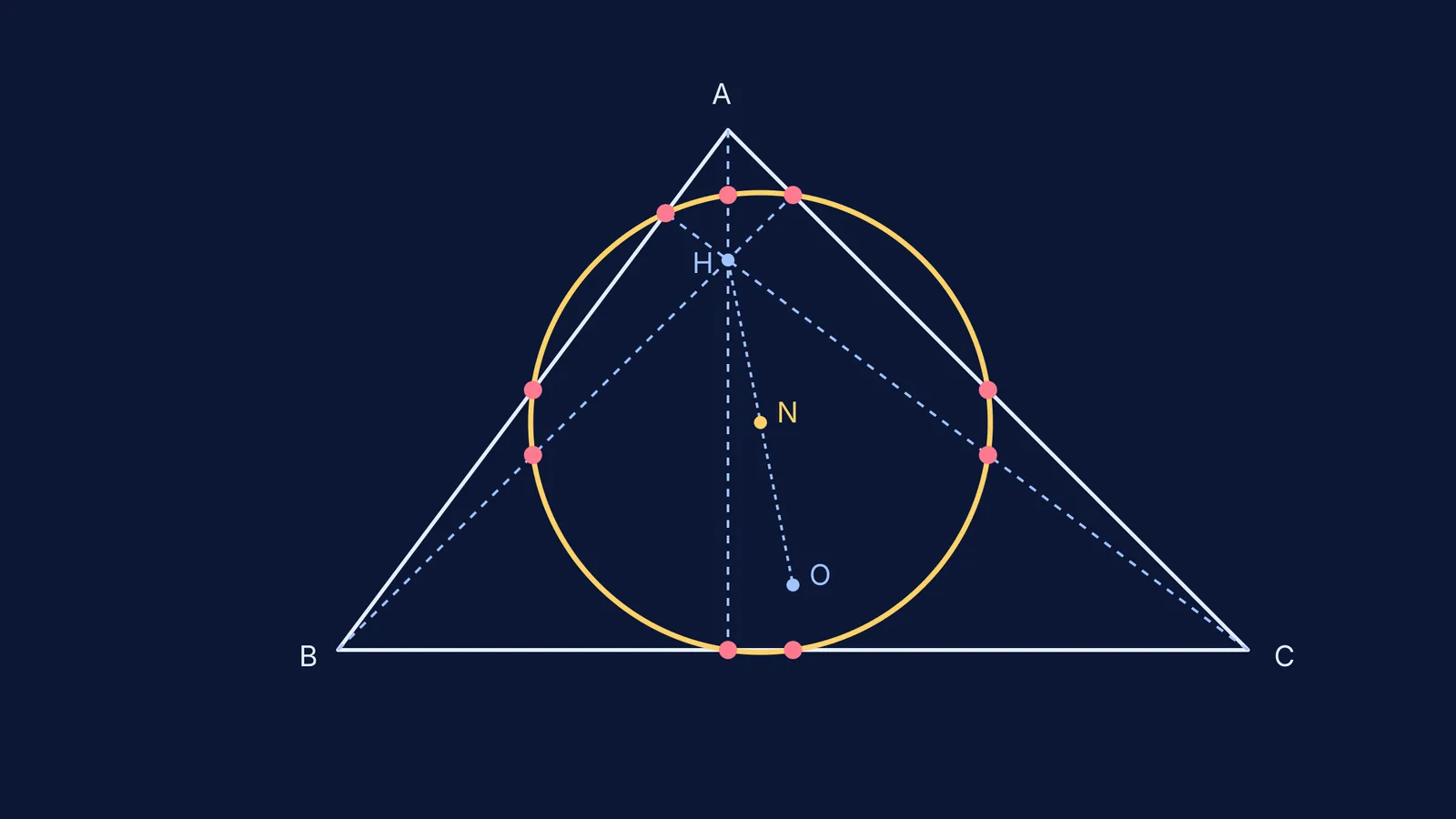
Every triangle, no matter its shape, has a unique circle that threads perfectly through nine specific points. First discovered in part by Leonhard Euler, this circle ties together several distinct geometric features of the triangle into a single elegant structure.
Karl Wilhelm Feuerbach later proved that this same circle is tangent to the triangle's incircle and its three excircles. When revising coordinate geometry, remembering formulas is less helpful than seeing how they emerge. The Fermi Concept Library has every concept in physics, chemistry, biology, mathematics and computing, each with its own lesson and its place in the map.
What are the nine points on the circle?
The circle takes its name from three sets of points that always lie on its circumference:
The side midpoints: The midpoints of the triangle's three sides.
The altitude feet: The points where the three altitudes meet the sides. (An altitude is the perpendicular line dropped from a vertex to the opposite side).
The Euler points: The midpoints of the segments connecting each vertex to the orthocentre. The orthocentre is the point where the three altitudes intersect.
Because altitudes define both the feet and the orthocentre, the nine-point circle is heavily tied to how a triangle's heights align. To find the orthocentre, you must verify the condition for three lines to be concurrent.
Why is the radius half the circumradius?
The radius of the nine-point circle is exactly half the radius of the triangle's circumcircle, according to MathWorld.
The simplest way to prove this involves a geometric transformation called a homothety (a scaling). If you draw a triangle using the midpoints of the original triangle's sides, you create the "medial triangle". This smaller triangle has exactly half the side lengths of the original.
The nine-point circle is the circumcircle of this smaller medial triangle. Because the medial triangle is scaled down by a factor of 1/2 from the main triangle, its circumcircle must also be exactly half the size of the original circumcircle.
How does it connect to the Euler line?
The centre of the nine-point circle, often labelled N, aligns perfectly with the triangle's other major centres.
In any triangle, the orthocentre (H), the centroid (G) and the circumcentre (O) are collinear points that form the Euler line. The nine-point centre N also sits on this Euler line. It is always exactly halfway between the orthocentre and the circumcentre.
If you know the coordinates of H and O, you can find N simply by taking their average.
Can the nine points overlap?
Yes, the nine points only remain distinct in a general scalene triangle. When a triangle has special symmetry, some of these points merge.
In an equilateral triangle: The side midpoints and the altitude feet are the exact same points. The nine-point circle becomes the inscribed circle (incircle).
In a right-angled triangle: The orthocentre sits exactly on the vertex with the right angle. The altitude feet for the two legs also fall on this vertex, so multiple points collapse into one.
How do you find the nine-point centre?
Working through the algebra helps confirm the geometry. Let's find the nine-point centre for a triangle with vertices at A(12, 2), B(6, 10) and C(20, 10).
Step 1: Find the side midpoints
The nine-point circle must pass through the midpoints of the sides:
Midpoint of BC: ((6 + 20) / 2, (10 + 10) / 2) = (13, 10)
Midpoint of AC: ((12 + 20) / 2, (2 + 10) / 2) = (16, 6)
Midpoint of AB: ((12 + 6) / 2, (2 + 10) / 2) = (9, 6)
Step 2: Locate the circumcentre of these midpoints
The nine-point centre N is equidistant from these three midpoints. Let N be at (x, y).
Since the midpoints of AC and AB share a y-coordinate of 6, the perpendicular bisector between them is a vertical line halfway between x = 9 and x = 16. So, x = (9 + 16) / 2 = 12.5.
Now, equate the squared distance from N(12.5, y) to (9, 6) and to (13, 10): 3.5² + (y − 6)² = (−0.5)² + (y − 10)² 12.25 + y² − 12y + 36 = 0.25 + y² − 20y + 100 48.25 − 12y = 100.25 − 20y 8y = 52 y = 6.5
The nine-point centre N is at (12.5, 6.5).
When a coordinate geometry question asks for a multi-stage calculation like this, taking a wrong step early on can ruin the final answer. The Fermi Problem Library has worked problems with a step-by-step solver that explains the reasoning rather than printing an answer, catching algebraic mistakes before they compound.


