

On this page
What is the formula for a new average?
In mathematics, the arithmetic mean is the sum of a collection of numbers divided by the count of numbers in the collection (Wikipedia). When working with ages, scores, or weights, we usually call this the average.
Because the average is the total sum divided by the number of people, you can always work backwards to find the total sum: Total = Average × Number of people
This simple rearrangement is the key to solving any problem where a group changes size.
How does the average age change when a new person joins?
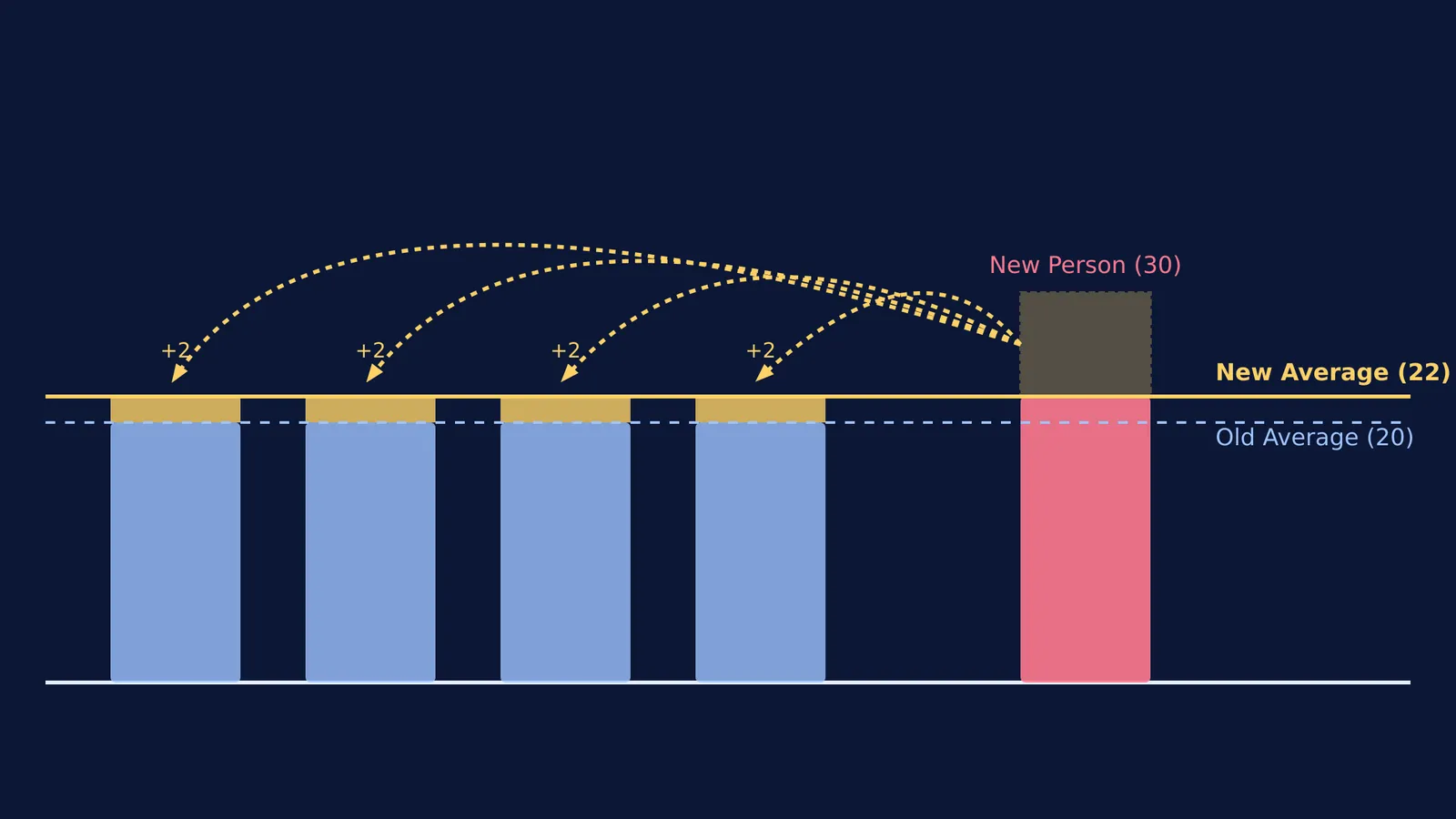
When a new person joins a group, their age pulls the average up or down. If they are exactly the same age as the old average, the average stays the same. If they are older, the new average goes up; if they are younger, the new average drops.
To find the exact age of the new person, you do not need to know the individual ages of everyone in the original group. You only need the old average, the new average, and the number of people.
The steps are always the same:
Find the old total age by multiplying the old average by the original number of people.
Find the new total age by multiplying the new average by the new number of people (which is the old number plus one).
Subtract the old total from the new total. The difference is the new person's age.
How do you find a new member's age?
Imagine a study group of ten students with an average age of fifteen. A new student joins, and the new average age of the group becomes sixteen. How old is the new student?
Using our three steps:
The old total age is ten students multiplied by fifteen to give one hundred and fifty.
The new group has eleven students, and their new average is sixteen. The new total age is eleven multiplied by sixteen, which gives one hundred and seventy-six.
The new student's age is the difference between the two totals: one hundred and seventy-six minus one hundred and fifty leaves twenty-six.
This method works for any quantity, not just ages. If you are struggling to set up these equations or getting stuck on word problems, the Fermi Problem Library has worked problems with a step-by-step solver that explains the reasoning rather than printing an answer.
What is the shortcut for average age changes?
If you are preparing for exams and need to save time, there is a shortcut that skips calculating the large total sums.
When the average increases, the new person must be older than the old average. They must bring enough extra value to give everyone in the new group the increase. Age of new person = Old average + (New number of people × Increase in average)
Using our previous example:
Old average is fifteen.
New number of people is eleven.
Increase in average is one.
Age is fifteen plus eleven multiplied by one, which gives twenty-six.
If the average decreases, the logic flips: Age of new person = Old average − (New number of people × Decrease in average)
Why does this method work for scores and weights?
This method is not limited to calculating ages. The exact same mathematical principle applies to average test scores, average weights, or average temperatures. The arithmetic mean formula treats all these values identically.
For example, suppose a cricket player has an average score of forty-five across ten matches. In their eleventh match, they score one hundred. What is their new average?
Old total score is ten multiplied by forty-five to give four hundred and fifty.
New total score is four hundred and fifty plus one hundred to give five hundred and fifty.
New average is five hundred and fifty divided by eleven, which gives fifty.
Notice that adding a score much higher than the old average significantly pulls the new average up.
What are common mistakes when calculating average changes?
One of the most frequent errors students make is attempting to average the averages. If a group of ten people has an average age of twenty, and a new person aged thirty joins, it is incorrect to simply add twenty and thirty and divide by two.
The arithmetic mean must always be calculated from the total sum of all individual values. By dividing the new total (two hundred and thirty) by the new count of people (eleven), you find the correct new average of roughly twenty point nine. The shortcut method also confirms this: the new person is ten years older than the old average, and this extra amount is distributed across eleven people, adding roughly zero point nine to the average.
When dealing with large data sets or complex word problems, keeping track of the total sum prevents these logical errors. If you find yourself frequently making these types of conceptual mistakes in mathematics or physics, the Fermi Concept Library has every concept in physics, chemistry, biology, mathematics and computing, each with its own lesson and its place in the map.
Understanding the logic behind these formulas is more powerful than just memorising them. Similar reasoning applies to finding the mean absolute deviation about the median, calculating the variance of two combined groups, and understanding how adding to or scaling data changes the mean and variance.


