

On this page
Which functional group gets numbering priority in an unsaturated alcohol?
When an organic molecule contains both a carbon-carbon double bond and a functional group like a hydroxyl group (-OH), choosing the principal chain and numbering direction is the first step. According to the IUPAC Blue Book (*Nomenclature of Organic Chemistry*, Favre & Powell, 2013), suffix functional groups take seniority over unsaturation for selecting the parent chain and assigning locants.
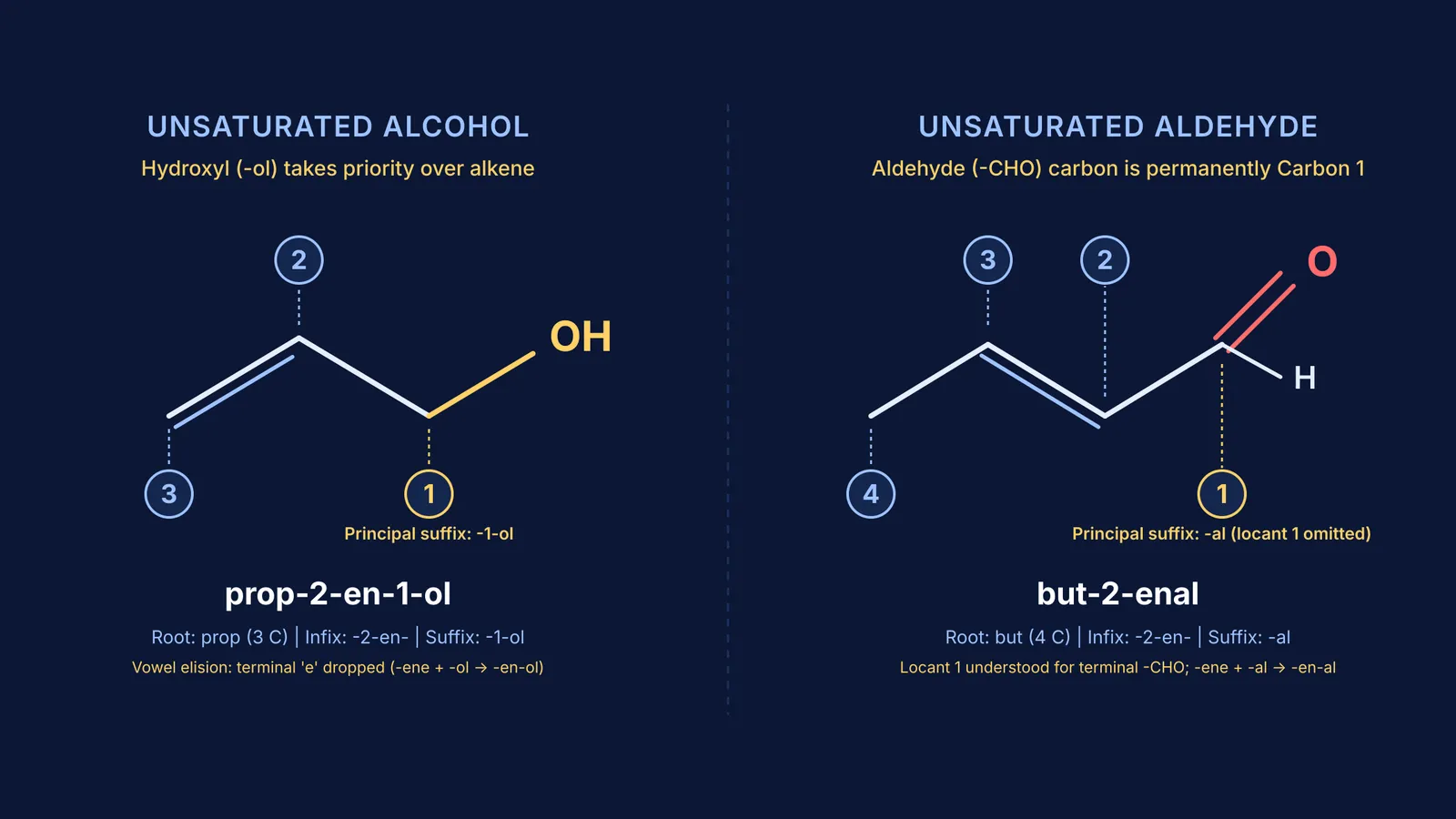
Under IUPAC rule P-62.2.6.1, the parent chain must contain the carbon bearing the hydroxyl group, numbered to give that carbon the lowest locant. The double bond receives whichever locant results after the principal functional group is numbered.
Consider allyl alcohol (CH₂=CH-CH₂OH). Numbering from the alkene end gives prop-1-en-3-ol, but because the hydroxyl group is senior, numbering starts at the -OH carbon. This places the alcohol at carbon 1 and the double bond at carbon 2, giving the systematic IUPAC name prop-2-en-1-ol.
When an alcohol and an aldehyde co-occur, the aldehyde outranks the alcohol (IUPAC Section P-66.6). The aldehyde carbon becomes carbon 1 and takes the suffix `-al`, while the -OH group becomes a `hydroxy-` prefix.
To review foundational naming rules before tackling polyfunctional systems, see our guide to naming carbon compounds in Class 10.
How do you combine the -en- infix with -ol, -al, and -oic acid?
Constructing a systematic name requires assembling five components: secondary prefix, primary prefix, word root, primary suffix, and secondary suffix. A 2026 classroom study evaluating this sequence found that teaching students to isolate these components improved accuracy and solving speed across 64 undergraduate chemistry students (Das, 2026).
When unsaturation meets a principal group, the primary suffix changes from `-an-` to `-en-` or `-yn-`. The grammatical rule is vowel elision:
Drop the terminal 'e' from '-ene' or '-yne' whenever the secondary suffix starts with a vowel (a, e, i, o, u) or 'y'.
Combining '-en-' with '-ol' gives '-en-ol'; combining '-en-' with '-al' gives '-en-al'.
Combining '-en-' with '-oic acid' gives '-en-oic acid', as in prop-2-enoic acid (CH₂=CH-COOH).
When practicing multi-step naming problems, working through each component step by step prevents missed locants. The Fermi Problem Library provides worked problems with a step-by-step solver that explains the reasoning rather than printing an answer.
Why is crotonaldehyde named but-2-enal instead of but-3-en-1-al?
Unsaturated aldehydes frequently appear in exams because they form via aldol condensation. Crotonaldehyde (CH₃-CH=CH-CHO) demonstrates chain numbering and locant omission in acyclic aldehydes.
Under IUPAC Section P-66.6, the carbonyl carbon of an acyclic mono-aldehyde is permanently carbon 1:
Carbon 1 is the carbonyl carbon (-CHO).
Carbons 2 and 3 form the double bond (-CH=CH-).
Carbon 4 is the terminal methyl group (-CH₃).
Because carbon 1 is understood for any acyclic mono-aldehyde, locant 1 is omitted from the suffix in preferred IUPAC nomenclature. The double bond spans carbons 2 and 3, and IUPAC rules mandate citing the lower-numbered carbon atom. Hence, the primary suffix is `-2-en-` and the preferred name is but-2-enal. Numbering backwards from the methyl carbon to produce 'but-3-en-1-al' violates the cardinal priority rule that fixes the carbonyl carbon at position 1.
For students exploring reaction pathways that form these molecules, our overview of alcohols, phenols and ethers details condensation and oxidation sequences. To see where functional group hierarchy connects to organic reaction mechanisms, explore the Fermi Concept Library, which covers every concept in physics, chemistry, biology, mathematics and computing, each with its own lesson and its place in the map.
What are the most common naming mistakes in JEE and NEET exams?
Examiners design questions to test whether students rely on 'lowest sum' heuristics or follow IUPAC hierarchy. Diagnostic research indicates that difficulties in identifying parent chains and functional group seniority remain persistent nomenclature hurdles (Ogundiji, 2025).
Common traps include:
Numbering from the alkene instead of the alcohol. In but-3-en-2-ol (CH₂=CH-CH(OH)-CH₃), numbering from the right gives 2 for the alcohol and 3 for the alkene, which is correct because the hydroxyl group outranks unsaturation.
Omitting 'e' before consonants. While prop-2-en-1-ol drops the 'e', but-2-ene-1,4-diol retains it because 'd' is a consonant.
Placing locants before the root. Modern IUPAC rules place each locant immediately before the unit it modifies: prop-2-en-1-ol and but-2-enal, not 2-propen-1-ol or 2-butenal.
Using lowest sum instead of first point of difference. When comparing alternative numbering paths, compare locants in ascending order and pick the path that is lower at the first point of difference.
For a comprehensive catalog of priority charts, see our guide to IUPAC naming of organic compounds.
If you are unsure whether a reaction condition modifies the double bond or the alcohol moiety in an en-ol, Fermi's AI tutor notices where a student is stuck and decides whether to explain, ask, or show.


