

On this page
When you replace a hydrogen atom in an aliphatic alkane or an aromatic benzene ring with a halogen, you create a haloalkane or a haloarene. Because these compounds are used in everything from laboratory solvents to complex pharmaceuticals, chemists have developed two parallel ways to name them: a traditional common system and the formal IUPAC (International Union of Pure and Applied Chemistry) system.
Knowing how to translate between the two is an essential skill for reading reaction schemes and tackling chemistry exam questions. Here is how the naming rules work for both aliphatic and aromatic compounds.
What are the IUPAC and common names of haloalkanes?
Haloalkanes (also widely known as alkyl halides) follow a straightforward pattern, but the two naming systems build the name in opposite directions.
The common naming system writes the name of the alkyl group first, followed by the halide 1. For example, attaching a bromine atom to an ethyl group gives the common name ethyl bromide.
The IUPAC system treats the halogen as a prefix attached to the parent alkane 1. To build the name, you find the longest carbon chain containing the halogen, and number the chain so the carbon holding the halogen gets the lowest possible number. If we apply this to the same molecule, ethyl bromide, the formal IUPAC name becomes bromoethane.
If the carbon chain is longer, the locant (the number indicating position) becomes critical for avoiding ambiguity. For a straight three-carbon chain with a chlorine atom on the end, the common name is n-propyl chloride, but the IUPAC name is 1-chloropropane. If the chlorine sits on the middle carbon instead, the common name changes to isopropyl chloride, while the IUPAC name is 2-chloropropane. If you want to see how these names shift as the molecules get more complex with branching, the Fermi Concept Library has every concept in physics, chemistry, biology, mathematics and computing, each with its own lesson and its place in the map.
How do you name geminal and vicinal dihalides?
When a molecule contains two of the same halogen atoms, it is classified as a dihalide. The common names for these compounds depend entirely on whether the halogens are grouped together or spread out across the carbon skeleton.
If both halogen atoms sit on the exact same carbon atom, they are called geminal halides (or gem-dihalides) 1. In the common system, these are named as alkylidene halides. For example, the molecule CH₃CHCl₂ has two chlorine atoms on the first carbon, so it is called ethylidene chloride.
If the two halogen atoms sit on adjacent carbon atoms, they are known as vicinal halides (or vic-dihalides) 1. The common system names these as alkylene dihalides, making ClCH₂CH₂Cl known as ethylene dichloride.
In the IUPAC system, both types are simply named by treating the halogens as individual substituents and giving each one its own number. Under these rules, ethylidene chloride is precisely named 1,1-dichloroethane, and ethylene dichloride is named 1,2-dichloroethane.
What are the IUPAC and common names of haloarenes?
Haloarenes are halogen derivatives of a benzene ring. For a benzene ring with a single halogen substituent, the common and IUPAC names are identical. A benzene ring carrying a chlorine atom is simply called chlorobenzene in both systems.
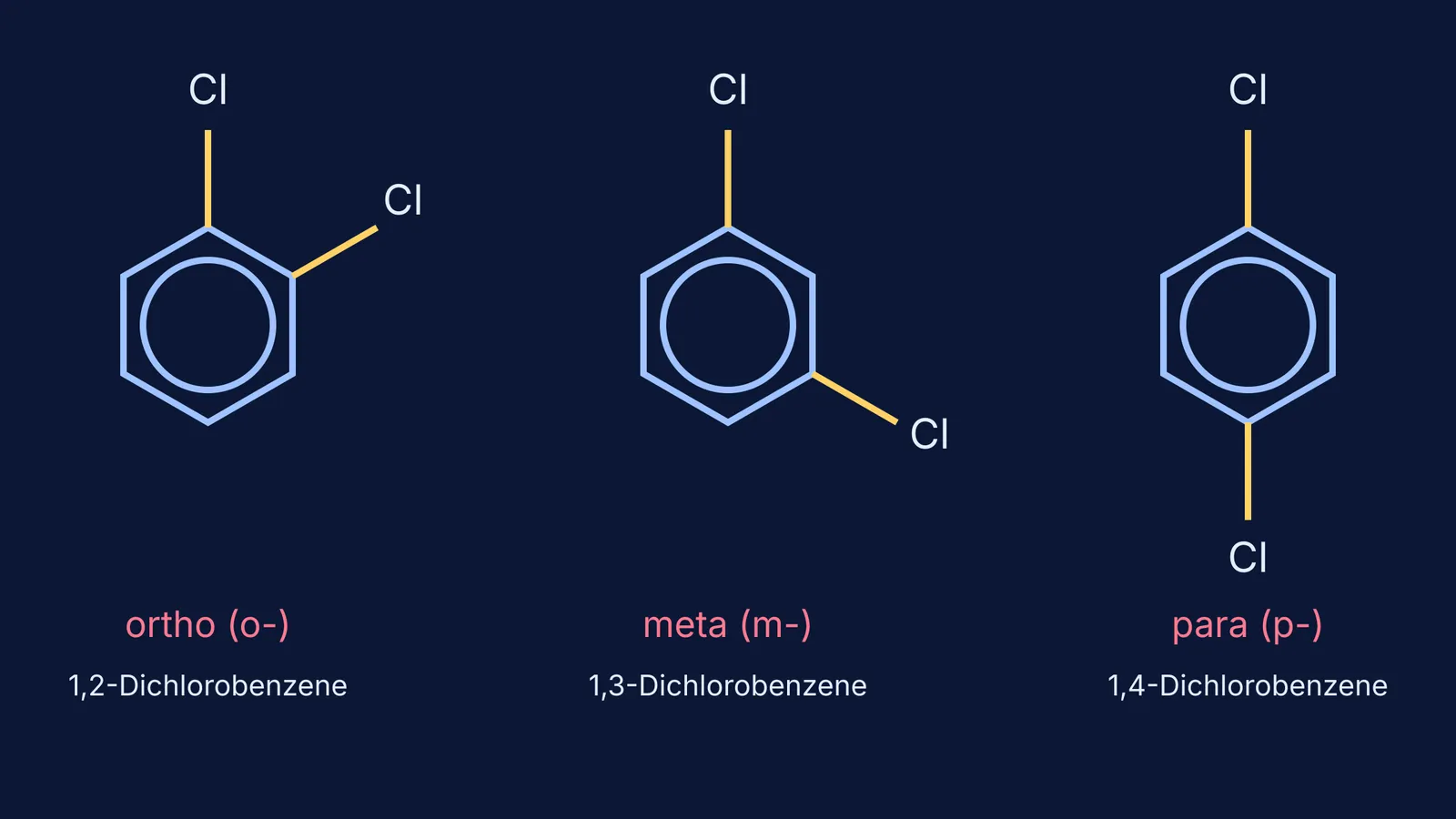
The rules diverge significantly when a second halogen is added to the ring. For dihaloarenes, common names indicate relative positions with the prefixes *ortho*, *meta* and *para*, while IUPAC names strictly use numbers like 1,2, 1,3 and 1,4 1.
ortho (o-): The substituents occupy adjacent carbons (positions 1 and 2).
meta (m-): The substituents are separated by one bare carbon (positions 1 and 3).
para (p-): The substituents sit on exact opposite sides of the ring (positions 1 and 4).
For example, a benzene ring with bromine atoms at positions 1 and 3 is called m-dibromobenzene in the common system, but 1,3-dibromobenzene in the formal IUPAC system. For rings with more than two substituents, the *ortho*, *meta* and *para* prefixes are dropped entirely to prevent confusion, and the numerical IUPAC system is mandatory (such as 1,3,5-tribromobenzene). If you are struggling with counting ring positions on heavily substituted molecules, the Fermi Problem Library has worked problems with a step-by-step solver that explains the reasoning rather than printing an answer.
If you are preparing for organic chemistry conversions, mastering these naming rules is the first step toward predicting substitution and coupling pathways. You can review the foundational rules in Naming carbon compounds in Class 10: prefixes, suffixes, examples, or see how these halogens are used to build larger structures in Wurtz-Fittig and Fittig reactions: coupling aryl and alkyl halides and Finkelstein and Swarts reactions: making alkyl iodides and fluorides.


