

On this page
Carbonyl compounds—molecules containing a carbon-oxygen double bond (C=O)—anchor extensive organic chemistry across board examinations and entrance tests like JEE Main and NEET-UG. Determining their systematic IUPAC names requires understanding whether the carbonyl carbon terminates a continuous chain or sits inside it, which functional group takes seniority, and how ring attachments alter standard suffix choices.
How do you choose between the -al and -one suffixes?
An aldehyde has a carbonyl group bonded to at least one hydrogen atom (R−CH=O). Because the formyl carbon must link to hydrogen, it terminates an open acyclic chain. A ketone features a carbonyl carbon bonded to two separate carbon atoms (R−CO−R'), placing the carbonyl group within the interior of the carbon skeleton.
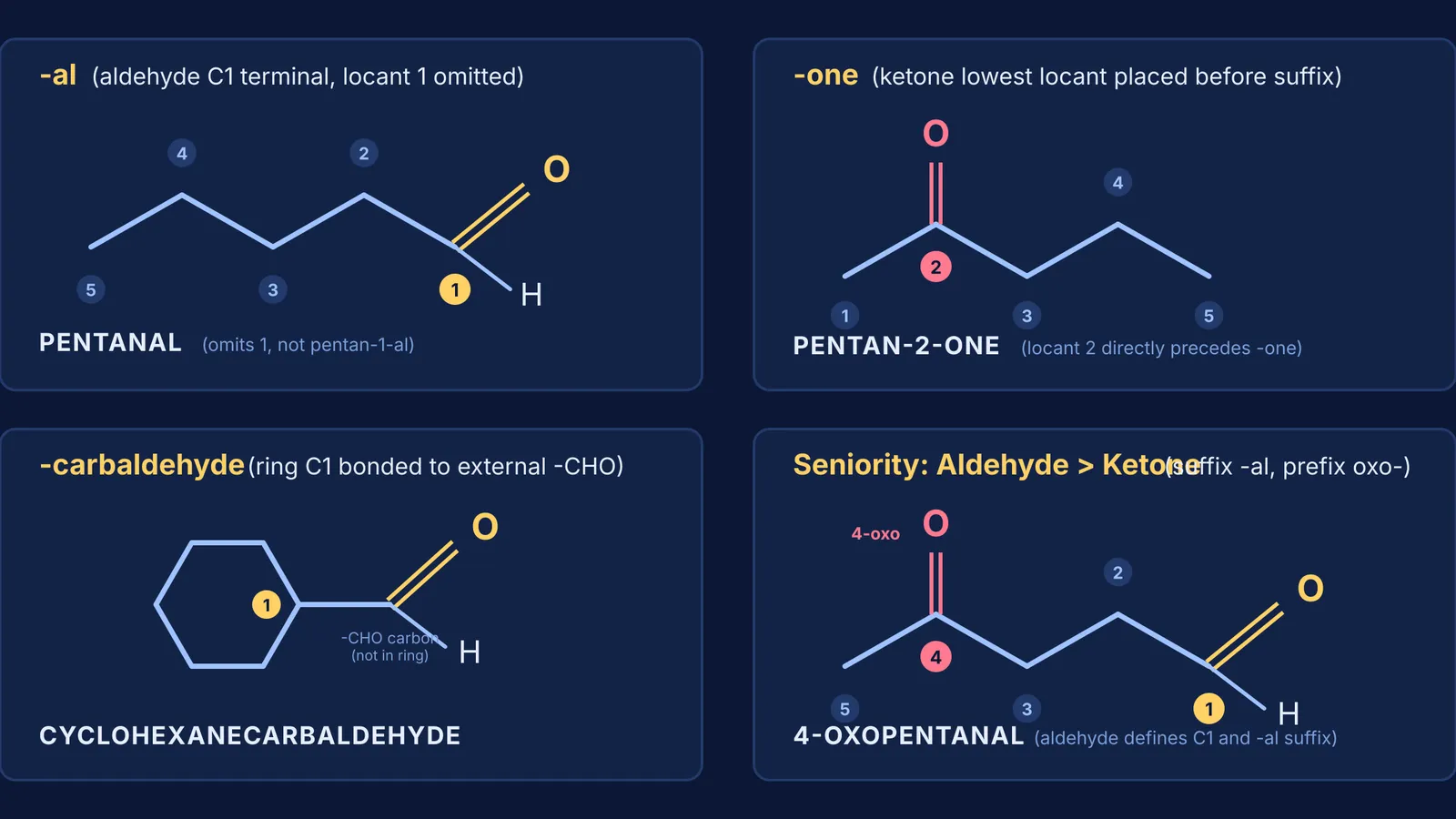
Under the IUPAC Recommendations compiled by Henri Favre and Warren Powell, acyclic monoaldehydes are named by replacing the terminal '-e' of the parent alkane with the suffix '-al' (converting ethane into ethanal). Ketones replace the terminal '-e' with '-one' (converting propane into propan-2-one). In preferred IUPAC nomenclature, the locant specifying the ketone position is placed directly before the suffix, bounded by hyphens, as in pentan-2-one or hexan-3-one. As shown in our Class 10 organic nomenclature guide, mastering these characteristic suffixes establishes the foundation before branching into complex carbon frameworks.
Why is the aldehyde carbon always numbered as C1?
In acyclic monoaldehydes, the carbonyl carbon is by definition a terminal carbon. Section P-66 of the IUPAC Blue Book dictates that the aldehyde carbon receives locant 1 when numbering the principal chain. Because an acyclic monoaldehyde cannot occupy any other position, citing the locant '1' is redundant. Chemists write butanal and pentanal, never butan-1-al or 1-pentanal.
When substituents or multiple functional groups attach to the chain, numbering still begins strictly from the aldehyde carbon:
In CH3−CH(CH3)−CH2−CHO, numbering assigns C1 to the aldehyde carbon, C2 to the CH2 group, C3 to the carbon bearing the methyl branch, and C4 to the terminal methyl group, producing 3-methylbutanal.
In symmetrical dialdehydes containing terminal −CHO groups at both chain ends, the suffix '-dial' is added to the alkane name (such as butanedial or hexanedial), and locants are omitted because the aldehyde groups necessarily bookend the chain.
When do you use -carbaldehyde for ring aldehydes?
When a −CHO group connects directly to a carbocyclic or heterocyclic ring, the carbonyl carbon cannot form part of the continuous ring numbering. IUPAC rule P-66.2.2 in the IUPAC Blue Book establishes that for such ring systems, the suffix '-carbaldehyde' is appended to the full name of the cycloalkane or aromatic ring.
For a six-membered cyclohexane ring bonded directly to a formyl group, the systematic name is cyclohexanecarbaldehyde. The ring carbon bonded to the −CHO group is designated as position 1. Ring substituents are then numbered around the perimeter to assign the lowest locants at the first point of difference:
A cyclopentane ring with a −CHO group at position 1 and a bromine atom at position 2 is named 2-bromocyclopentanecarbaldehyde.
For a benzene ring, benzenecarbaldehyde is the systematic name, although benzaldehyde is officially retained as the preferred IUPAC name.
How do you name aldehydes and ketones when substituents compete?
In polyfunctional molecules, functional groups follow a strict hierarchy called the seniority of characteristic groups. Under IUPAC rules, aldehydes outrank ketones, and both carbonyl classes outrank alcohols (−OH), amines (−NH2), alkenes, and alkynes.
When an aldehyde and a ketone occur on the same acyclic chain:
The aldehyde defines the principal functional group, assigning suffix '-al' and designating the aldehyde carbon as C1.
The ketone carbonyl is treated as a substituent and designated with the prefix 'oxo-'.
In CH3−CO−CH2−CH2−CHO, the principal chain contains 5 carbons with an aldehyde at C1 and a ketone at C4, giving the systematic name 4-oxopentanal.
If a higher-priority group like a carboxylic acid (−COOH) is present, the aldehyde group is subordinated:
The prefix 'oxo-' is used when the aldehyde carbon forms part of the principal chain (e.g., 5-oxopentanoic acid).
The prefix 'formyl-' is used when the −CHO group attaches as an external branch not included in the principal chain (e.g., 4-formylbenzoic acid).
To see where each functional group fits into organic chemistry, the Fermi Concept Library covers every concept in chemistry, each with its own lesson and its place in the map. Understanding these structural distinctions is crucial when predicting nucleophilic addition reactions of aldehydes and ketones and assessing steric effects during reactions of carbonyls with ammonia derivatives.
Which common carbonyl names are retained in IUPAC?
While systematic names follow strict structural derivation, several historical names are so established that IUPAC explicitly retains them as Preferred IUPAC Names (PINs):
Acetone is the preferred IUPAC name for propan-2-one (CH3COCH3).
Acetophenone is the preferred IUPAC name for 1-phenylethan-1-one (C6H5COCH3).
Benzophenone is the preferred IUPAC name for diphenylmethanone ((C6H5)2CO).
Benzaldehyde is the preferred IUPAC name for benzenecarbaldehyde (C6H5CHO).
For multi-step practice questions featuring branched aldehydes and cyclic ketones, the Fermi Problem Library provides worked problems with a step-by-step solver that explains the reasoning rather than printing an answer.


