

On this page
When naming simple alcohols in IUPAC, the rule is to drop the "e" from the parent alkane and add "-ol". For instance, ethane becomes ethanol. But what happens when there is more than one hydroxyl (–OH) group?
For diols and triols, the IUPAC rules change a critical detail: you keep the "e". In this post, we will walk through the exact steps for naming these polyols, using two common chemicals—ethane-1,2-diol and propane-1,2,3-triol—as our primary examples.
Why does the "e" stay in diols and triols?
In IUPAC nomenclature, phonetics plays a major role. If we added the suffix "-diol" directly to the alkane name after dropping the "e", we would end up with names like "ethandiol". Having two consonants (the "n" of the alkane and the "d" of the diol) together without a vowel makes the word awkward to read and pronounce.
To prevent this clash, the IUPAC naming rules state that the final "-e" of the parent alkane is retained when the suffix begins with a consonant (such as "d" in -diol or "t" in -triol). Therefore, ethane plus diol correctly becomes ethane-1,2-diol.
This rule applies to all polyols (alcohols with multiple –OH groups) in the IUPAC system. If you are ever stuck on the basics of Naming carbon compounds in Class 10: prefixes, suffixes, examples, remembering this consonant-vowel distinction clears up most suffix errors.
How to name ethane-1,2-diol and glycerol?
Let's look at the step-by-step naming of two compounds you will encounter frequently in chemistry.
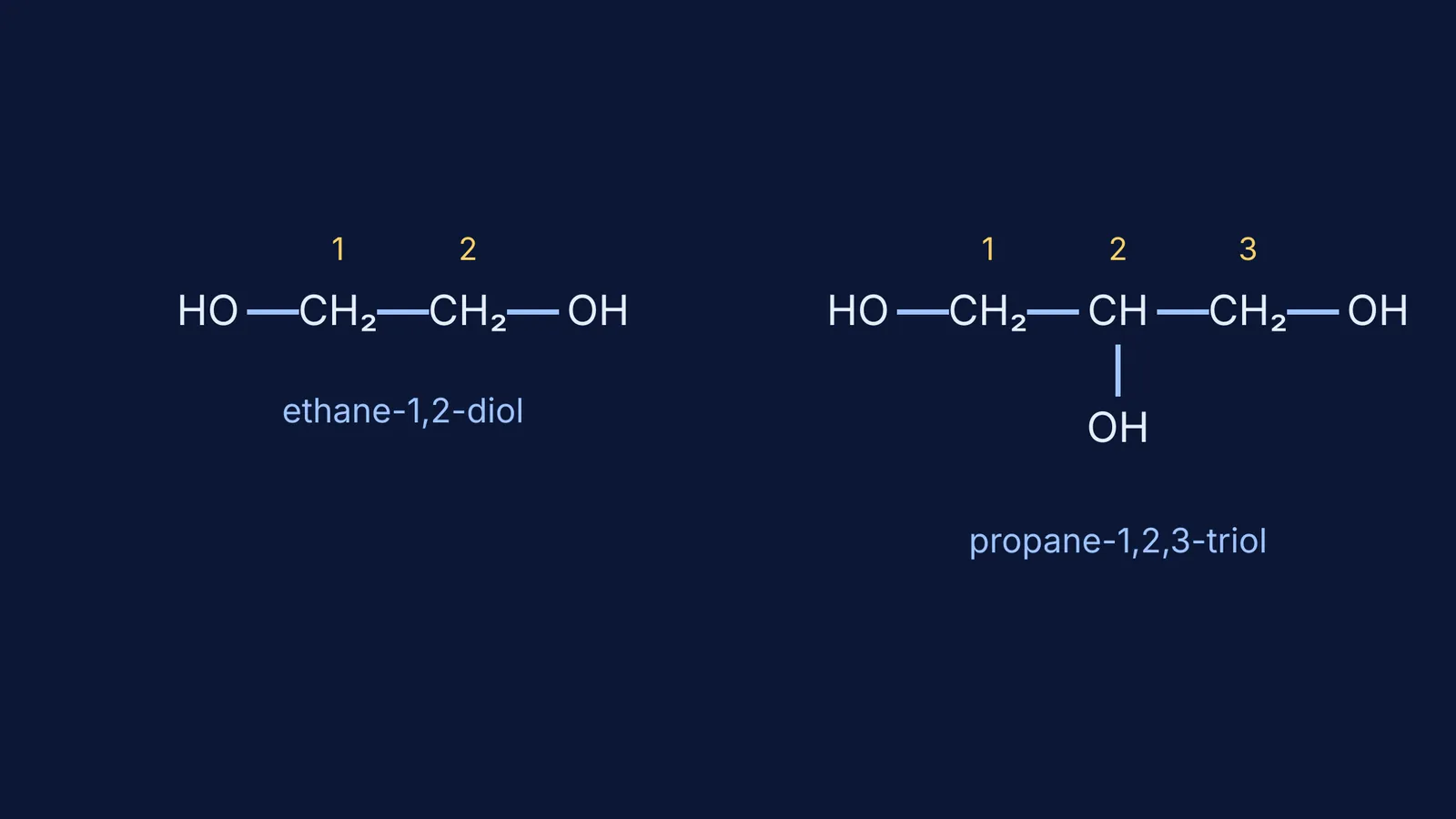
Ethylene glycol (Ethane-1,2-diol) Ethylene glycol is widely used as an industrial antifreeze and has a boiling point of 197.3 °C, according to PubChem.
Parent chain: It has a two-carbon chain, so the parent alkane is ethane.
Numbering: The two –OH groups are on adjacent carbons, numbered 1 and 2.
Suffix: Because there are two –OH groups, we use the suffix "-diol".
Result: Putting it together while keeping the "e", the IUPAC name is ethane-1,2-diol.
Glycerol (Propane-1,2,3-triol) Glycerol is a thick, sweet liquid used in food and cosmetics; its extensive hydrogen bonding gives it a very high boiling point of 290 °C, as listed by PubChem.
Parent chain: The longest continuous carbon chain has three atoms, giving us propane.
Numbering: There is one –OH group on each carbon, so the locants are 1, 2, and 3.
Suffix: With three –OH groups, the suffix is "-triol".
Result: Retaining the "e" in propane, we get propane-1,2,3-triol.
If you are distinguishing between compounds with the same formula, such as the C4H10O isomers: telling the four alcohols and three ethers apart, mastering this locant numbering is essential.
What are common mistakes when naming polyols?
When students first learn how to name diols and triols, a few common mistakes tend to appear on exams.
Forgetting the "e": The most common error is writing names like "butandiol" instead of butane-1,4-diol. Always double-check if your suffix starts with a consonant.
Numbering from the wrong end: You must number the carbon chain to give the hydroxyl groups the lowest possible locants. For example, a four-carbon chain with –OH groups on the second and third carbons should be numbered to give butane-2,3-diol.
Mixing up prefixes and suffixes: If there is a higher-priority functional group present (like a carboxylic acid), the hydroxyl groups are treated as substituents and named with the prefix "hydroxy-". But when –OH is the highest priority, it always claims the suffix.
How do you name polyols step by step?
When you face an alcohol with multiple –OH groups on an exam, follow this consistent framework:
Find the longest chain: Select the longest continuous carbon chain that contains the maximum number of hydroxyl groups.
Number for the lowest locants: Number the chain from the end that gives the –OH groups the lowest possible position numbers.
Write the alkane name: Write down the parent alkane name, being sure to keep the final "e".
Add locants and suffix: Write a hyphen, the position numbers separated by commas, another hyphen, and then the correct suffix (-diol, -triol, -tetrol).
If you are practicing these rules and find organic chemistry naming tricky, the Fermi Problem Library has worked problems with a step-by-step solver that explains the reasoning rather than printing an answer. It can help you spot whether you missed a suffix rule or numbered the chain from the wrong end.
Understanding these foundational naming rules prepares you for predicting more complex reactions, such as the differences covered in Ethanol and ethanoic acid: Class 10 properties and reactions, where identifying functional groups correctly is half the battle.


