

On this page
Dinitrogen pentoxide (N₂O₅) is a classic example of a chemical compound that completely changes its bonding nature depending on its physical state.
What is the structure of covalent N2O5?
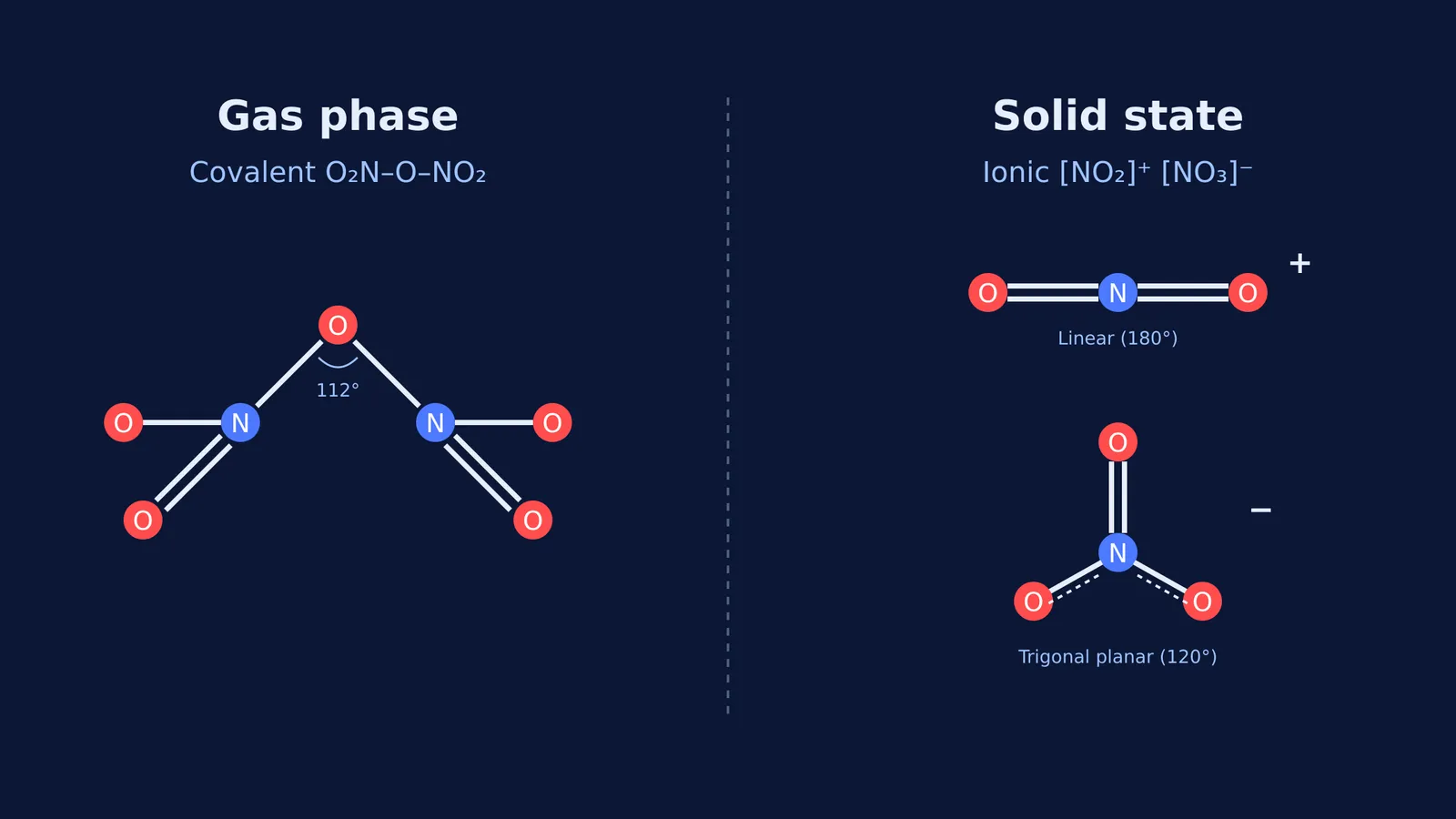
In the gas phase or when dissolved in nonpolar solvents like carbon tetrachloride, dinitrogen pentoxide exists as a covalently bound molecule with the structure O₂N–O–NO₂. The molecule features a central oxygen atom bonded to two NO₂ wings.
The central N–O–N bond angle is approximately 112°, while the O–N–O angle within each wing is roughly 134° (Source). This arrangement gives the isolated molecule a distinct propeller shape. The two –NO₂ groups are rotated by about 35° away from the N–O–N plane, creating a geometry that minimizes the repulsion between the oxygen atoms. It remains stable in this covalent form at room temperature because it has enough thermal energy to exist as a gas, where molecules are far apart and do not interact strongly with one another.
Why does solid N2O5 exist as NO2+ and NO3- ions?
When N₂O₅ is cooled below room temperature to form colourless crystals, it undergoes autoionization. The solid is not molecular; it is an ionic compound called nitronium nitrate, consisting of nitronium cations ([NO₂]⁺) and nitrate anions ([NO₃]⁻).
The driving force behind this dramatic transformation is lattice energy. Lattice energy is defined as the energy released when separated gaseous ions bind into a rigid, repeating crystalline lattice (Source). The linear shape of the [NO₂]⁺ ion and the flat, trigonal planar shape of the [NO₃]⁻ ion allow them to pack together efficiently in a crystal lattice.
In this packed arrangement, the electrostatic attraction between the oppositely charged cations and anions is immensely powerful. This attraction releases so much energy that it more than compensates for the high amount of energy required to break the central N–O covalent bond of the original gas-phase molecule. In simple terms, the solid state forces the molecule to break apart because being in an ionic lattice is vastly more thermodynamically stable at those low temperatures.
What do the nitronium and nitrate ions look like?
The two ions have distinct structures that explain their ability to pack closely in the crystal lattice:
Nitronium ion ([NO₂]⁺): Formed when a molecule loses an electron or undergoes heterolytic cleavage, this cation has a perfectly linear structure with a bond angle of 180°. It is isoelectronic with carbon dioxide, meaning it shares the same arrangement of valence electrons (Source). Because of its linear geometry, the N–O bond lengths are relatively short at 1.15 Å, indicating strong double-bond character.
Nitrate ion ([NO₃]⁻): The anion is completely flat (trigonal planar) with 120° bond angles. Its N–O bond distances are 1.24 Å, which are slightly longer than those in the cation (Source). This intermediate length is due to the partial double-bond character shared equally across all three oxygen atoms via resonance.
You can explore these structures further in the Fermi Concept Library, which has a lesson for every concept in chemistry and its place in the map.
Checklist: Covalent gases that form ionic solids
Lattice energy determines whether a solid prefers to be ionic or covalent, and N₂O₅ is not the only molecule that switches to an ionic structure when it solidifies. The competition between covalent bond strength and ionic lattice stability is a common theme in inorganic chemistry. Here is a checklist of similar molecules to watch out for in your studies:
Phosphorus pentachloride (PCl₅): The gas exists as trigonal bipyramidal molecules, but the solid form packs as the ionic salt [PCl₄]⁺ [PCl₆]⁻.
Phosphorus pentabromide (PBr₅): Unlike PCl₅, the solid form of this compound exists as [PBr₄]⁺ Br⁻.
Dinitrogen tetroxide (N₂O₄): Primarily molecular in both states, but it can autoionize into [NO]⁺ [NO₃]⁻ under specific extreme conditions or in strong acid solvents.
Iodine trichloride (I₂Cl₆ dimer): Solidifies as the ionic salt [ICl₂]⁺ [ICl₄]⁻.
Understanding these phase-dependent structure changes is a common topic in advanced chemistry exams. If you are preparing for your exams and want to test your knowledge of unusual chemical structures, looking at oxides of nitrogen structures can help solidify these concepts. You can also link this behaviour to how average bond order from resonance stabilises the nitrate ion, or explore similar structural quirks in the Lewis acidity of boron trihalides.


