

On this page
When learning to multiply two expressions like (x + 3) and (x - 5), you might have been handed the mnemonic FOIL: First, Outer, Inner, Last. It is a quick memory trick that tells you which terms to multiply. But what happens when you need to multiply a binomial by a trinomial, or if you simply forget the acronym under exam pressure?
Mathematics researcher Richard Skemp famously distinguished between *instrumental understanding* (memorising a rule without knowing why it works) and *relational understanding* (knowing both what to do and why it works) in a classic paper. FOIL often traps students in the first category. By treating algebraic multiplication as a disconnected set of steps, students can easily make mistakes when expressions become more complex. By contrast, the area model (or box method) gives you a visual way to handle algebraic multiplication that scales to any number of terms and roots itself deeply in mathematical logic.
Why does the area model beat the FOIL trick?
The area model connects algebra directly back to something you learned in early arithmetic: the area of a rectangle. If you want to multiply 13 by 12, you are essentially finding the area of a rectangle with a width of 13 and a height of 12. Because 13 is just (10 + 3) and 12 is (10 + 2), you can split that large rectangle into four smaller, manageable pieces: 100, 20, 30, and 6. Adding them up gives you 156.
In the exact same way, the product (x + 3)(x - 5) represents an area. Drawing it out as a grid forces you to apply the distributive property correctly. The distributive property dictates that every term in the first bracket must meet every term in the second. The grid ensures this happens by assigning each term its own row or column. Visualising math in this way engages different neural pathways, helping the concept stick better than rote memorisation.
If a visual method feels like it might help with other tricky topics, the Concept Library contains every concept in mathematics, each with its own lesson and its place in the map. It can guide you from basic expansions all the way to tackling quadratic word problems in Class 10 and discovering when two quadratics share a root.
How do you multiply (x + 3)(x - 5) using a grid?
Let's set up the multiplication using the box method step by step. Even though a negative number for a "length" does not exist in physical geometry, the visual grid still serves as a perfect accounting tool for algebra.
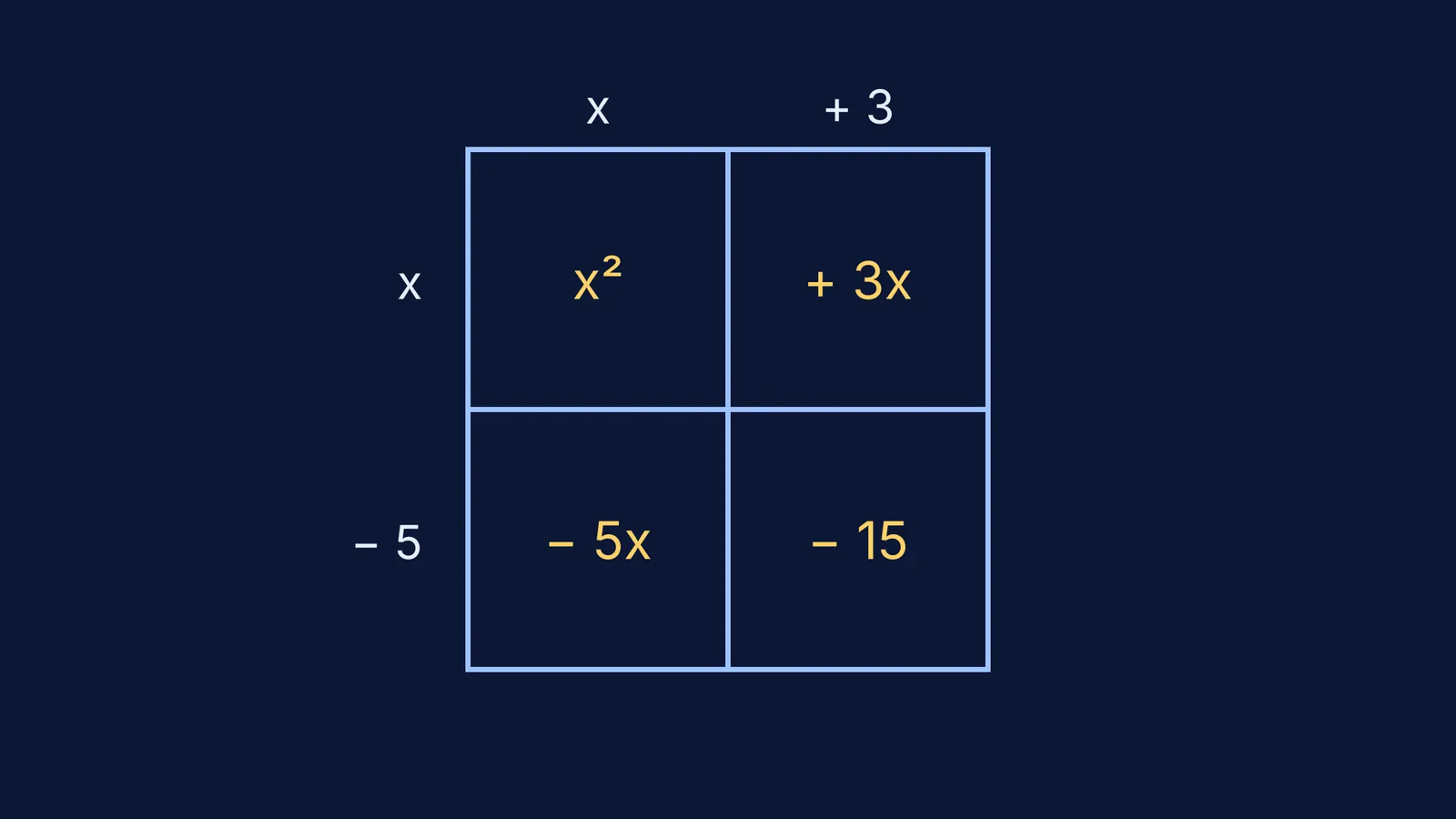
Draw the framework: Start by drawing a 2×2 grid because you are multiplying two terms by two terms.
Label the columns: Write the terms of the first binomial across the top. Place `x` above the first column and `+3` above the second.
Label the rows: Write the terms of the second binomial down the left side. Place `x` next to the first row and `-5` next to the second.
Multiply to fill: Fill each of the four boxes by multiplying the row and column headers that meet at that specific box.
Inside your grid, you will get four partial products:
Top-left box: x × x = x²
Top-right box: +3 × x = +3x
Bottom-left box: x × -5 = -5x
Bottom-right box: +3 × -5 = -15
Finally, sum the contents of the four boxes and combine the like terms. The diagonal usually contains the like terms (in this case, the +3x and -5x): x² + 3x - 5x - 15 = x² - 2x - 15.
Because the grid acts as a strict visual organiser, you are much less likely to accidentally drop a minus sign or forget a term—a common error when students rely on drawing messy arcs over their equations in the FOIL method.
How can you check your answer by substitution?
Exams can be stressful, and it is easy to make a small arithmetic slip. How do you know for sure that x² - 2x - 15 is exactly the same as (x + 3)(x - 5)?
Because the two expressions are algebraically identical, they must yield the exact same result for any given value of x. This means you can pick a simple number, substitute it into both sides, and check your work instantly. Let's test it with x = 2.
Test the original expression: (2 + 3)(2 - 5) = (5)(-3) = -15
Test your expanded expression: (2)² - 2(2) - 15 = 4 - 4 - 15 = -15
Both sides equal -15, which proves beyond doubt that your multiplication is correct. (Try it again with x = 10 if you want to be doubly sure). This substitution check is an active learning habit you can use in any test to verify your algebraic manipulations before moving on to the next question.
Once you master the area model for multiplication, it also makes the reverse process—factoring quadratics—much more intuitive. When you factor, you are simply given the "area" inside the box (like x² - 2x - 15) and asked to work backward to find the outside edge lengths. The grid gives you a solid, reliable foundation for all the polynomial work to come.


