

On this page
When working with real numbers, finding the multiplicative inverse is trivial: the inverse of 5 is 1/5. But when dealing with a complex number like z = 3 + 4i, simply writing 1 / (3 + 4i) is not a finished answer. In standard algebra, a complex number must be written in the form a + ib, with clear real and imaginary parts.
Leaving an imaginary number in the denominator makes it impossible to cleanly separate these parts. To fix this, you must transform the fraction using a technique called rationalising the denominator.
How do you find the multiplicative inverse of a + ib?
The multiplicative inverse of z = a + ib is 1/z. To clear the imaginary unit (i) from the denominator, you multiply both the numerator and the denominator by the complex conjugate of z, which is a - ib.
The genius of this method lies in the denominator. When you multiply a complex number by its conjugate, you are applying the difference of two squares: (a + ib)(a - ib) = a² - (ib)². Because i² = -1, the term -(ib)² becomes +b². The denominator neatly collapses into a² + b², which is always a purely real number.
This is not just a mathematical trick; it is a way to reduce mental strain. A 1988 study by John Sweller in *Cognitive Science* demonstrated that conventional problem-solving can overwhelm cognitive processing capacity, preventing students from acquiring new schemas (DOI: 10.1207/s15516709cog1202_4). By standardising the division process into a familiar multiplication step, you bypass the need to memorise a new, complex division formula. It is much easier to recycle your knowledge of binomial expansion.
This technique is closely tied to the modulus of a complex number. As explored in our guide on using z z̄ = |z|² to simplify complex number problems, the denominator a² + b² is exactly the square of the modulus.
A worked example: the inverse of 3 + 4i
Let's apply this to a concrete example. Find the multiplicative inverse of z = 3 + 4i.
Write the initial fraction: z⁻¹ = 1 / (3 + 4i)
Identify the complex conjugate of the denominator: 3 - 4i
Multiply the top and bottom by this conjugate:
z⁻¹ = [1 × (3 - 4i)] / [(3 + 4i)(3 - 4i)]
Expand the denominator: 3² - (4i)² = 9 - 16i² = 9 - 16(-1) = 9 + 16 = 25
Split the result into real and imaginary parts:
z⁻¹ = (3 - 4i) / 25 = 3/25 - (4/25)i
How do you check that z × z⁻¹ = 1?
Exams like the JEE punish careless algebraic mistakes. Checking your answer takes only a few seconds. If we multiply our original z by our calculated z⁻¹, we should get exactly 1.
(3 + 4i) × [3/25 - (4/25)i]
Expand the brackets:
First terms: 3 × 3/25 = 9/25
Outer terms: 3 × -(4/25)i = -12/25 i
Inner terms: 4i × 3/25 = 12/25 i
Last terms: 4i × -(4/25)i = -16/25 i²
The outer and inner terms (-12/25 i and +12/25 i) cancel each other out. Because i² = -1, the last term becomes +16/25.
Add the remaining real parts together: 9/25 + 16/25 = 25/25 = 1.
If you find yourself making sign errors during these checks, it helps to practice the foundational algebra. You can use the Fermi Problem Library, which has worked problems with a step-by-step solver that explains the reasoning rather than printing an answer. This allows you to catch exactly where a negative sign was dropped.
What does the inverse look like on the Argand plane?
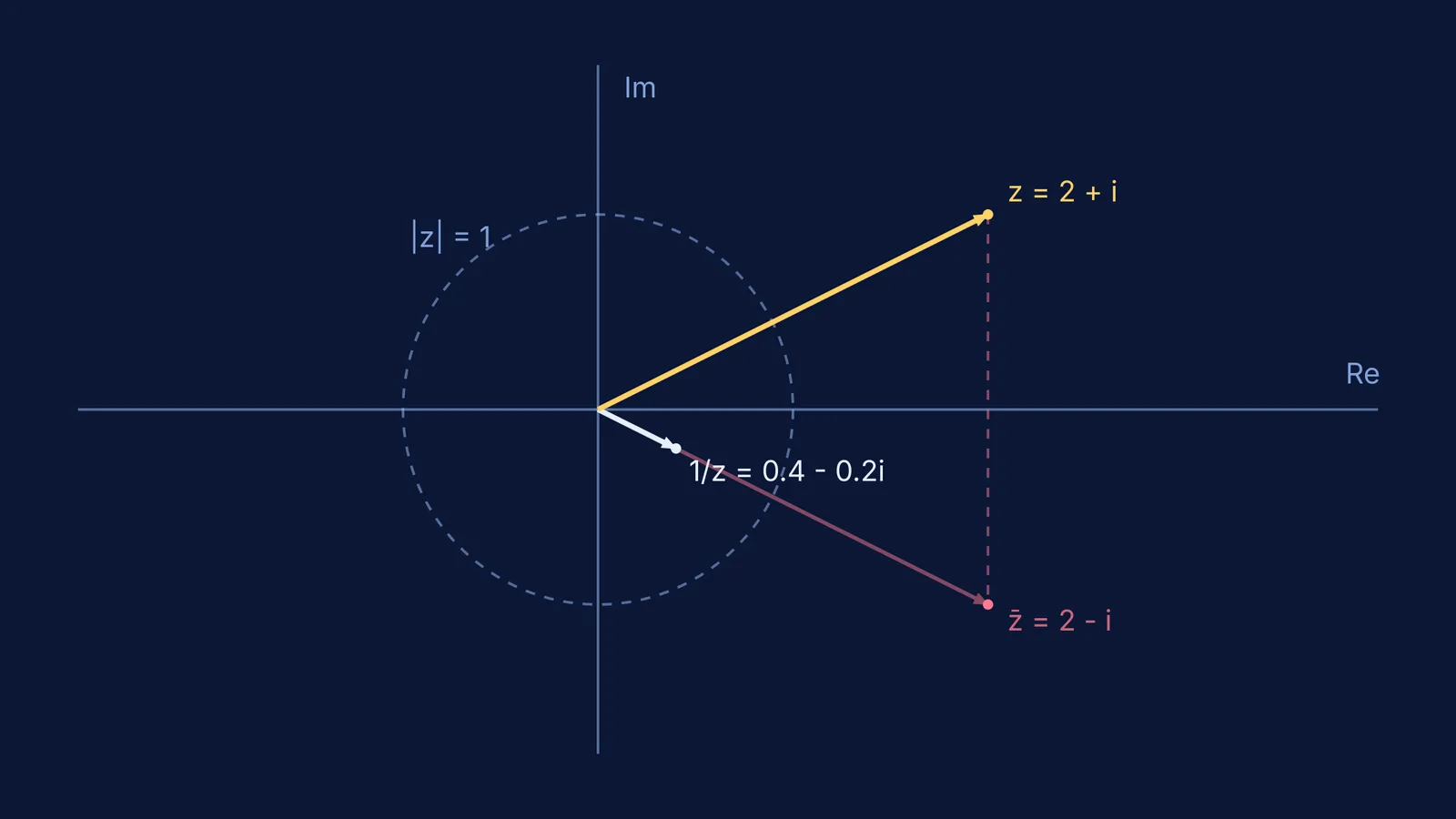
When studying complex numbers for JEE: using the Argand plane as a geometry tool, the multiplicative inverse has a beautiful geometric meaning.
If you plot z on the Argand plane, finding 1/z involves two geometric steps:
Find the conjugate z̄, which reflects your point across the real axis.
Scale that point by dividing it by the squared distance from the origin (|z|²).
If z lies far outside the unit circle, its inverse 1/z will sit close to the origin, tucked inside the circle on the same angle as the conjugate. Conversely, if z is a tiny fraction inside the unit circle, its inverse will be cast far outward into the Argand plane. Understanding this spatial relationship provides an intuitive check against calculation errors. If you are struggling to picture these reflections, the Fermi Concept Library contains every concept in mathematics, each with its own lesson and its place in the map, so you can see how inversion relates to geometry.


