

On this page
These questions are arithmetic once you know which nucleotides get read. Most wrong answers count too much: the untranslated ends, the introns, or the stop codon itself.
What does one codon add to a protein?
A codon is a sequence of three nucleotides that either encodes one amino acid or signals the end of protein synthesis, as the NHGRI genetics glossary defines it. Of the 64 possible codons, 61 specify amino acids and 3 are stop signals (NHGRI codon entry).
AUG does two jobs: it codes for methionine and it is the start codon that begins translation (OpenStax Biology 2e). From there, the mRNA is read in threes until a stop codon (same source). The stop codons are UAA, UAG and UGA, and they halt protein synthesis instead of adding an amino acid (NHGRI stop codon entry).
Three parts of a gene's message are never read as codons:
The 5′ untranslated region (UTR), the sequence before the start codon (UCSC Genome Browser education page).
The 3′ UTR, the region after the stop codon that is not translated into protein (EMBL-EBI feature definition).
Introns, which are removed by splicing before the mRNA is used to make protein (NHGRI intron entry).
If the genetic code itself feels shaky, our guide to reading codons in the genetic code without mistakes covers it first.
How many amino acids are coded by an mRNA of given length?
Count only the coding stretch: from the A of AUG to the last base of the stop codon. Call that length N.
Codons = N ÷ 3.
Amino acids = N ÷ 3 − 1, because the stop codon adds none.
If N ÷ 3 is not a whole number, you have included UTR bases or misread the question.
If the question says the length excludes the stop codon, skip the subtraction: amino acids = N ÷ 3.
How do you solve the five common question types?
Type 1, an mRNA with start and stop codons. The coding region of an mRNA is 450 nucleotides long, including AUG and a stop codon. 450 ÷ 3 = 150 codons. One is a stop codon, so the polypeptide has 149 amino acids.
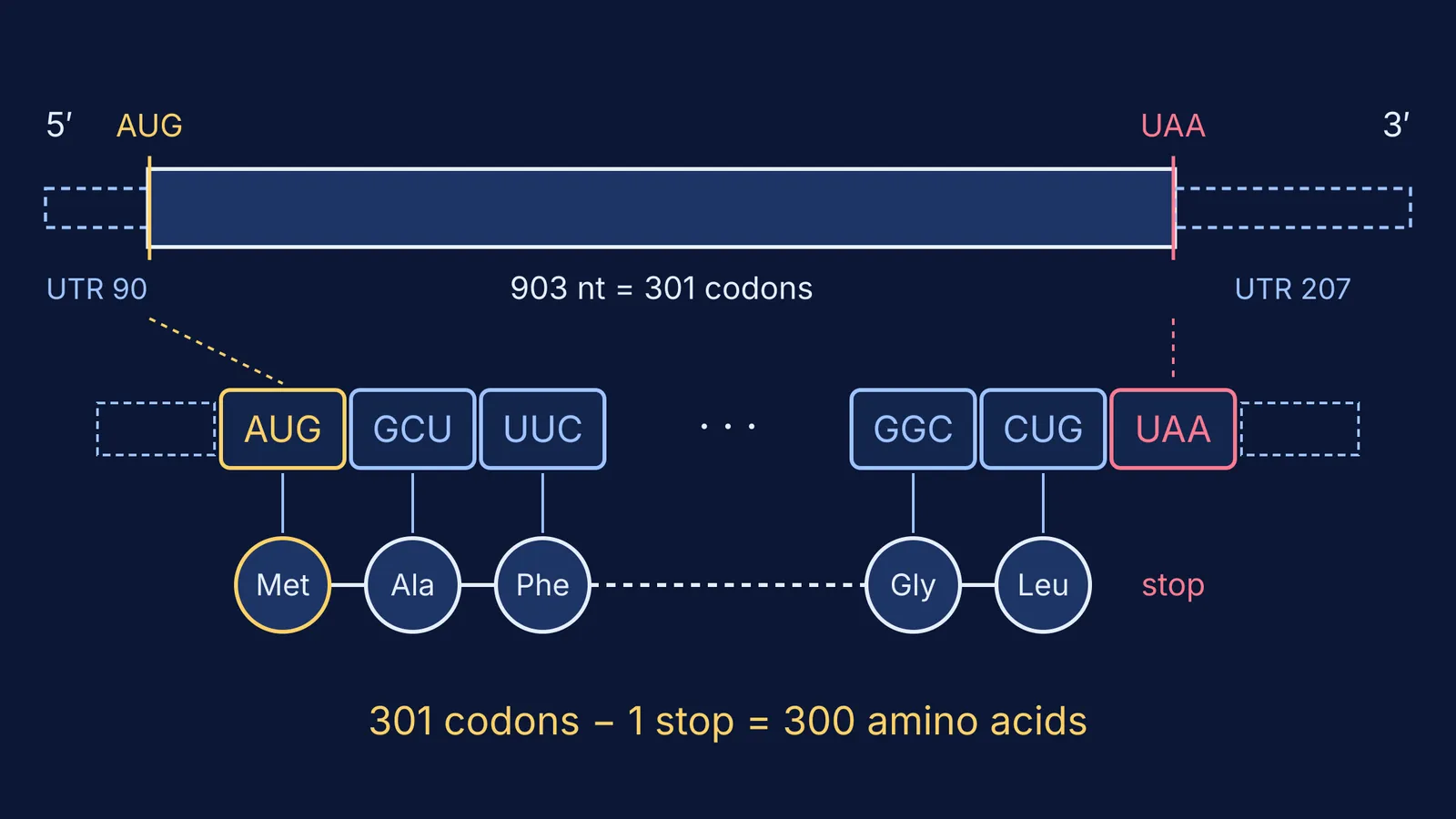
Type 2, an mRNA with untranslated ends. A mature mRNA is 1,200 nucleotides long. Its 5′ UTR is 90 nucleotides and its 3′ UTR is 207. Coding stretch = 1,200 − 90 − 207 = 903 nucleotides. 903 ÷ 3 = 301 codons; minus the stop codon, that is 300 amino acids. This is the case drawn, to scale, in the diagram above.
Type 3, from protein back to mRNA. A polypeptide has 120 amino acids. Each needs one codon: 120 × 3 = 360 nucleotides. Add 3 for the stop codon, so the minimum coding length is 363 nucleotides. Do not add another 3 for the start codon: AUG is the codon for the first methionine, so it is already inside the 360.
Type 4, a gene with introns. A eukaryotic gene is 2,100 base pairs long. Its introns total 1,200 base pairs, and the exons hold the start and stop codons with no UTRs. Exon length = 2,100 − 1,200 = 900. 900 ÷ 3 = 300 codons, so 299 amino acids. Dividing the full 2,100 gives 699, the trap answer. For how introns are cut out, see capping, tailing and splicing in eukaryotes.
Type 5, reading a written sequence. You are given 5′-GCAUGGCUUUCGGCUAAGC-3′. Do not start at the first base; find the first AUG, at positions 3 to 5. Read in threes from there: AUG GCU UUC GGC UAA. Using a standard codon table/zz:_Back_Matter/21:_Appendix_1:_Codon_Table), that is Met, Ala, Phe, Gly, then stop. Four amino acids. The GC before AUG and the GC after UAA are untranslated.
Which mistakes cost marks in these questions?
Check these before you mark an option.
Did I subtract one for the stop codon, and only once?
Going from protein to mRNA, did I add 3 for the stop codon but nothing extra for AUG?
Did I remove the UTRs and introns before dividing?
Is the length in nucleotides of one strand, or in base pairs? A 363-base-pair stretch of DNA has 363 nucleotides on each strand, so 726 in total. Answer what was asked.
In a written sequence, did I start at the first AUG rather than the first base?
If your answer keeps missing the key, the Fermi Problem Library has worked problems with a step-by-step solver that explains the reasoning rather than printing an answer, so you can see which step went wrong. When the gap is in the biology rather than the arithmetic, the Fermi Concept Library gives each biology concept its own lesson.
Next, see what happens to these counts when a single base is added or lost in point and frameshift mutations.


