

On this page
In organic synthesis, reducing a carbonyl group to an alcohol—or oxidising an alcohol back to a carbonyl—often requires harsh reagents that can destroy other fragile parts of a molecule. The Meerwein-Ponndorf-Verley (MPV) reduction and the Oppenauer oxidation solve this problem. These two named reactions are simply the forward and backward directions of a single, elegant equilibrium process.
They stand out because they do not rely on powerful metal hydrides or strong oxidising agents. Instead, they use a simple alcohol, a ketone and an aluminium catalyst to pass a hydrogen atom back and forth. You can explore the chemical properties of carbonyls and alcohols in depth within the Fermi Concept Library.
What is the Meerwein-Ponndorf-Verley reduction?
Discovered independently in 1925 by Albert Verley and the team of Hans Meerwein and Rudolf Schmidt, the MPV reduction is a selective method for reducing aldehydes and ketones to their corresponding alcohols.
The reaction uses aluminium isopropoxide as a catalyst and isopropanol (isopropyl alcohol) as the hydride source. When a ketone is heated with these reagents, the isopropanol transfers a hydride ion (H⁻) to the ketone. This converts the ketone into a secondary alcohol, while the isopropanol itself is oxidised into acetone.
To drive the equilibrium towards the desired alcohol product, the reaction is usually carried out in an excess of isopropanol, and the low-boiling acetone is continuously distilled off as it forms.
If you instead need to strip the oxygen away completely to form an alkane, you would use a different approach; see Clemmensen vs Wolff-Kishner: reducing a C=O group to CH2.
What is the Oppenauer oxidation?
Introduced in 1937 by Rupert Viktor Oppenauer, the Oppenauer oxidation is the exact reverse of the MPV reduction. It is widely used to oxidise secondary alcohols to ketones.
In this process, the starting alcohol is treated with a ketone (often acetone or cyclohexanone) in the presence of an aluminium catalyst, typically aluminium isopropoxide or aluminium tert-butoxide. The starting alcohol donates a hydride to the acetone, turning the acetone into isopropanol and converting the starting alcohol into a ketone.
Because the reaction is a true equilibrium, it is driven forward by using a large excess of the hydride-accepting ketone. The Oppenauer oxidation is famous for its role in steroid chemistry, where it oxidises specific hydroxyl groups without degrading the complex steroid skeleton.
How does the cyclic transition state work?
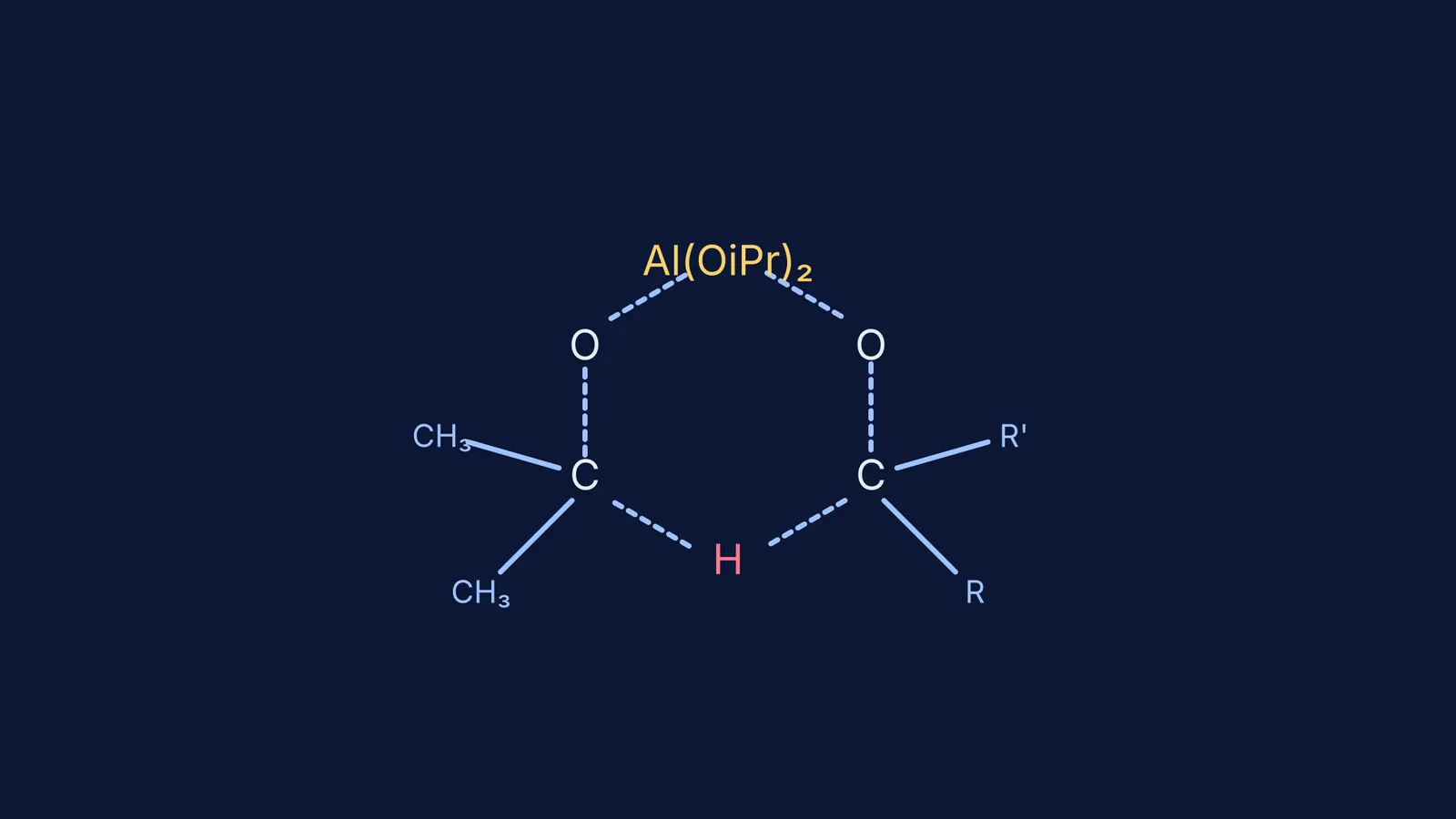
Both reactions proceed through the same mechanism: a direct hydride transfer via a six-membered cyclic transition state.
Coordination: The aluminium catalyst acts as a Lewis acid. In the MPV reduction, the oxygen atom of the starting ketone binds to the aluminium atom, which is already attached to isopropoxide groups.
The six-membered ring: The atoms arrange themselves into a six-membered ring containing the aluminium atom, two oxygen atoms, two carbon atoms and the transferring hydrogen atom.
Hydride shift: Within this tight, concerted ring, a hydride ion shifts directly from the carbon of the alcohol to the carbon of the ketone.
Release: The newly formed alcohol detaches from the aluminium, ready for the cycle to begin again.
Because the hydride transfers entirely within the coordinated complex, no free hydride ions are ever released into the solution. If you find drawing these transition states tricky, the Fermi Problem Library offers a step-by-step solver that explains the reasoning behind reaction mechanisms.
Why are these reactions so selective?
The hallmark of both the MPV reduction and the Oppenauer oxidation is their high chemoselectivity.
Standard catalytic hydrogenation (using hydrogen gas over a metal catalyst) will often reduce both a ketone and any carbon-carbon double bonds present in the molecule. In contrast, the MPV reduction specifically targets the carbonyl group. It leaves carbon-carbon double bonds, triple bonds, nitro groups and halogens untouched.
Similarly, the Oppenauer oxidation is mild enough to oxidise secondary alcohols to ketones without over-oxidising them to carboxylic acids, avoiding the side reactions that plague primary alcohols under harsher conditions. For distinguishing between different types of oxidisable carbonyls analytically, see Tollens' and Fehling's tests: which carbonyl compounds pass them.
How do you choose the right conditions?
The choice between reduction and oxidation comes down to Le Chatelier's principle.
For reduction (MPV): You must force the hydride onto your molecule. You use an excess of isopropanol (the hydride donor) and physically remove the resulting acetone from the reaction vessel.
For oxidation (Oppenauer): You must pull a hydride off your molecule. You flood the system with acetone or cyclohexanone (the hydride acceptor) so that it outcompetes everything else to take the hydride.


