

On this page
It is one of the most stubborn misconceptions in all of science. You kick a football across the grass, and it eventually rolls to a stop. You slide a book across a table, and it halts almost immediately. Because every moving thing we see eventually stops, it is natural to conclude that motion requires a continuous force to sustain it.
But this intuition is completely backward. Newton's first law of motion states that a moving body will continue moving in a straight line forever, without any pushing or pulling, as long as no net external force acts upon it.
So why do things stop? Because of friction.
Does a moving body need a force to keep moving?
No, it does not. If you throw a wrench in deep space, far from the gravitational pull of planets or stars, it will travel in a straight line at a constant speed forever. It requires zero force to maintain its motion.
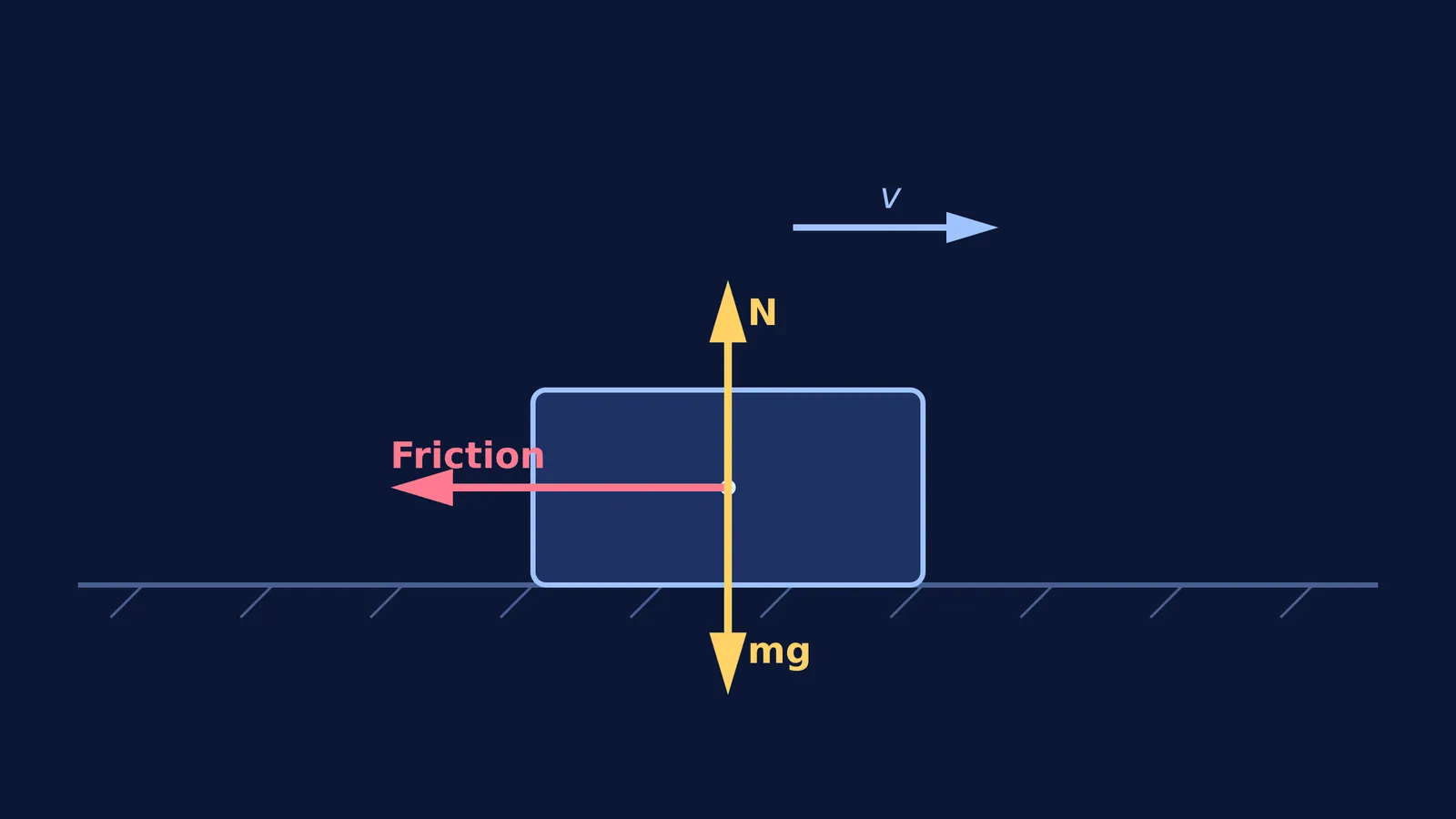
Here on Earth, however, objects are always interacting with their environment. When you push a heavy box across the floor and then let go, the box slows down and stops. It does not stop because the "force of your push" ran out. It stops because the floor is actively pulling backward on the box. That backward pull is friction.
According to research behind the Force Concept Inventory published in *The Physics Teacher* (source), 80% or more of students in traditional introductory courses begin with non-Newtonian misconceptions about motion. This belief—often called the "impetus" misconception—dates back to Aristotle, who incorrectly believed that rest was the natural state of all matter. In the Aristotelian view, an object requires a mover to keep it in motion, and once the mover stops acting, the object returns to rest. It took Galileo and Newton to realize that objects resist changes to their motion, a property we now call inertia.
Why does friction hide Newton's first law?
When you ride a bicycle on a flat road at a steady 15 km/h, you have to keep pedalling. It feels like your pedalling force is what is keeping you moving.
However, your pedalling is not causing your forward motion—it is merely cancelling out the opposing forces. Air resistance is pushing against your chest, and rolling resistance is acting on your tyres. If your forward push exactly matches the combined backward push of friction and drag, the net force on you is zero. (Understanding how friction behaves is essential for mechanics, such as finding the angle of repose and angle of friction for sliding blocks.)
With a net force of zero, Newton's first law takes over: you maintain your current state of motion. Your pedalling does not create velocity; it prevents deceleration.
This is why free-body diagrams are so crucial in physics. If you draw all the forces acting on a coasting car, you will see that the only horizontal force is friction, pointing backward. The net force is backward, which means the car must be decelerating. There is no "forward force of velocity."
Why is a frictionless world hard to imagine?
Our brains are wired for the environment we live in, where friction and air resistance are inescapable. We never see a frictionless surface in everyday life. Even an ice rink has some friction.
Because we never experience true inertia without opposing forces, learning Newton's first law requires unlearning decades of personal experience. It means accepting that a puck sliding on a perfectly frictionless table has exactly the same horizontal forces acting on it as a puck sitting still on that same table: none at all.
How do you fix the "impetus" misconception?
If you find yourself drawing forward force arrows on objects that are merely coasting, here is a framework to correct your reasoning:
Separate velocity from force: Velocity tells you which way an object is going. Force tells you how that velocity is changing (accelerating or decelerating). They do not have to point in the same direction.
Name the interacting object: For every force you draw, you must be able to name the physical object applying it. Gravity comes from the Earth. The normal force comes from the floor. (Correctly naming the normal force is critical in complex scenarios, such as calculating the normal force for a car over a hump.) If you draw a forward "force of motion," ask yourself: *what object is pushing it?* If you cannot name the object, the force does not exist.
Check for acceleration: If an object is moving at a constant speed in a straight line, its acceleration is zero. According to Newton's second law, a zero acceleration means a zero net force.
Use the Concept Library: If you are preparing for exams like JEE Main or NEET-UG, mastering these fundamental rules is the difference between guessing and knowing. The Fermi Concept Library contains every concept in physics, chemistry, biology, mathematics and computing, each with its own lesson to help you untangle intuition from actual physics.
When you finally accept that motion is just as "natural" a state as rest, mechanics becomes much easier to understand. Objects do not want to stop—they are forced to stop. If you are stuck on a tricky free-body diagram, Fermi's AI tutor can sit with you and work through the reasoning, drawing the figure and running the simulation until the concept clicks.


