

On this page
When studying rotational motion, you will frequently encounter objects of different shapes spinning about their axes. The moment of inertia describes how much an object resists rotational acceleration, which depends entirely on how its mass is distributed.
What is the moment of inertia of a solid cone about its axis?
The moment of inertia (I) of a uniform solid right circular cone of mass M and base radius R about its central axis is 3MR²/10 1. This applies when the cone rotates around the vertical line passing straight through its apex and the centre of its circular base.
Comparing this to a uniform solid cylinder, which has a moment of inertia of MR²/2 1, the solid cone's value is significantly smaller. Because a cone tapers towards the top, more of its mass is packed closely around the axis of rotation, reducing its rotational inertia. The angular variation of this inertia and the resulting inertia ellipsoid are classic subjects of experimental physics labs 2.
How do you set up the integral with infinitesimally thin discs?
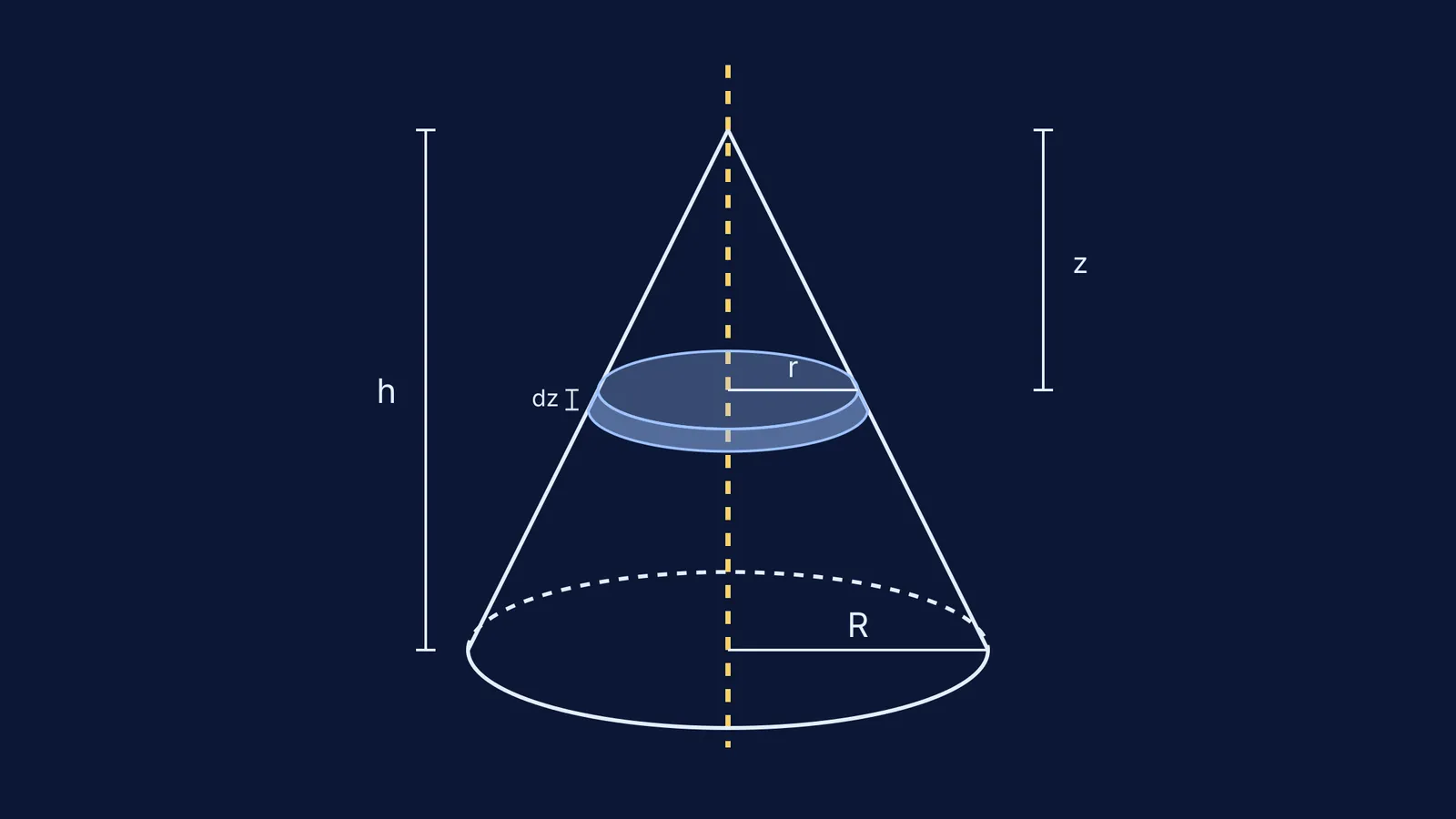
To calculate the moment of inertia for continuous objects, we use the integral I = ∫ r² dm 3. For a solid cone, the easiest approach is the method of discs. We imagine slicing the cone horizontally into infinitesimally thin circular discs stacked on top of each other, parallel to the base.
If the cone has a total mass M, a base radius R, and a total height h, its uniform volume density (ρ) is its mass divided by its total volume. The volume of a cone is one-third the volume of a cylinder with the same base and height: ρ = 3M / (πR²h)
Consider one infinitesimally thin disc at a depth z down from the apex, with a microscopic thickness dz. By looking at the similar triangles formed by a cross-section of the cone, the radius r of this disc shrinks linearly with depth: r = Rz / h
The mass (dm) of this elemental disc is its volume multiplied by the uniform density. The volume of the disc is its flat face area (πr²) multiplied by its vertical thickness (dz): dm = ρ × πr² dz
Substituting the expression for r into the mass equation gives: dm = ρ × π(R² / h²) z² dz
The moment of inertia of any uniform thin disc about its central perpendicular axis is 1/2 mr² 3. So, the moment of inertia (dI) of our single elemental disc is half its mass times its radius squared: dI = 1/2 × dm × r² dI = 1/2 × [ρ × π(R² / h²) z² dz] × (R² / h²) z² dI = (1/2) ρπ (R⁴ / h⁴) z⁴ dz
How to integrate the discs from apex to base?
To find the total moment of inertia I, we sum up the individual contributions of all these thin discs. We integrate dI from the apex (z = 0) down to the circular base (z = h).
I = ∫ (from 0 to h) (1/2) ρπ (R⁴ / h⁴) z⁴ dz
Since 1/2, ρ, π, R, and h are constants that do not change as we move along the z-axis, we pull them outside the integral sign: I = (1/2) ρπ (R⁴ / h⁴) ∫ (from 0 to h) z⁴ dz
The integral of z⁴ with respect to z is z⁵/5. Evaluating this from 0 to h gives h⁵/5: I = (1/2) ρπ (R⁴ / h⁴) (h⁵ / 5) I = (1/10) ρπ R⁴ h
Now, we substitute the uniform density ρ = 3M / (πR²h) back into our integrated expression: I = (1/10) [3M / (πR²h)] × π R⁴ h
The terms π, h, and two powers of R cancel out neatly, leaving the final result: I = 3MR² / 10
How does a solid cone compare to a hollow cone?
What happens if the cone is hollow, like a party hat, with all its mass M residing on the thin outer shell?
The moment of inertia of a right circular hollow cone about its central axis is MR²/2 1. This is exactly the same as the moment of inertia of a solid cylinder of the same mass and radius. The hollow cone has its mass distributed further out along the slanted surface than a solid cone does. Because the mass is further from the central axis on average, its moment of inertia (5MR²/10) is significantly greater than the solid cone's (3MR²/10).
If you are reviewing the dynamics of rotating bodies, see our guides to finding torque about a point with vectors and solving radius of gyration problems. If you find yourself getting stuck setting up integral volume elements for these derivations, the Fermi Problem Library provides worked problems with a step-by-step solver that explains the reasoning rather than printing an answer. To see where moment of inertia fits into the wider syllabus, check the Fermi Concept Library, which covers every concept in physics, chemistry, biology, mathematics and computing, each with its own lesson and its place in the map.


