

On this page
Calculating the moment of inertia of a complex shape often looks daunting, but it becomes straightforward when you break the object into simpler parts. An L-shaped rod is a classic example of this approach.
To find the moment of inertia of an L-shaped rod about the corner, you simply calculate the moment of inertia for each straight arm and add them together. This relies on the principle of superposition, which states that the total moment of inertia of a compound object is the sum of the moments of inertia of its individual segments.
What is the moment of inertia of a single uniform rod?
Before tackling the full L-shape, you need the formula for a single, straight rod. According to OpenStax University Physics, the moment of inertia for a uniform thin rod of mass M and length L rotating about an axis through its end (perpendicular to its length) is:
I = ML² / 3
If the axis passes through the rod's centre of mass instead, the moment of inertia is ML² / 12. You can confirm this relationship using the Moment of inertia: parallel and perpendicular axis theorems, shifting the axis from the centre to the end by a distance of L/2.
How do you find the moment of inertia of an L-shaped rod about the corner?
When the rotation axis passes through the corner of the "L" and is perpendicular to the plane of the rod, both arms are rotating about their ends.
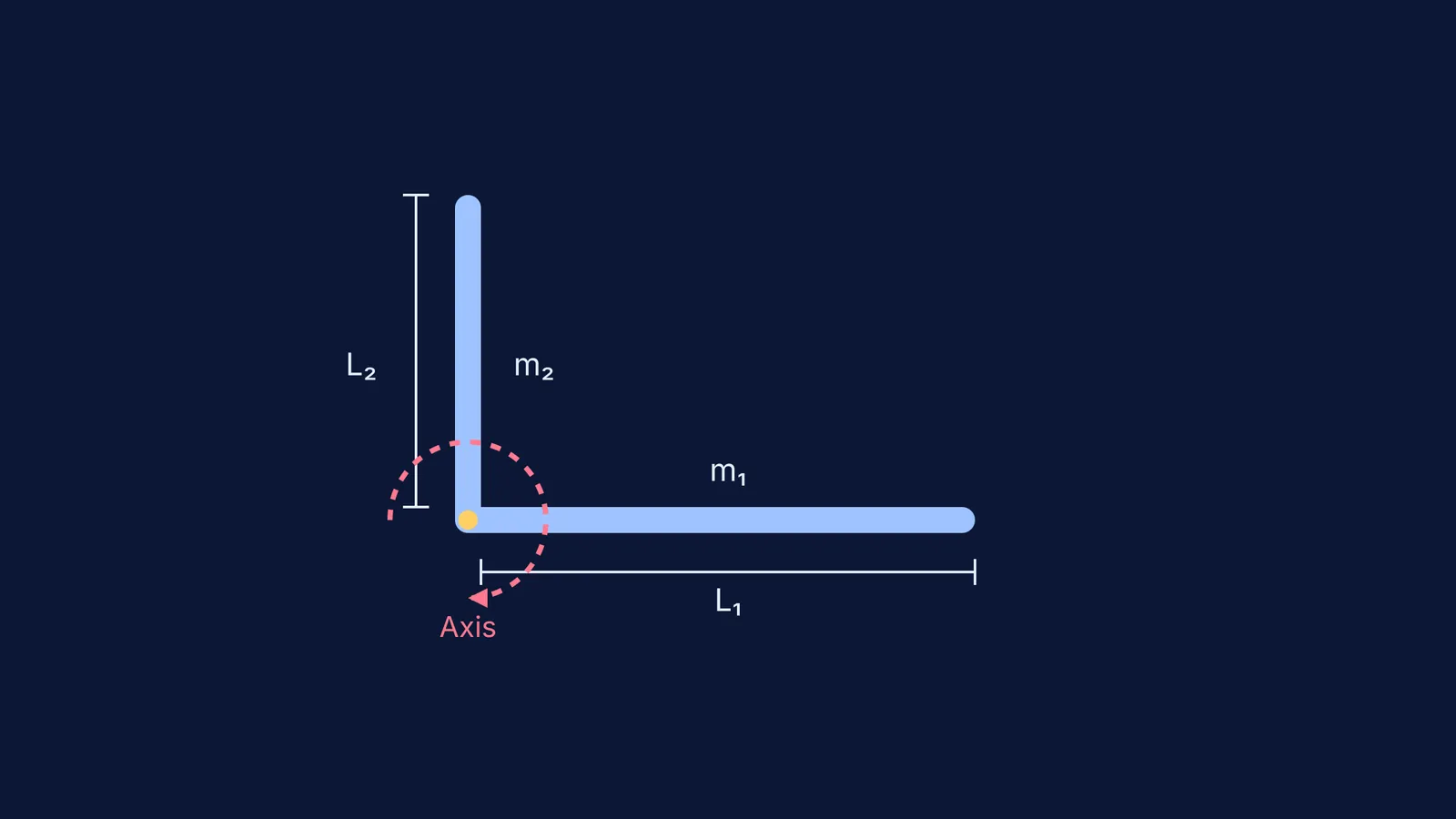
Imagine an L-shaped rod made of two segments:
Arm 1 (horizontal): Mass m₁ and length L₁.
Arm 2 (vertical): Mass m₂ and length L₂.
Because the axis passes exactly through the vertex where they meet, you apply the end-pivot formula to each arm independently.
The moment of inertia of Arm 1 is I₁ = m₁L₁² / 3.
The moment of inertia of Arm 2 is I₂ = m₂L₂² / 3.
The total moment of inertia is just the sum: I_total = (m₁L₁² / 3) + (m₂L₂² / 3)
What if the L-shape has two equal arms?
Examiners frequently set a problem where an L-shaped object is made of two identical uniform rods, each of mass m and length L, joined at a right angle.
Using our framework:
I₁ = mL² / 3
I₂ = mL² / 3
Adding them together gives the total moment of inertia about the corner: I_total = 2mL² / 3
What if the rod is bent from a single wire?
Be careful with the wording in your exams. If the problem states that a single uniform wire of total mass M and total length L is bent into an L-shape at its midpoint, the values change:
The mass of each arm is M/2.
The length of each arm is L/2.
Substitute these into the end-pivot formula for one arm: I_arm = (1/3) × (M/2) × (L/2)² = ML² / 24
Since there are two identical arms, the total moment of inertia is: I_total = 2 × (ML² / 24) = ML² / 12
You can find more derivations like this in our guide to Moment of inertia by integration: rods, rings, discs and spheres.
What is the moment of inertia about the far end?
What happens if the axis does not pass through the corner, but instead passes through the free end of the horizontal arm (perpendicular to the plane)?
Let the two arms each have mass m and length L.
The horizontal arm is rotating about its own end, so its contribution is still I₁ = mL² / 3.
The vertical arm is no longer rotating about its end. Its centre of mass is halfway down its length. From the new axis, the horizontal distance is L and the vertical distance is L/2.
Using Pythagoras' theorem, the straight-line distance d from the pivot to the vertical arm's centre of mass is d = √(L² + (L/2)²) = √(5L² / 4).
Apply the parallel axis theorem (I = I_cm + md²) to the vertical arm, giving I₂ = (1/12)mL² + m(5L² / 4) = (1/12)mL² + (15/12)mL² = (16/12)mL² = 4mL² / 3.
The total moment of inertia is the sum of both parts: I_total = (1/3)mL² + (4/3)mL² = 5mL² / 3
If you want to practise applying these rotational theorems to complex shapes, try the Fermi Problem Library. It offers worked problems with a step-by-step solver that explains the reasoning, so you can check your parallel axis distances.


