

On this page
When you inflate a tyre, you are pushing more gas molecules into a fixed volume. The pressure on the walls increases because countless molecules are striking them every second. But how many exactly?
The kinetic theory of gases links the macroscopic property of pressure to the microscopic chaos of moving molecules. By looking at the momentum change of a single molecule and the total collision rate, we can work out how many molecules hit a given area in a given time.
How do molecules create pressure on a wall?
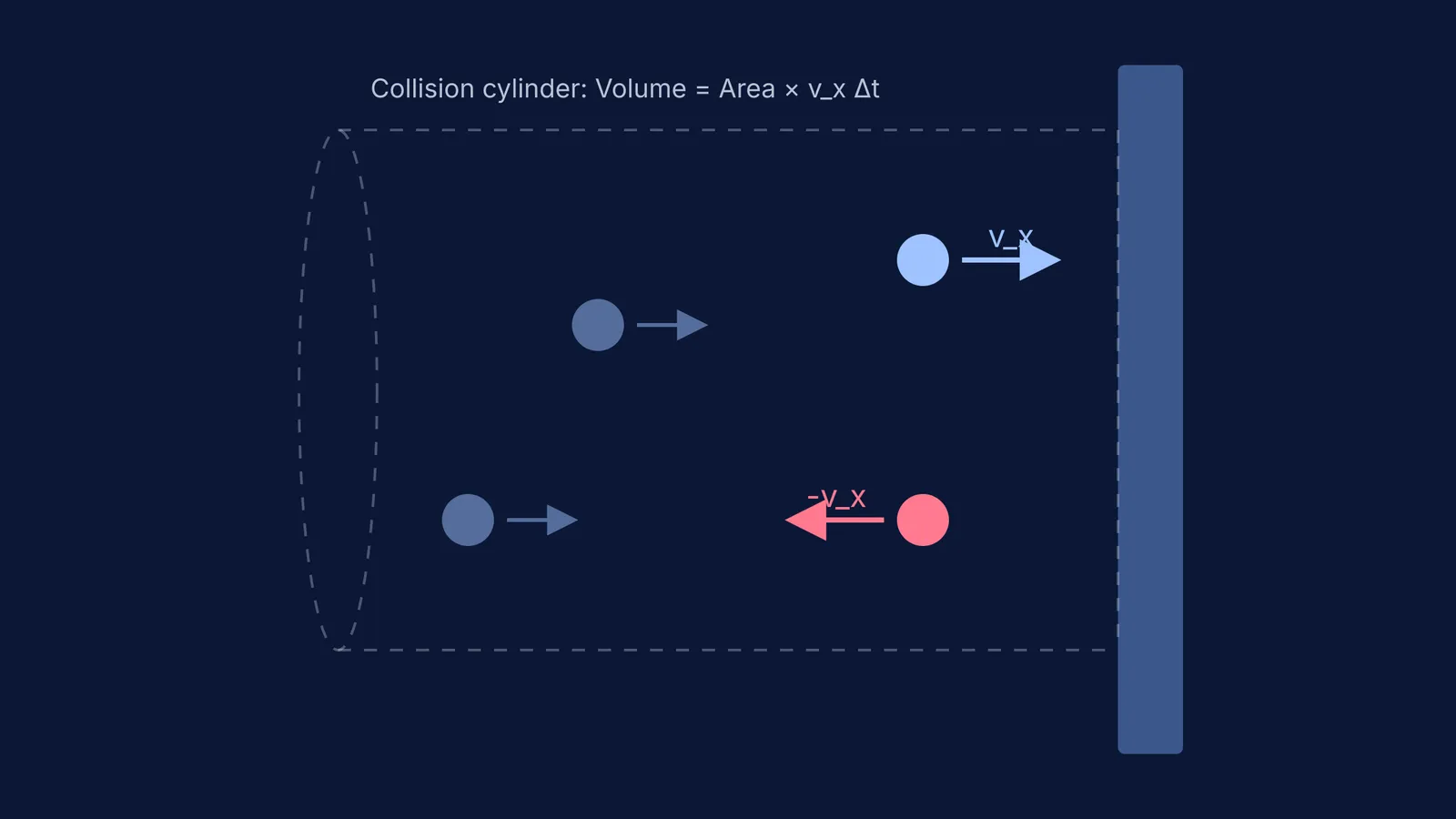
Pressure is force per unit area, and force is the rate of change of momentum. When a gas molecule of mass *m* moves towards a wall with a velocity *vₓ* and bounces off elastically, it rebounds with a velocity of *−vₓ*.
The change in momentum for this single collision is *2mvₓ*. To find the total force on the wall, we need to know how many of these collisions happen every second. This requires counting all the molecules that are close enough to the wall and moving in the right direction to hit it within a given time interval. A common way to visualise this is by drawing a "collision cylinder" extending away from the wall. Only the molecules inside this cylinder that are heading towards the wall will actually strike it.
If you are studying for exams and struggle to picture these microscopic models, the Fermi Concept Library gives every concept its own lesson and its place in the map.
What is the number of gas molecules hitting a wall per second?
According to kinetic theory, the number of collisions with a wall per unit area per unit time (often written as *z_w*) depends on how dense the gas is and how fast its molecules are moving. The formula is:
z_w = (1/4) × (N/V) × ⟨v⟩
Here, *N/V* is the number density of the gas (how many molecules are in a unit volume), and *⟨v⟩* is the average speed of the molecules.
Where does the factor of 1/4 come from? First, at any given moment, only half of the molecules are moving towards the wall (the other half are moving away), which introduces a factor of 1/2. Second, because molecules are moving in all possible directions in three-dimensional space, the average of their velocity components perpendicular to the wall is half of their overall average speed. Multiplying these together gives the 1/4 factor.
To put this into perspective, oxygen gas (O₂) at 25 °C and 1.00 bar has a collision frequency of 2.70 × 10²³ collisions per square centimetre per second (Chemistry LibreTexts/27%3A_The_Kinetic_Theory_of_Gases/27.04%3A_The_Frequency_of_Collisions_with_a_Wall)).
How does collision rate depend on temperature and mass?
The average speed of a gas molecule is governed by its temperature and its molar mass. If you heat the gas, the molecules move faster. If you swap a light gas for a heavy one, the molecules move slower.
Because the collision rate *z_w* is directly proportional to the average speed, it is also proportional to the square root of the absolute temperature, and inversely proportional to the square root of the molar mass.
This relationship is the microscopic reason behind Graham's Law of Effusion. If you prick a tiny hole in a container, the rate at which gas escapes is simply the collision frequency with the area of that hole. Hydrogen (H₂), being very light, has an average speed of 1770 m/s at 25 °C and 1.00 bar, giving it a collision rate of 1.08 × 10²⁴ hits per cm² per second under the same conditions (Chemistry LibreTexts/27%3A_The_Kinetic_Theory_of_Gases/27.04%3A_The_Frequency_of_Collisions_with_a_Wall)). It will effuse much faster than oxygen.
If you hit a roadblock while working through effusion numericals, the Fermi Problem Library has worked problems with a step-by-step solver that explains the reasoning rather than printing an answer.
How to work back from pressure to collision rate?
We can also express the collision frequency entirely in terms of measurable macroscopic properties: pressure (*P*) and temperature (*T*). Using the ideal gas law to replace the number density (*N/V = P / k_B T*) and substituting the formula for average speed, the collision rate becomes:
z_w = P / √(2π m k_B T)
This form is incredibly useful in vacuum physics and surface chemistry. If you know the pressure of a gas, you can instantly find out how often molecules are bombarding a surface. When you are tackling a tricky problem, follow this checklist to avoid common mistakes:
Check your units: pressure must be in Pascals (N/m²), not atmospheres or bar.
Use the mass of a single molecule (*m*) in kilograms, not the molar mass (*M*) in grams per mole.
Ensure the temperature is in Kelvin.
Remember that *z_w* gives you collisions per square metre per second. If the question asks for square centimetres, you must convert the area carefully.
By tying together the average molar mass of a gas mixture and the mechanics of a free expansion of an ideal gas, the kinetic theory provides a complete picture: from the invisible bounce of a single molecule to the pressure that holds up a car tyre.


