

On this page
If you are solving complex number problems in your Class 11 exams or the JEE, you will often need to simplify fractions involving z. When a problem states that z lies on the unit circle (which means its modulus |z| = 1), a very useful shortcut appears.
What happens if mod z equals 1?
Every complex number z = x + iy has a complex conjugate, written as z̄ = x - iy. When you multiply a number by its conjugate, the imaginary parts cancel out, leaving the sum of the squares of the real and imaginary parts. According to mathematical definitions, this sum is the square of the modulus (or absolute value) of z, giving the fundamental identity z × z̄ = |z|² 1.
If you know that the modulus is 1, squaring it still gives 1. Substitute this into the equation, and you get z × z̄ = 1. By dividing both sides by z, you find that the reciprocal of z is exactly its conjugate: 1/z = z̄.
Why does 1 by z equal z bar?
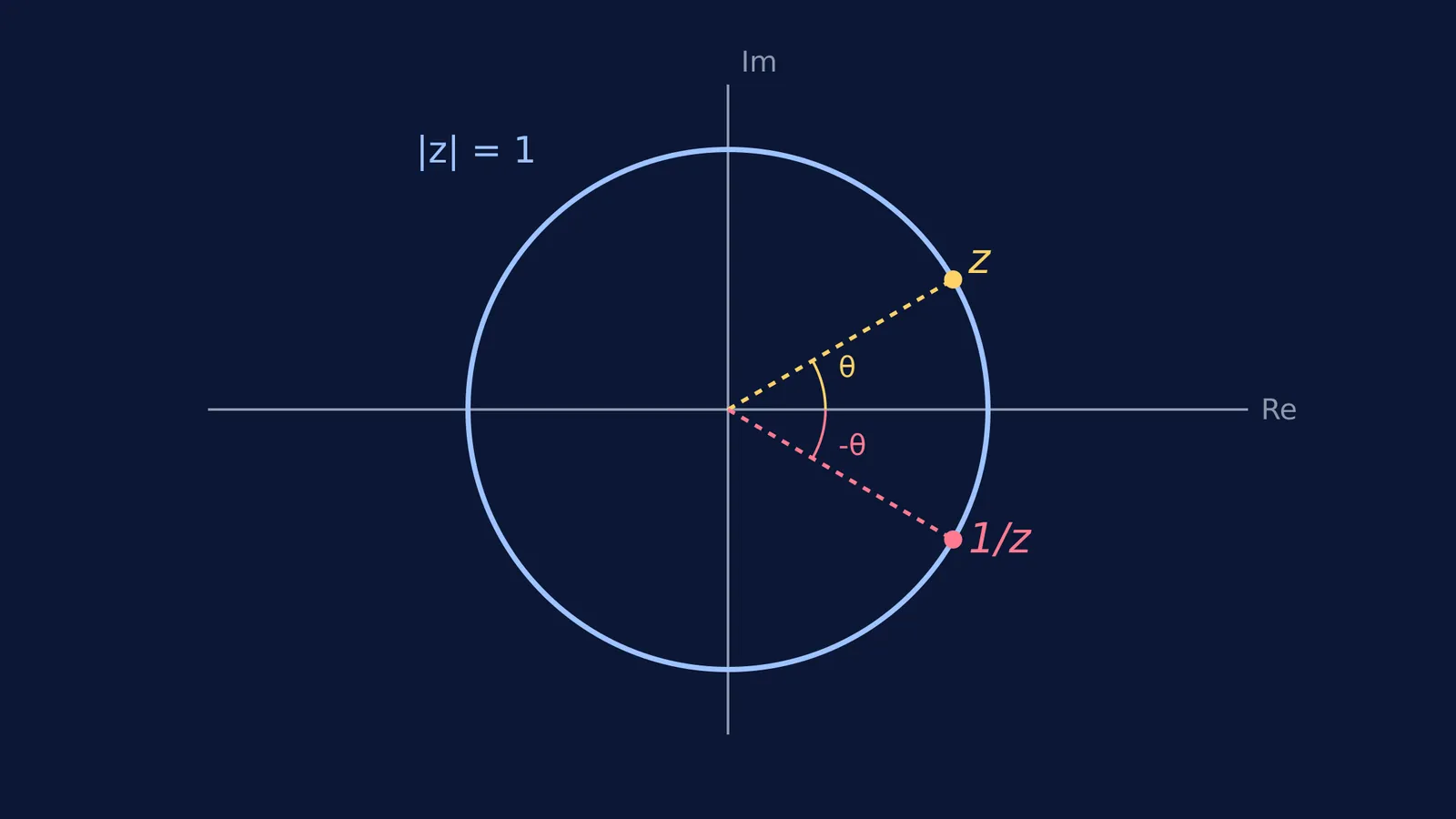
Geometrically, the modulus of a complex number is its distance from the origin on the complex plane. An equation like |z| = 1 describes a circle with a radius of 1, known as the unit circle.
When you take the conjugate of a number on this circle, you reflect it across the horizontal real axis. When you calculate the reciprocal, you invert its distance from the origin and you reverse its angle. Because the distance was already 1, inverting it leaves it at 1. Reversing the angle puts it in the exact same spot as the reflection. Therefore, the reciprocal and the conjugate are the very same point.
Once you have established this point on the circle, you might also need to find its angle, which you can read more about in finding arg z in each quadrant.
How do you use this in exam problems?
This fact is a standard tool for simplifying complex expressions. If a question asks you to evaluate or simplify a fraction like (z - 1) / (z + 1) given that |z| = 1, you can replace z̄ with 1/z.
Example: Proving an expression is purely imaginary Let W = (z - 1) / (z + 1). To test if this is real or imaginary, we can find its conjugate, W̄.
The conjugate of a quotient is the quotient of the conjugates: W̄ = (z̄ - 1) / (z̄ + 1).
Because |z| = 1, we can substitute z̄ = 1/z.
W̄ = (1/z - 1) / (1/z + 1).
Multiply the top and bottom by z to clear the fractions: W̄ = (1 - z) / (1 + z).
Factor out a minus sign from the numerator: W̄ = -(z - 1) / (z + 1) = -W.
Because W̄ = -W, the number W must be purely imaginary. Trying to solve this by substituting x + iy would take a page of algebra, but the conjugate shortcut solves it in a few lines. You can see more examples of this technique by using z z̄ = |z|² to simplify complex number problems.
If you struggle to spot algebraic shortcuts like this during a test, you might benefit from the Fermi Problem Library. When you tackle a problem, Fermi works out what you already know and builds a plan for the session, guiding you step by step through the reasoning instead of just printing an answer.
A step-by-step checklist for modulus problems
When you face equations and inequalities with modulus, apply this workflow to avoid getting stuck:
Check the conditions: If the problem states |z| = 1, write down z × z̄ = 1 immediately.
Substitute: Replace any instances of z̄ with 1/z, or replace 1/z with z̄, depending on which makes the fraction easier to handle.
Clear fractions: Multiply the numerator and denominator by z to remove any 1/z terms.
Test for real or imaginary: Check if the resulting expression is the negative of the original (meaning it is purely imaginary) or exactly equal to it (meaning it is purely real).
This shortcut saves time and greatly reduces the chance of making a sign error when expanding algebraic terms. If you want to explore the underlying rules behind these patterns, the Fermi Concept Library contains every concept in physics, chemistry, biology, mathematics and computing, each with its own lesson.


