

On this page
Why does one precipitate mass reveal two unknown salt quantities?
Determining the composition of an alkali halide mixture without physical separation is a standard analytical problem. When a mixture containing only sodium chloride (NaCl) and potassium chloride (KCl) dissolves in water, both salts dissociate into their respective metal cations and free chloride anions.
Adding excess silver nitrate (AgNO3) precipitates all dissolved chloride as sparingly soluble silver chloride (AgCl). In precipitation gravimetry, as detailed by David Harvey in Analytical Chemistry 2.1/08%3A_Gravimetric_Methods/8.02%3A_Precipitation_Gravimetry), carefully coagulating, filtering, washing, and drying the precipitate yields quantitative recovery exceeding 99.9% with analytical accuracy typically better than ±0.1% and relative precision of 0.1–0.2% for samples above 100 mg.
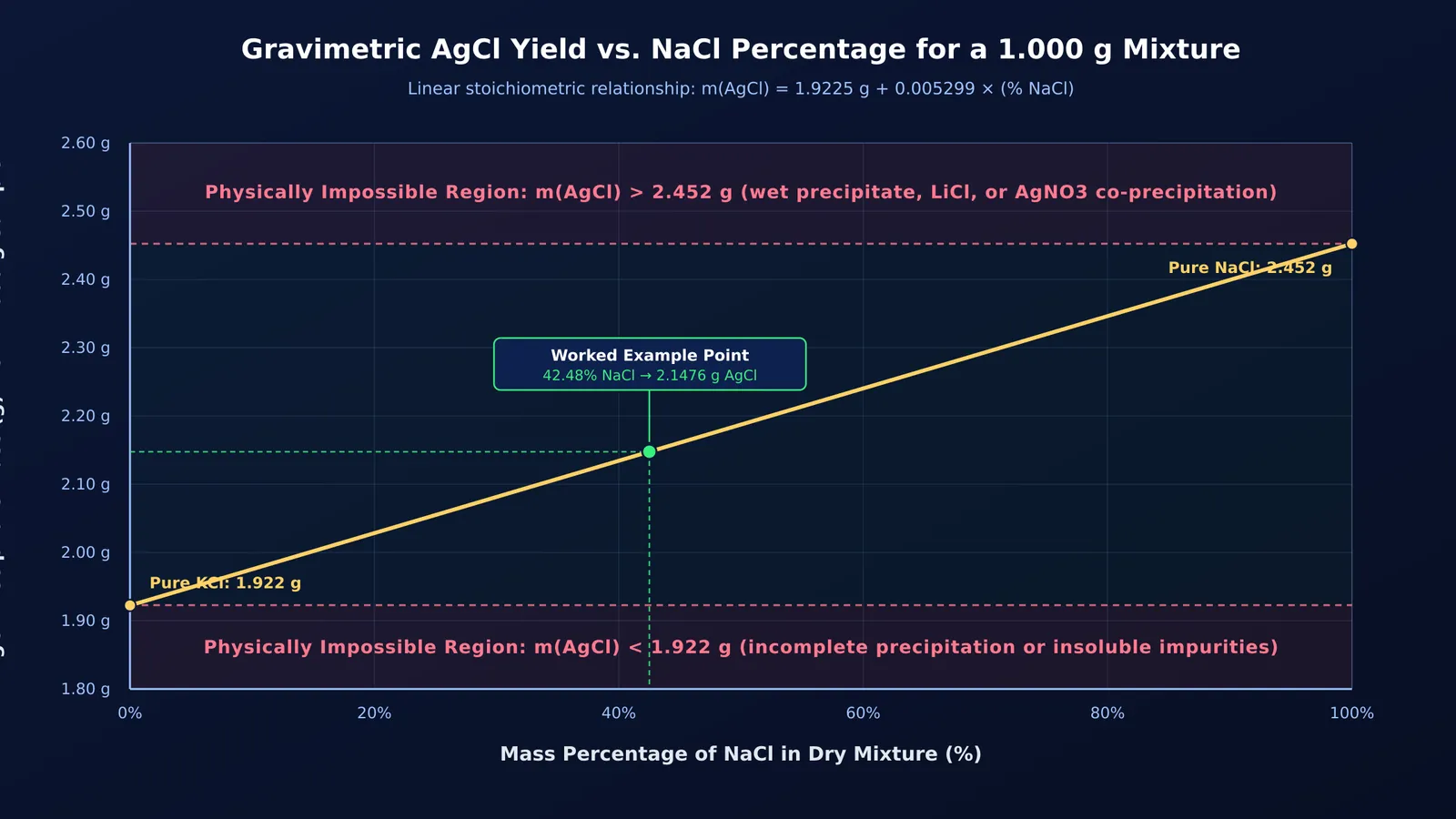
Because sodium and potassium have different atomic masses, one gram of NaCl delivers more chloride ions than one gram of KCl. Standard atomic weights compiled by the IUPAC Commission on Isotopic Abundances and Atomic Weights establish molar masses of 58.44 g/mol for NaCl and 74.55 g/mol for KCl. Consequently, 1.000 g of pure NaCl yields 2.452 g of AgCl precipitate, whereas 1.000 g of pure KCl yields only 1.922 g. Any binary mixture of the two produces an intermediate precipitate mass that varies linearly with the mass fraction of NaCl.
How do you set up the single-variable mole equation?
Solving an NaCl and KCl mixture silver nitrate precipitate composition problem is straightforward when tracking chloride moles directly. Rather than solving two simultaneous equations, express both component masses using a single variable:
Let m_mix be the total dry sample mass in grams.
Let x be the mass of NaCl in grams.
Express the mass of KCl as (m_mix − x) grams.
Each formula unit of NaCl and KCl supplies one chloride ion, and each formula unit of AgCl incorporates one chloride ion. Based on CIAAW standard atomic weights, AgCl has a molar mass of 143.32 g/mol. Equating the chloride moles from both salts to the total AgCl precipitate moles gives:
x / 58.44 + (m_mix − x) / 74.55 = m_AgCl / 143.32
Rearranging isolates x directly:
x × (1 / 58.44 − 1 / 74.55) = (m_AgCl / 143.32) − (m_mix / 74.55)
The term (m_mix / 74.55) represents the baseline chloride moles if the sample were pure KCl. The right side measures the excess chloride above this baseline, while (1 / 58.44 − 1 / 74.55) is the additional chloride delivered per gram when NaCl replaces KCl.
This conservation principle mirrors methods used in back titration calculations and when counting ionisable chlorides in coordination complexes. For multi-step gravimetric practice, the Fermi Problem Library provides worked problems with a step-by-step solver that explains the reasoning rather than printing an answer.
What does a complete step-by-step worked example look like?
Consider a representative laboratory problem based on gravimetric chloride determinations discussed by Philip J. Oles in the Journal of Chemical Education:
A 1.0000 g mixture of NaCl and KCl is dissolved in water and treated with excess AgNO3. The resulting AgCl precipitate is dried to a constant mass of 2.1476 g. Calculate the mass percentage of each salt.
Find total AgCl moles: n_AgCl = 2.1476 g / 143.32 g/mol = 0.014985 mol.
Set up the mole balance with x as NaCl mass: x / 58.44 + (1.0000 − x) / 74.55 = 0.014985.
Evaluate reciprocals: 0.017112 x + 0.013414 (1.0000 − x) = 0.014985.
Collect terms: 0.003698 x = 0.014985 − 0.013414 = 0.001571.
Solve for x: x = 0.001571 / 0.003698 = 0.4248 g of NaCl.
Calculate percentages: NaCl is (0.4248 g / 1.0000 g) × 100 = 42.48%, and KCl is 100% − 42.48% = 57.52%.
Using common exam-rounded molar masses (NaCl 58.5, KCl 74.5, AgCl 143.5 g/mol) yields x = 0.4203 g, or 42.03% NaCl and 57.97% KCl. Always use the atomic weights given on your test.
How do you verify that your calculated salt percentages are physically possible?
Under timed exam conditions, arithmetic slips can produce mathematically derived values that violate physical laws. Carry out two quick checks:
First, check the precipitate boundaries. For a 1.0000 g binary sample of NaCl and KCl, the precipitate mass must fall strictly within the limits set by CIAAW atomic weights:
Pure KCl (100%) produces 1.9225 g of AgCl.
Pure NaCl (100%) produces 2.4524 g of AgCl.
Precipitate mass below 1.9225 g indicates incomplete precipitation or inert impurities. Precipitate mass above 2.4524 g indicates retained moisture or lighter halides like LiCl.
Second, verify that 0 ≤ x ≤ m_mix. A negative value or a value exceeding m_mix indicates an algebraic sign reversal.
Checking boundary limits strengthens accuracy across quantitative chemistry, from gravimetric analysis to mixing and diluting solutions. For structured review, the Fermi Concept Library covers every concept in physics, chemistry, biology, mathematics and computing, each with its own lesson and its place in the map.


