

On this page
Why does only sodium bicarbonate decompose on heating?
The sharp difference in thermal stability between sodium hydrogen carbonate (baking soda, NaHCO₃) and anhydrous sodium carbonate (soda ash, Na₂CO₃) is rooted in cation charge density and lattice energetics. In Group 1 alkali metal carbonates, the relatively large sodium cation (Na⁺) carries a single positive charge and possesses low polarizing power. Because the Na⁺ cation cannot significantly distort the electron cloud of the large carbonate anion (CO₃²⁻), anhydrous sodium carbonate resists thermal breakdown under standard Bunsen burner temperatures (which reach approximately 1,000 °C), as explained in Chemguide's inorganic chemistry guide. Anhydrous sodium carbonate melts at 851 °C without decomposing under ordinary laboratory conditions, as catalogued in Wikipedia's sodium carbonate reference.
In contrast, solid sodium hydrogen carbonate (molar mass 84.007 g/mol, catalogued in the NIST Chemistry WebBook) decomposes readily upon gentle heating according to a well-defined endothermic reaction:
2 NaHCO₃(s) → Na₂CO₃(s) + H₂O(g) + CO₂(g)
In a kinetic study published in *Thermochimica Acta*, Yee-Lin Wu and Shin-Min Shih (1993)80132-T) measured the intrinsic solid-state decomposition kinetics of sodium bicarbonate. Using non-isothermal thermogravimetric analysis, they demonstrated that decomposition occurs between 360 K and 450 K (87 °C to 177 °C), achieving complete conversion to anhydrous sodium carbonate below 200 °C. Because sodium carbonate remains unchanged across this temperature range, any observed loss in mass comes exclusively from the decomposition of sodium hydrogen carbonate.
How do you calculate mixture composition from mass loss?
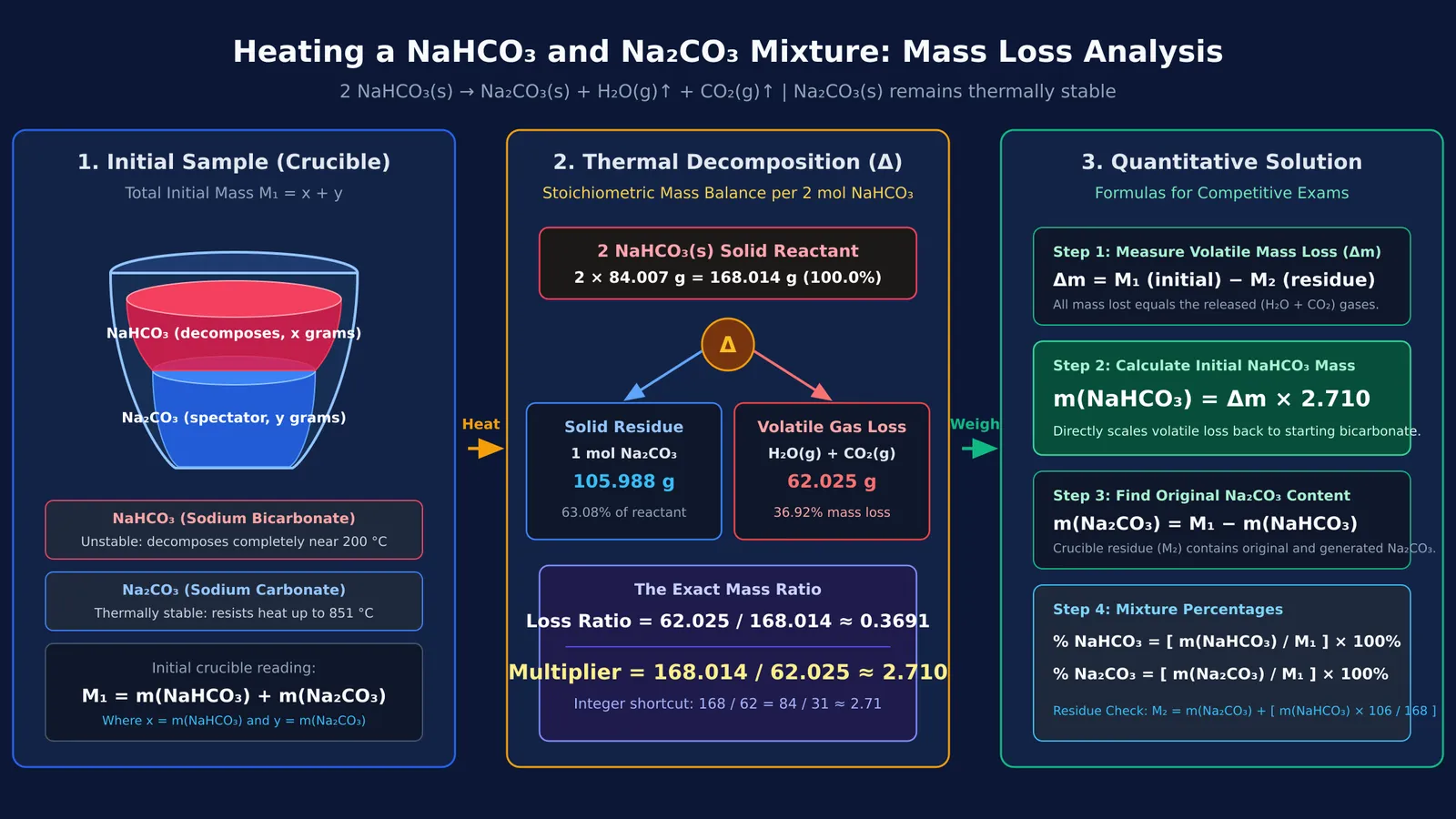
When a dry solid mixture containing x grams of NaHCO₃ and y grams of Na₂CO₃ (total mass M₁ = x + y) is heated to constant mass in a crucible, the sodium carbonate acts as an inert spectator. The decomposition products separate into two distinct phases: solid Na₂CO₃ remains in the crucible, while water vapor (molar mass 18.015 g/mol, NIST Chemistry WebBook) and carbon dioxide (molar mass 44.010 g/mol, NIST Chemistry WebBook) escape into the surrounding air.
From the balanced reaction, two moles of NaHCO₃ (molar mass 84.007 g/mol, NIST Chemistry WebBook) decompose to produce one mole of solid Na₂CO₃ (molar mass 105.988 g/mol, NIST Chemistry WebBook), one mole of gaseous H₂O, and one mole of gaseous CO₂. In gravimetric terms:
2 × 84.007 g = 168.014 g of NaHCO₃ produces 105.988 g of solid Na₂CO₃ residue and 18.015 g + 44.010 g = 62.025 g of volatile gases.
Every gram of NaHCO₃ present in the original sample therefore accounts for a mass loss of:
62.025 / 168.014 ≈ 0.3691 g (or 36.91% volatile mass loss).
Inverting this relationship gives the direct formula to recover the mass of NaHCO₃ from the measured loss in mass (Δm = M₁ − M₂):
m(NaHCO₃) = Δm × (168.014 / 62.025) ≈ 2.7097 × Δm
When solving timed exam problems with integer atomic weights (84 g/mol for NaHCO₃, 18 g/mol for H₂O, and 44 g/mol for CO₂), the conversion factor simplifies to 168 / 62 = 84 / 31 ≈ 2.710. Subtracting m(NaHCO₃) from the initial mass M₁ yields the mass of original Na₂CO₃, from which you obtain the percentage composition directly.
What does a complete worked example look like?
Following the standard stoichiometric molar masses catalogued in the NIST Chemistry WebBook, consider a typical competitive exam problem: A 10.00 g mixture of solid NaHCO₃ and anhydrous Na₂CO₃ is heated strongly in a porcelain crucible until no further loss in weight occurs. After cooling to room temperature in a desiccator, the final solid residue weighs 8.76 g. What is the mass percentage of each component in the initial mixture?
First, find the experimental loss in mass:
Δm = 10.00 g − 8.76 g = 1.24 g
Second, calculate the initial mass of NaHCO₃ responsible for this volatile loss:
m(NaHCO₃) = 1.24 g × (168.0 g / 62.0 g) = 1.24 g × 2.7097 = 3.36 g
Third, determine the mass of unreacted Na₂CO₃ in the initial mixture:
m(Na₂CO₃) = 10.00 g − 3.36 g = 6.64 g
Finally, calculate the percentage of each salt:
Percentage of NaHCO₃ = (3.36 g / 10.00 g) × 100% = 33.6%
Percentage of Na₂CO₃ = (6.64 g / 10.00 g) × 100% = 66.4%
How can you avoid common exam traps in mixture stoichiometry?
Thermal decomposition questions frequently trip up students in JEE Main, JEE Advanced, and NEET. Comparing exam problem patterns against the systematic inorganic chemistry principles on Chemguide helps pinpoint three recurring traps.
The most common trap is ignoring the mass of escaped water. Because students frequently associate carbonate reactions solely with carbon dioxide effervescence, many divide the mass loss by 44 g/mol rather than 62 g/mol. Omitting water inflates the calculated mass of NaHCO₃ by roughly 41%, leading to an impossible mixture composition. Unless a problem explicitly states that water vapor was absorbed in a desiccant tube and only CO₂ was vented, the gravimetric mass loss always equals the combined sum of H₂O and CO₂.
A second mistake is confusing the solid residue with the initial Na₂CO₃ content. The residue in the crucible is 100% sodium carbonate, but it is a combination of two streams: the original unreacted salt and the newly synthesized salt formed from baking soda. Treating the final crucible weight as the original mass of Na₂CO₃ is a classic blunder, as explored in our reviews of mole concept errors that cost marks and limiting reagent and percentage yield problems.
A third trap involves sample hydration. Anhydrous sodium carbonate does not lose mass upon heating, but hydrated forms such as washing soda (Na₂CO₃·10H₂O) lose crystallization water above 34 °C and dehydrate to anhydrous salt above 100 °C, as noted in Wikipedia's sodium carbonate reference. Always verify whether the problem specifies anhydrous salts. When competitive questions pair thermal mass loss with volumetric titration, cross-checking your mole balance against back titration calculations ensures complete numerical consistency.
Developing fluency with quantitative mixture analysis requires seeing how each chemical constraint narrows down the solution path. The Fermi Problem Library provides worked problems with a step-by-step solver that explains the reasoning rather than printing an answer. When you need to review the thermodynamic principles governing alkali metal stability, the Fermi Concept Library covers every concept in physics, chemistry, biology, mathematics and computing, each with its own lesson and its place in the map.


