

On this page
The moment a test paper flips from a standard "find the mean" question to something backwards like "the mean is 12, find the missing value", many students freeze.
Most students learn the mean as a rigid set of instructions: add everything up and divide by the number of items. In a 1995 study published in the *Journal for Research in Mathematics Education*, researchers Jan Mokros and Susan Jo Russell found that students who treat the average purely as an algorithm struggle to reverse the process when a value is missing (DOI: 10.2307/749226). Because division was the last step they took, they are unsure how to untangle the calculation. To solve these problems effortlessly, you need to step away from division and focus on the total sum instead.
What does the mean actually tell us?
When you are given a mean, you are being told what every value in the set would be if the total amount was shared out equally. If the mean of five numbers is 50, it is mathematically identical to having five 50s.
You can also think of the mean as a balance point on a seesaw. The numbers larger than the mean pull up, and the numbers smaller than the mean pull down. For the system to balance perfectly at the mean, the total distance above the mean must exactly equal the total distance below it. When a value goes missing, you are essentially looking for the exact weight needed to restore that balance.
This means that the most important relationship in any average problem is not the division step, but the multiplication step: Sum = Mean × Count
If you find yourself plugging numbers into formulas without knowing why, the Fermi Concept Library covers every concept in physics, chemistry, biology, mathematics and computing, each with its own lesson and its place in the map.
How do you find the missing number when the mean is given?
The secret to finding a missing observation is to ignore the unknown value at first and calculate the grand total.
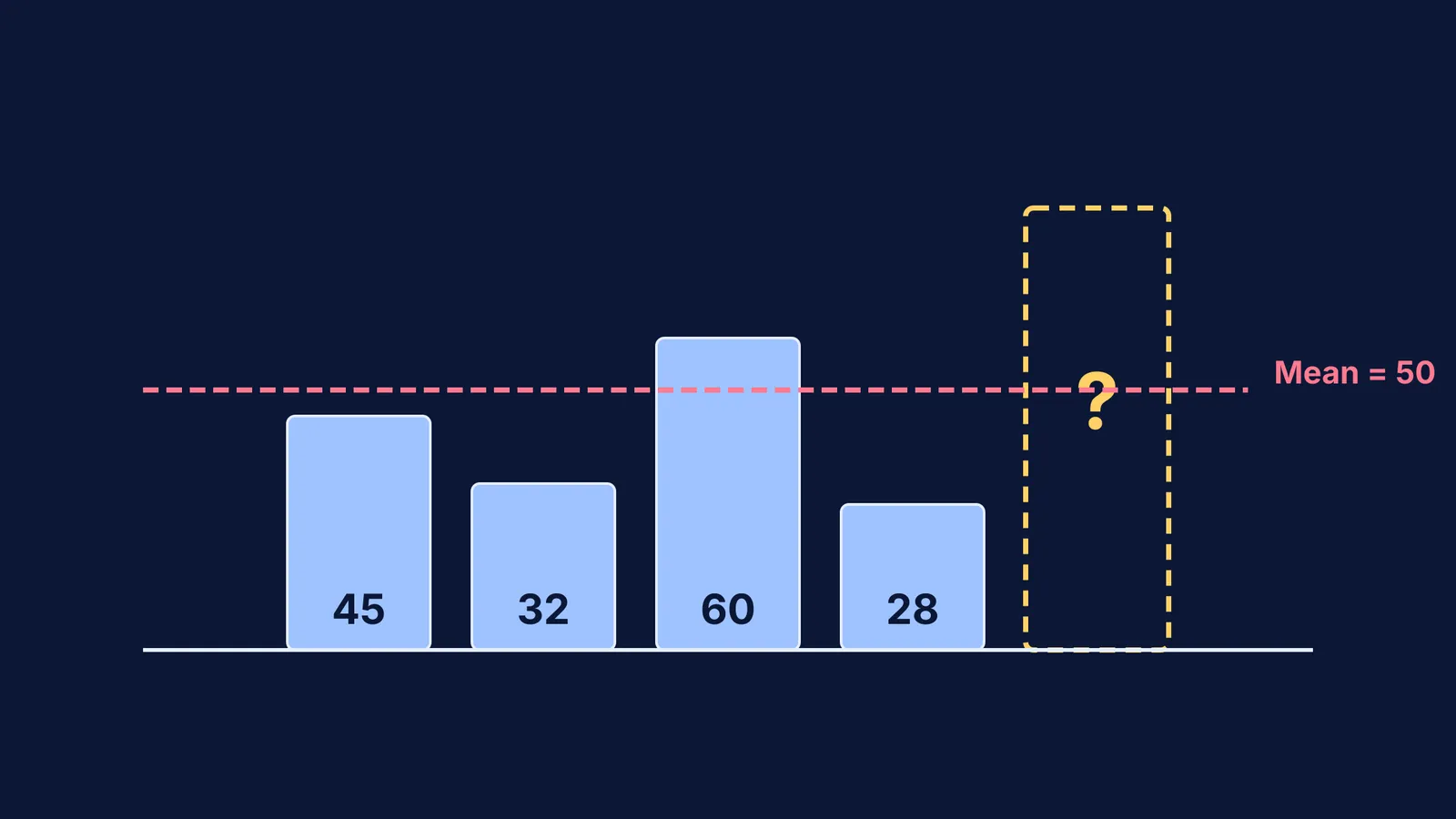
Worked Example: A cricketer has scores of 45, 32, 60, and 28 in four matches. What must he score in his fifth match to average 50?
Target Sum: The total count will be 5 matches. To average 50, the target sum is 5 × 50 = 250 runs.
Current Sum: The known scores add up to 45 + 32 + 60 + 28 = 165 runs.
Missing Value: The required score is 250 − 165 = 85 runs.
When you are stuck on a similar problem in a past paper, the Fermi Problem Library has worked problems with a step-by-step solver that explains the reasoning rather than printing an answer.
What happens to the mean when you add or remove a value?
School exams frequently ask how the mean shifts when a data point is added (like a teacher joining a group of students) or removed. The logic remains exactly the same: find the old sum, adjust it, and divide by the new count.
Worked Example: The mean weight of 10 students is 40 kg. When the teacher joins, the new mean becomes 42 kg. What is the teacher's weight?
Old Sum: 10 students × 40 kg = 400 kg.
New Sum: 11 people (10 students + 1 teacher) × 42 kg = 462 kg.
Teacher's Weight: The difference between the new sum and the old sum is 462 − 400 = 62 kg.
By calculating the totals first, the algebra simplifies to basic subtraction. If you need to know how these shifts affect the spread of the data as well, read our guide on how adding to or scaling data changes the mean and variance.
How to solve missing frequency problems in Class 10?
In the CBSE Class 10 statistics syllabus, missing frequency problems step up the complexity by grouping the data. You are given the mean and the frequencies, but one frequency (often labelled *f*) is unknown.
Because the data is grouped into class intervals, you must use the class mark (the midpoint of the interval) as your observation. Here is how to apply the Direct Method:
Find the class marks: Calculate the midpoint for each interval. If the interval is 11–13, the class mark is 12.
Calculate the products: Multiply each class mark by its frequency. If an interval has a class mark of 20 and a missing frequency of *f*, its product is 20*f*.
Sum the totals: Add up all the frequencies to find the total count (which will include *f*, such as 44 + *f*). Then add up all the products to find the total sum (which will include your variable, such as 752 + 20*f*).
Solve the equation: Set your given mean equal to the total sum divided by the total count. For example, if the mean is 18, you solve `18 = (752 + 20f) / (44 + f)`. Multiplying both sides by the denominator clears the fraction and leaves a simple linear equation to find *f*.
Once you have mastered finding a missing value using the mean, you can apply similar logic to more advanced statistical measures, such as finding the variance of two combined groups.


