

On this page
Missing-frequency questions use the same formula as ordinary mean or median sums. The difference: one or two frequencies are letters, and the answer is given. Keep the letter in every row and the formula becomes an equation.
What does the Class 10 syllabus expect?
The CBSE Class X Mathematics syllabus for 2026-27 lists mean, median and mode of grouped data under Unit VII, Statistics and Probability, which carries 11 of the 80 theory marks. The same document says students compute the mean of a grouped frequency distribution using the direct, assumed mean and step deviation methods, and the median and mode by the algebraic method.
How do you find a missing frequency when the mean is given?
Use mean = Σfx ÷ Σf, where x is the class mark (midpoint) of each class.
Write each class mark.
Multiply f × x in each row, keeping the letter.
Add both columns.
Set Σfx ÷ Σf equal to the given mean and solve.
Worked example 1. This is the pocket-allowance question from the NCERT Class 10 Statistics exercises, Exercise 13.1, Question 3 (data as reproduced by Careers360). The mean daily allowance is Rs 18; classes 11-13, 13-15, 15-17, 17-19, 19-21, 21-23 and 23-25 have 7, 6, 9, 13, f, 5 and 4 children.
Class marks: 12, 14, 16, 18, 20, 22, 24.
Σf = 44 + f.
Σfx = 84 + 84 + 144 + 234 + 20f + 110 + 96 = 752 + 20f.
Equation: 18(44 + f) = 752 + 20f, so 792 + 18f = 752 + 20f, which gives 2f = 40 and f = 20.
Check: with f = 20, Σf = 64, Σfx = 1152, and 1152 ÷ 64 = 18.
Worked example 2 (two unknowns, step deviation). We built this one. When the given mean is a class mark, use it as the assumed mean a. The classes 0-10, 10-20, 20-30, 30-40 and 40-50 have frequencies 4, p, 10, q and 6. The total frequency is 40 and the mean is 25.
From the total: 4 + p + 10 + q + 6 = 40, so p + q = 20.
Take a = 25 and h = 10. Then u = (x − a) ÷ h is −2, −1, 0, 1, 2.
Σfu = −8 − p + 0 + q + 12 = 4 − p + q.
Mean = a + h × (Σfu ÷ Σf), so 25 = 25 + 10 × (4 − p + q) ÷ 40, so p − q = 4.
Adding the two equations: p = 12, q = 8.
Check by the direct method: Σfx = 20 + 180 + 250 + 280 + 270 = 1000, and 1000 ÷ 40 = 25.
How do you find a missing frequency when the median is given?
Median = l + [(n/2 − cf) ÷ f] × h, where l is the lower limit of the median class, n is the total frequency, cf is the cumulative frequency of the class before the median class, f is the frequency of the median class and h is the class size (formula and definitions as set out in Careers360's NCERT solutions).
The key move: the given median tells you the median class, so read l, f and h straight from the table. The cf usually contains a letter.
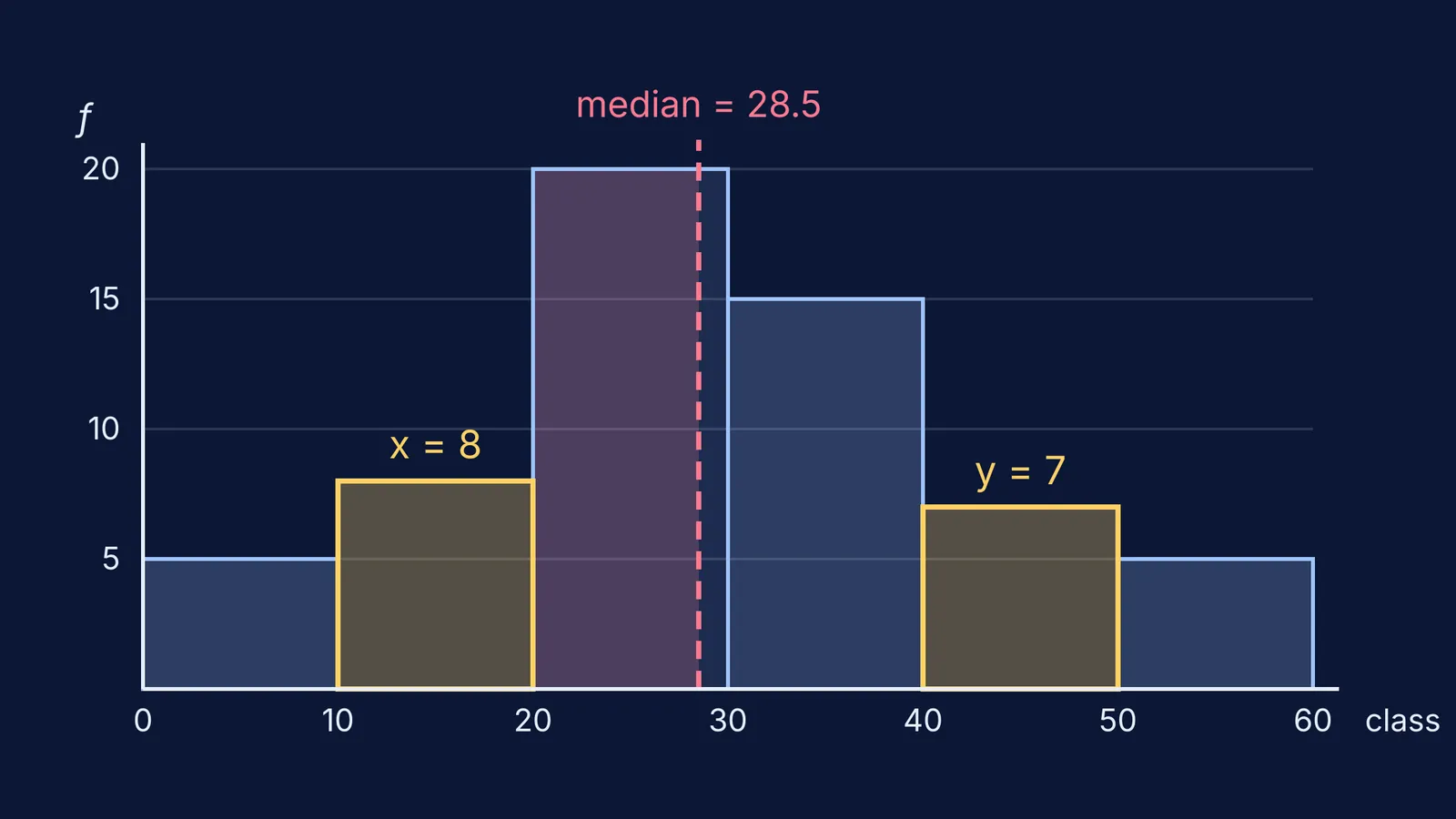
Worked example 3. This is NCERT Exercise 13.3, Question 2, with median 28.5 and total frequency 60 (data as reproduced by Careers360). The classes 0-10, 10-20, 20-30, 30-40, 40-50 and 50-60 have frequencies 5, x, 20, 15, y and 5.
From the total: 5 + x + 20 + 15 + y + 5 = 60, so x + y = 15.
28.5 lies in 20-30, so l = 20, f = 20, h = 10 and cf = 5 + x.
n/2 = 30, so 28.5 = 20 + [(30 − 5 − x) ÷ 20] × 10.
That gives 8.5 = (25 − x) ÷ 2, so 25 − x = 17 and x = 8. Then y = 7.
Check: the cumulative frequencies are 5, 13, 33, 48, 55, 60. The 30th value falls between 13 and 33, so 20-30 is the median class, and 20 + (17 ÷ 20) × 10 = 28.5.
Which mistakes cost marks in these questions?
Using the cumulative frequency of the median class instead of the class before it.
Taking the upper limit as l.
Forgetting the total-frequency equation: two letters need two equations.
Using class limits instead of class marks in Σfx.
Skipping the check. A frequency is a count, so −3 or 7.5 means a slip somewhere.
Where can you practise this step by step?
If the setup is where you stall, the Fermi Problem Library has worked problems with a step-by-step solver that explains the reasoning rather than printing an answer. If the gap is the idea itself, the Fermi Concept Library gives each mathematics concept its own lesson.
Try it now: cover the working, redo example 3 from the table alone, and check it.


