

On this page
When you learn geometric optics, the mirror formula 1/v + 1/u = 1/f is usually introduced for curved mirrors — concave and convex. But the formula is a universal rule for reflection. It works perfectly for a flat plane mirror, too.
To see why, you have to treat a plane mirror as a curve that has been flattened out completely.
What is the focal length of a plane mirror?
In optics, the focal length (f) of a spherical mirror is half its radius of curvature (R). A highly curved mirror has a short radius and a short focal length. As you flatten the mirror, the curve gets wider and the radius grows.
A perfectly flat plane mirror has zero curvature. Mathematically, it is a piece of a sphere with an infinite radius of curvature (R = ∞). Because f = R/2, the focal length of a plane mirror is also infinite. This means parallel rays striking the mirror remain parallel and never converge to a single focal point.
How does the mirror formula apply to a plane mirror?
We can use the infinite focal length in the standard mirror equation to find where the image forms. The formula relates the focal length (f), the object distance (u), and the image distance (v):
1/v + 1/u = 1/f
For a plane mirror, substitute f = ∞:
1/v + 1/u = 1/∞
In mathematics, 1 divided by infinity approaches zero. So, the right side of the equation disappears:
1/v + 1/u = 0
Why does the mirror formula give v = −u?
With the focal length out of the way, the equation becomes a simple relationship between the object and the image. Subtracting 1/u from both sides gives:
1/v = −1/u
Which immediately simplifies to:
v = −u
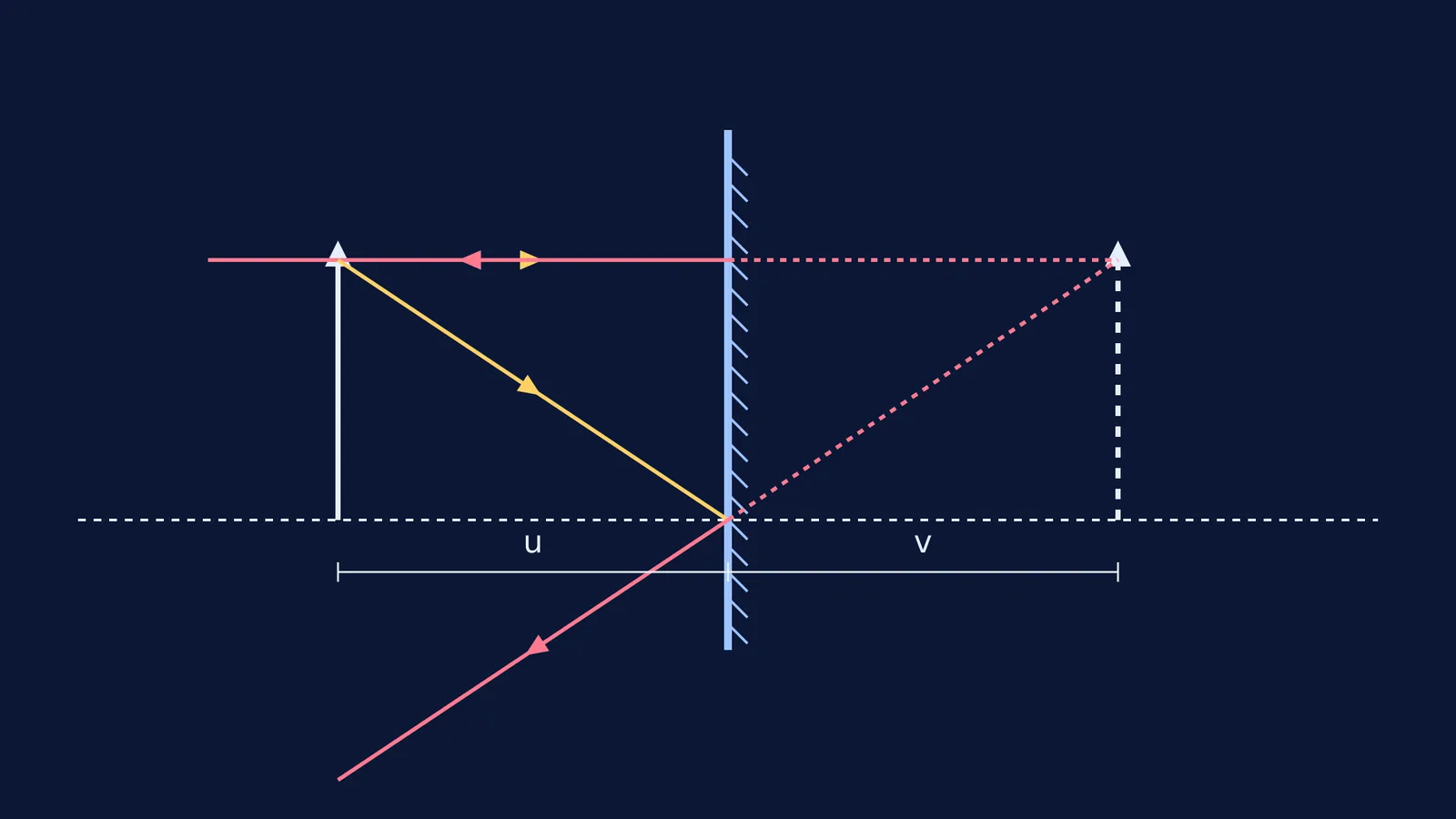
This mathematical result perfectly matches what you observe when you look in a bathroom mirror:
The magnitude (v = u): As shown in the OpenStax University Physics/University_Physics_III_-_Optics_and_Modern_Physics_(OpenStax)/02%3A_Geometric_Optics_and_Image_Formation/2.02%3A_Images_Formed_by_Plane_Mirrors) textbook, the image distance is exactly equal to the object distance. If you stand 2 metres in front of the mirror, your image forms exactly 2 metres behind it.
The negative sign: In the Cartesian sign convention, a negative image distance means the image forms behind the mirror. This is a virtual image, meaning light rays do not actually pass through it.
If you have a concept gap in geometric optics, the Fermi Concept Library holds a lesson for every idea in physics and its place in the map.
How to calculate magnification for a plane mirror?
You can also use the plane mirror's image distance to find its magnification (m). The magnification formula for any mirror is:
m = −v/u
Substitute v = −u into the equation:
m = −(−u)/u
m = +1
The magnification is exactly +1. The positive sign proves that the image is erect (upright), and the 1 proves that the image is exactly the same size as the object.
A checklist for plane mirror problems
When a physics problem mixes plane and spherical mirrors, such as finding concave mirror image positions, you can rely on these rules for the flat mirror:
Set f = ∞: If a formula asks for power (P = 1/f) or focal length, use infinity (or a power of zero).
Flip the sign for v: Whatever the object distance u is, the image forms at −u.
Keep the size: The magnification is always +1.
If you need help visualising these rules in a ray diagram or tracing rays as you would in a glass slab practical, Fermi's AI tutor can work out what you already know and teach through it by drawing the figure with you.


